If you’ve been with me for a while, you know I try to separate “loud” from “important.” This week, t

If you’ve been with me for a while, you know I try to separate “loud” from “important.” This week, the market is loud. But it’s loud for a reason: we’re watching a geopolitical shock move from headline risk into cash-flow risk, and that’s when portfolios start behaving differently.
The center of gravity right now is energy.
1) Energy is no longer just a price on a screen
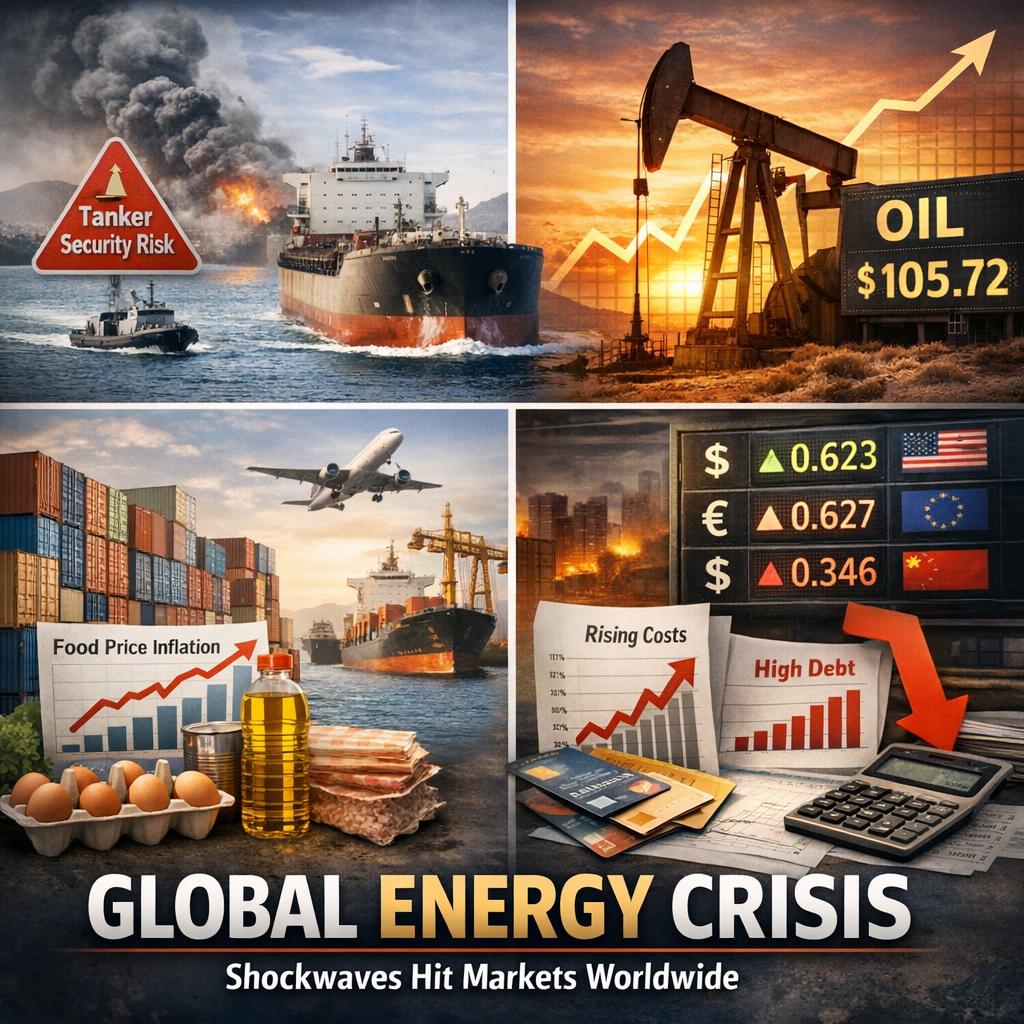
When big banks start openly gaming out oil above $100 and policymakers are scrambling over safe passage for a critical shipping route, that’s the market telling you something simple: the probability-weighted range of outcomes just widened.
Here’s what matters for investors globally:
– Oil isn’t only a commodity; it’s an input into almost everything.
– When energy costs jump and stay elevated, it’s not a one-day “risk-off” trade. It shows up in inflation prints, freight rates, airline margins, food costs, and the cost of doing business in places that import most of their energy.
For investors outside the US, this can be even more acute. If your country runs a current account deficit and imports energy, a sustained rise in oil can pressure the currency, force tougher central bank choices, and tighten financial conditions without anyone “choosing” to tighten them.
2) The market is repricing resilience, not just growth
A lot of people still talk about “the economy” as if it’s one thing. Markets don’t. They price supply chains, financing conditions, and political constraints separately, then mash them together into asset prices.
A prolonged energy disruption tends to reward:
– Balance-sheet strength (companies that can absorb higher input costs or pass them through)
– Pricing power (brands and mission-critical suppliers)
– Operational redundancy (multiple sourcing options, diversified logistics)
– Regions with domestic energy advantages or better terms of trade
And it tends to punish:
– High leverage plus thin margins
– Business models that rely on cheap transportation or cheap credit
– Countries and companies that must import energy and roll a lot of debt
This is why you’ll see “odd” leadership in equities when energy becomes the macro driver. The market starts caring less about the perfect story and more about who can keep delivering in imperfect conditions.
3) “Is this a 2008-style shock?” The better question is: where is the hidden leverage?
The financial system is generally better capitalized than it was back then. But shocks don’t need to look identical to be damaging. They just need a transmission mechanism.
In 2026, that transmission mechanism is more likely to be:
– Private credit and less transparent leverage
– Crowded trades in “safe yield”
– Liquidity mismatches (daily liquidity offered on assets that aren’t truly liquid)
– Knock-on effects from higher energy costs feeding inflation uncertainty, which feeds rate volatility, which stresses borrowers
So I’m less focused on “Will this be 2008?” and more focused on “Where does a modest move become a forced move?” Forced selling is what turns volatility into dysfunction.
If you’re watching credit spreads, funding markets, and the plumbing indicators, you’re doing the right work. If you’re only watching the S&P, you’re seeing the headline, not the mechanism.
4) Speculation is creeping into the cracks again
On the other end of the spectrum, you can feel a growing appetite for ultra-short-term gambling in places like crypto (the rise of very short-dated “five-minute” style bets is a sign of that). I don’t say that to moralize. I say it because speculative intensity is often a contrary indicator for liquidity and risk tolerance.
When risk is truly being taken thoughtfully, people want time on their side. When risk is being chased, people want speed.
That doesn’t mean everything is about to collapse. It does mean you should be careful about confusing “activity” with “opportunity.”
5) The long game hasn’t stopped: technology keeps moving
One thing I don’t want you to miss: even while macro dominates attention, the real economy keeps evolving.
A good example is the continued progress in EV infrastructure and charging technology. Breakthroughs that shrink charging time meaningfully change adoption curves, competitive dynamics, and the long-term oil demand narrative. That doesn’t negate a near-term energy shock. It just reminds us that the market is always pricing multiple horizons at once.
This is why it’s dangerous to build an entire portfolio around a single macro storyline, no matter how compelling. The world doesn’t move in one dimension.
How I’m thinking about portfolios (practically, not poetically)
If you’re a long-term investor, this is not the moment for heroic predictions. It’s the moment for robust positioning.
A framework I like in periods like this:
A) Reconfirm your “must-not-break” rules
– Are you taking more equity risk than you can actually sit with if volatility rises?
– Do you have hidden concentration (one sector, one geography, one factor like momentum or low volatility)?
– Are you relying on liquidity that might not be there in a fast market?
B) Upgrade quality where it matters
– Companies with durable free cash flow and manageable refinancing needs
– Sovereigns and currencies where terms-of-trade aren’t deteriorating
– Avoiding businesses that only work when input costs are stable and financing is easy
C) Don’t overpay for comfort
In shocks, everyone runs toward the same perceived safety. Sometimes that safety gets priced like perfection. If you’re buying insurance, check the premium.
D) Keep optionality
Having some dry powder isn’t about timing the bottom. It’s about being able to act when the market offers you something genuinely mispriced.
The global investor takeaway
This is one of those stretches where global diversification matters, but only if you understand what you actually own. In an energy-driven shock:
– Correlations can rise between risk assets
– Currency moves can dominate local returns
– “International” isn’t automatically diversified if exposures are all tied to the same global inputs (energy, dollar funding, trade)
So I’m emphasizing clarity: what’s your exposure to energy, to rates volatility, to dollar funding, and to refinancing risk? Answer those four questions and you’ll understand most of what your portfolio is likely to do if this drags on.
I’ll leave you with the simplest version of my view:
The market isn’t just reacting to news. It’s updating its assumptions about the cost of stability.
In the weeks ahead, the investors who do best won’t be the ones with the hottest takes. They’ll be the ones who stay liquid enough to be patient, disciplined enough to avoid fragile balance sheets, and humble enough to accept that the range of outcomes is wider than it was a month ago.