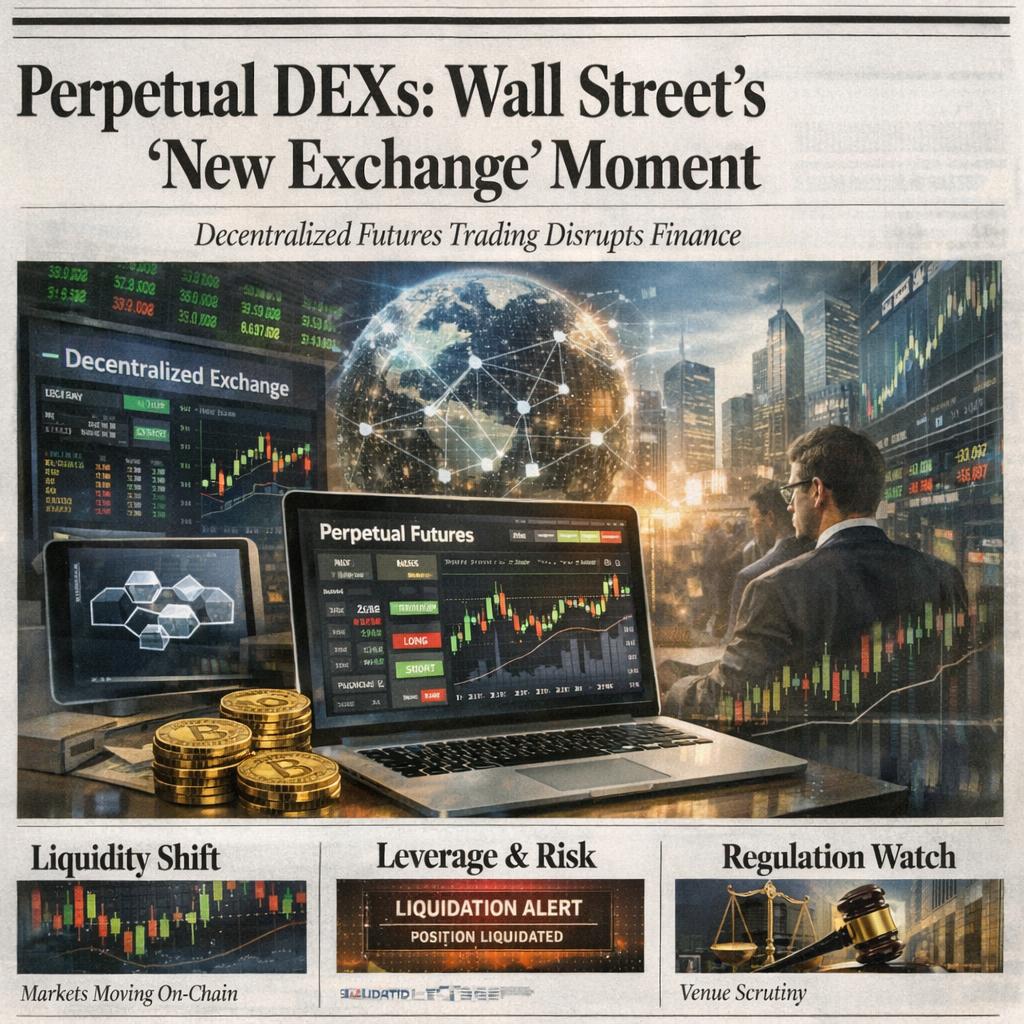
Perpetual DEXs Are Wall Street’s “New Exchange” Moment — And Investors Should Pay Attention
A quiet but important shift is happening in market structure right now, and it’s not coming from the NYSE or Nasdaq. It’s coming from crypto’s plumbing: perpetual futures traded on decentralised exchanges (perpetual DEXs).
If you’ve mostly filed crypto under “volatile assets” and moved on, that’s understandable. But perpetual DEXs aren’t just another token narrative. They’re a serious attempt to rebuild one of the most profitable corners of modern finance: leveraged derivatives trading. And because derivatives sit at the heart of liquidity, hedging, and price discovery, changes here tend to ripple outward—into risk assets, volatility, and even how institutions think about execution.
Let’s unpack what this is, why it’s gaining traction, and what it could mean for investors globally.
What a perpetual is (in plain terms)
A “perpetual” is a futures contract that doesn’t expire. Traditional futures have a settlement date; perps don’t. Instead, they use a mechanism (often a funding rate) designed to keep the contract price anchored near the underlying spot price.
Why that matters: the product is built for continuous trading, continuous leverage, and continuous positioning. That’s catnip for active traders and market makers because it keeps liquidity concentrated in one instrument rather than rolling from one monthly contract to the next.
In traditional finance, you can see the appeal immediately. The closest analogues are highly liquid index futures, CFDs in certain jurisdictions, or the constant rollover behaviour seen in front-month futures. But perps package that “always on” exposure into a single, simple interface.
Now add the DEX component.
What a perpetual DEX changes
A decentralised exchange (DEX) runs trading via smart contracts rather than a central broker or exchange operator. A perpetual DEX specifically enables perp trading on-chain or via hybrid designs that settle on-chain.
That creates a very different set of trade-offs versus a centralised exchange:
1) Access and distribution
Perp DEXs can be more globally accessible. That has a direct effect on liquidity—because liquidity follows users, and users follow where they can trade.
2) Transparency (with caveats)
Positions, liquidations, and sometimes reserves can be more visible. That changes how risk is perceived. But it doesn’t eliminate risk—smart contract risk and oracle risk replace some of the trust you’d normally place in an exchange operator.
3) Market structure innovation
Instead of a traditional order book owned and operated by an exchange, you can have different models: on-chain order books, RFQ systems, automated market makers, or hybrids. Each design affects spreads, slippage, and how liquidations cascade during volatility spikes.
4) The speed vs. settlement tension
Markets demand speed; blockchains demand finality. So a lot of the “race” in perpetual DEXs is about solving latency, keeping costs low, and still settling in a way traders trust. That’s where newer platforms and protocols are trying to differentiate.
Why investors should care (even if they never trade perps)
Because this isn’t just a “crypto story.” It’s a “where liquidity and leverage go next” story.
Here are a few second-order impacts worth watching:
A) Liquidity can migrate faster than you think
In finance, distribution is destiny. If enough traders and market makers prefer a venue (for fees, access, or flexibility), liquidity can shift. Liquidity then pulls in more liquidity. That’s how exchanges become dominant.
If perp DEXs keep improving execution quality, they could siphon activity from centralised venues—especially in regions where access to certain derivatives is constrained.
B) Volatility dynamics can change
Perps are highly leveraged instruments. Leverage compresses time: it forces liquidation events faster, and it amplifies reflexivity (price moves cause liquidations, which cause more price moves).
If a meaningful slice of global crypto derivatives volume ends up on perp DEXs, liquidation cascades could become more transparent but not necessarily less violent. Investors holding spot exposure should care, because derivative-led moves often dictate spot direction in the short run.
C) Regulation and “venue risk” become a portfolio variable
Traditional investors are used to thinking about company risk and macro risk. Crypto adds venue risk: where you trade matters almost as much as what you trade.
As perp DEXs grow, regulators will scrutinise them more heavily—especially around market integrity, leverage limits, and user protections. That can create abrupt regime shifts: geofencing, product changes, liquidity fragmentation, and fee/structure adjustments.
If you’re investing in crypto-related equities, market makers, exchanges, or infrastructure providers, this becomes a real business-model issue, not a theoretical one.
D) Tokenization meets derivatives
The more the market gets comfortable with on-chain settlement, the more natural it becomes to imagine tokenized assets (Treasuries, credit, equities) using similar rails for hedging and liquidity.
You don’t need to believe every asset will move on-chain to see the trajectory: once a new distribution channel proves it can handle leverage, liquidity, and risk management at scale, it becomes a candidate for other asset classes.
What to watch next (practical investor checklist)
If you’re tracking this theme, I’d keep an eye on a few concrete signals rather than hype:
1) Sustained volume and open interest growth
Not one-off spikes—steady participation across different market regimes.
2) Liquidity quality
Spreads, slippage, and how platforms behave during high volatility. Stress events reveal the truth.
3) Liquidation mechanics
How liquidations are triggered, how they’re executed, and whether the system creates feedback loops.
4) Security and uptime history
Smart contract exploits, oracle failures, and performance under load are existential risks.
5) Institutional “bridge points”
Prime brokerage equivalents, better collateral options, risk dashboards, and compliant access routes. Institutions follow tooling.
The bigger picture
Perpetual DEXs are essentially competing to become the default venue for a high-velocity, high-margin form of trading. That matters because derivatives often lead spot, liquidity often leads price discovery, and market structure often determines who wins the next cycle.
Even if you’re a long-term investor who never touches leverage, the plumbing still affects your outcomes: spreads, volatility, market contagion, and the winners and losers among listed companies tied to crypto infrastructure.
If you’ve been watching this space, I’m interested in how you’re thinking about it: do you see perpetual DEXs as a genuine evolution in market structure, or as a niche product that will stay mostly inside crypto? Comment your take.