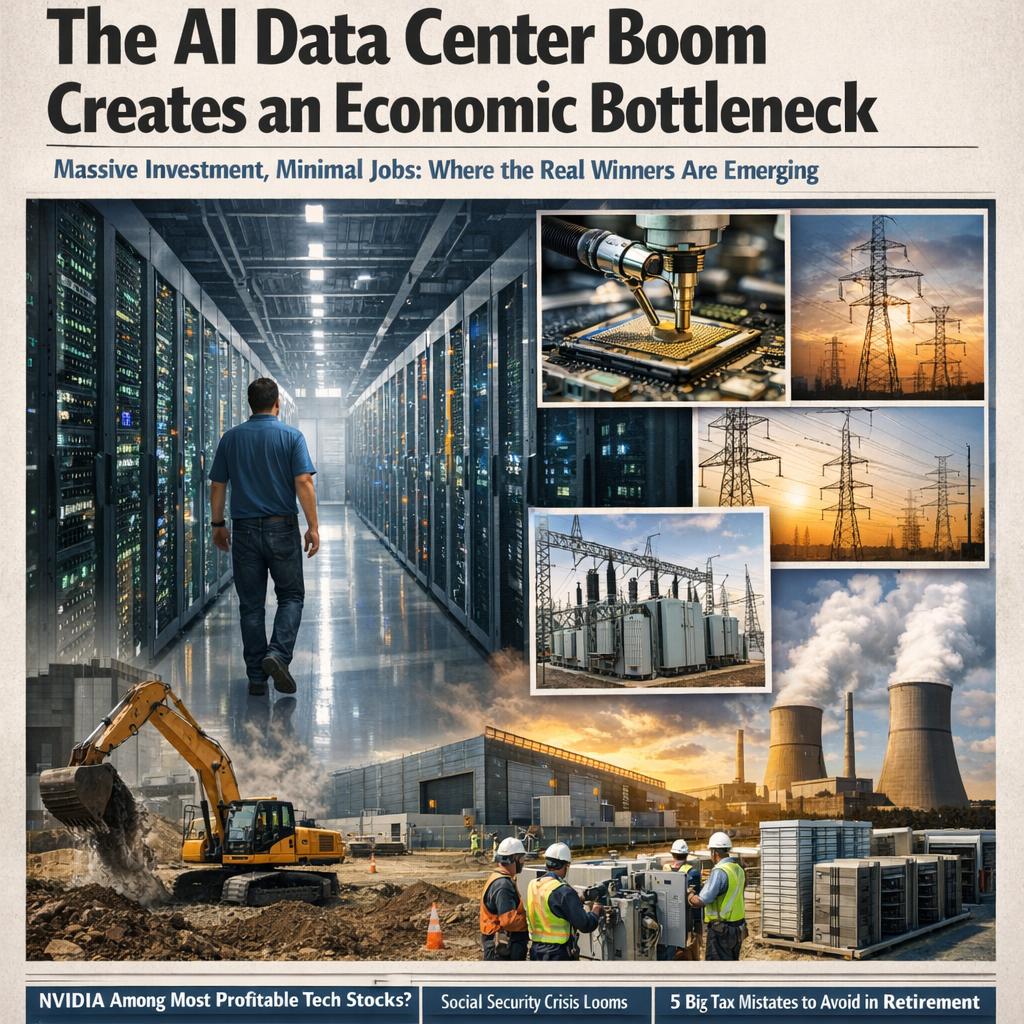
AI Data Centers Create the New Bottleneck Economy — And Investors Shouldn’t Miss the Second-Order Effects
One of the more revealing stories in markets this week wasn’t about a blowout earnings print or a surprise rate decision. It was the quiet reminder that AI data centers—despite the trillion-dollar narrative forming around them—employ remarkably few people relative to the scale of capital being deployed.
That sounds like a niche detail. It isn’t.
It gets to the heart of what kind of “AI boom” we’re actually investing in, and why the winners may look different from the winners of past industrial buildouts.
1) The AI buildout is capital-heavy, not labor-heavy
For investors, this matters because the macro “spillover” from AI infrastructure will likely be uneven.
When an economy experiences a labor-intensive boom, you tend to see broad wage effects, local consumption lift, and a more obvious flywheel into services, housing, and small business growth. A capital-intensive boom behaves differently: it concentrates returns in the ownership of scarce assets and in the companies that sell the picks and shovels.
If AI data centers don’t employ many people, then the most immediate and reliable cashflows in the ecosystem may accrue to:
– Chip designers and manufacturers
– Server and networking vendors
– Cooling and power management suppliers
– Utilities, grid equipment makers, and energy producers
– Data center landlords/REIT-style infrastructure plays
– Specialty contractors (build, fit-out, electrical)
This is one reason the AI trade keeps snapping back to the same handful of “capacity suppliers.” The labor footprint is small, but the hardware footprint is enormous.
2) Watch the constraint: power, permitting, and politics
Low headcount doesn’t mean low friction. In fact, it can increase political sensitivity.
When local communities don’t see many jobs created, but do see higher power demand, water usage, land competition, and grid upgrades, the “social license” of these projects can get complicated. That doesn’t have to derail the trend, but it can change timelines and costs—two variables investors often underestimate during hype cycles.
Globally, this becomes even more relevant:
– In regions where electricity pricing is volatile, AI infrastructure margins can become less predictable.
– In markets with tight grids, the marginal value shifts toward energy reliability and long-term supply contracts.
– In jurisdictions where permitting is slow, scarcity increases and incumbents with existing sites and relationships gain an edge.
The investing implication is simple: the AI theme is not only a semiconductor story. It’s a power-and-real-estate story wearing a tech headline.
3) The “productivity dividend” may lag the spending boom
Another subtle point: if employment at the infrastructure layer is limited, then the near-term economic boost won’t come from staffing these sites. The broader benefit depends on downstream productivity gains—how effectively firms turn AI capabilities into higher output per worker.
Markets can price in the capex wave quickly. The productivity dividend takes longer, and it won’t be evenly distributed across sectors. That gap between “investment now” and “benefit later” is where valuation risk creeps in—especially for companies promising AI-driven margin expansion without showing credible execution.
So while the data center buildout supports revenues for suppliers today, investors should be cautious about assuming a straight line from “AI capex up” to “everyone’s earnings up.”
4) How I’d frame it as an investor (without making it overly complicated)
If you’re allocating globally, this story pushes you to think in layers:
Layer A: Immediate beneficiaries (capacity and components)
These are the firms selling compute, networking, cooling, power gear, and the construction ecosystem.
Layer B: Toll collectors (scarce infrastructure)
Data center real estate, grid equipment, utilities with favorable regulation, and energy suppliers positioned for long-duration demand.
Layer C: Application winners (monetization)
Companies that can convert AI into real pricing power, retention, or cost reduction—without hand-wavy projections.
Layer D: The vulnerable (cost pass-through risk)
Businesses facing higher energy costs, higher cloud bills, or competitive pressure from AI-native entrants—without the balance sheet to keep up.
None of this is a guarantee of outperformance, but it’s a cleaner mental model than simply “AI = tech stocks go up.”
The bigger takeaway
AI data centers employing very few people is not an argument against the AI buildout. It’s a clue about where the economic value is likely to concentrate, where the political friction may emerge, and why the market’s biggest “AI winners” might continue to be the companies closest to physical constraints: chips, power, land, and infrastructure.
If you’re positioning for the next 12–24 months, it’s worth paying as much attention to the grid as you do to the model.
If you’ve been investing around the AI theme, which layer are you most exposed to right now—components, infrastructure toll collectors, or application winners? Share your take in the comments.