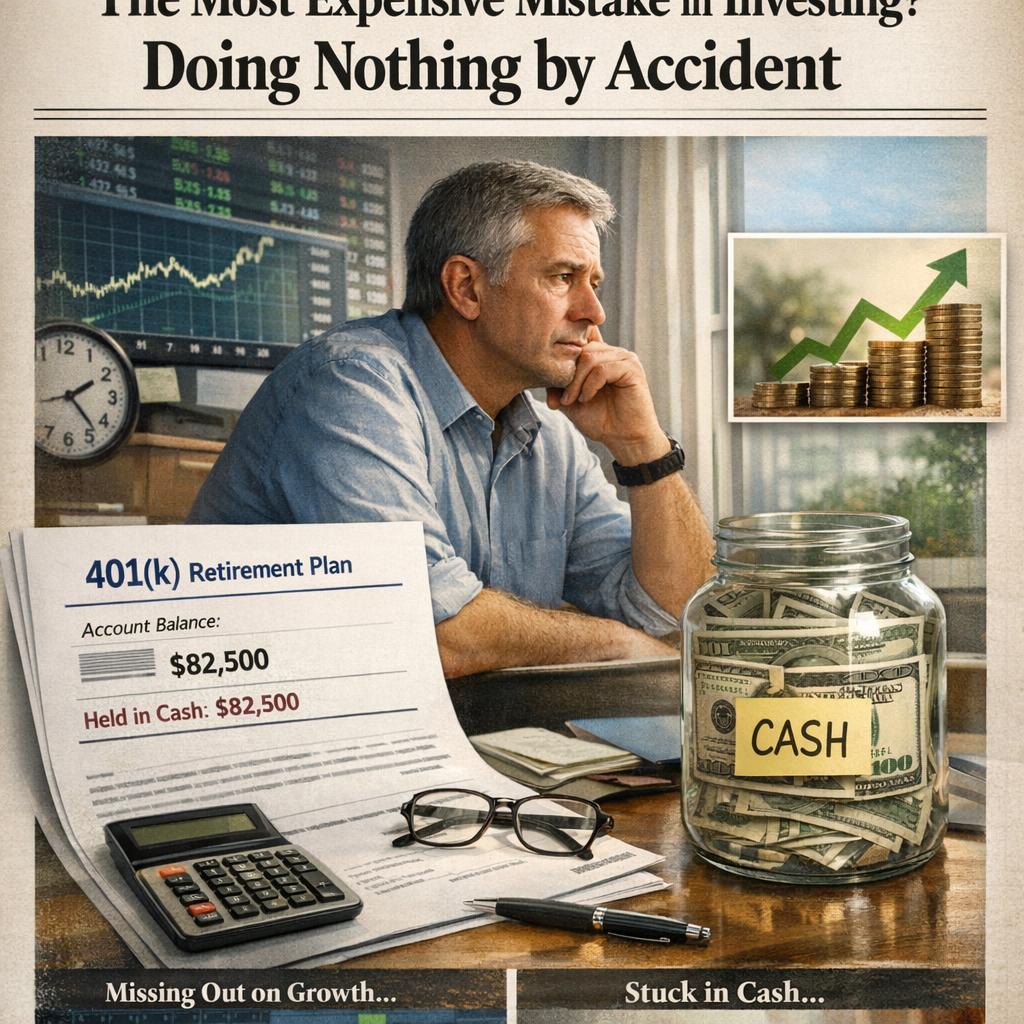
The Most Expensive Mistake in Investing Might Be… Doing Nothing by Accident
One of the more unsettling market stories doing the rounds right now isn’t about a flashy AI stock, a surprise takeover bid, or another chip announcement. It’s much quieter than that—and that’s exactly why it matters.
The headline is simple: you can contribute to your retirement plan for years and still end up with a meaningful chunk of your money sitting in cash.
Not because you chose a conservative allocation. Not because you were waiting for a “better entry.” But because of defaults, administrative quirks, auto-enrolment settings, or missed investment elections. In other words: you did the responsible part (contributing), but the compounding part (being invested) never really kicked in.
Why this matters more than ever
Cash has a role in a portfolio. It’s a shock absorber, an opportunity fund, and sometimes a sanity saver. But long-term retirement money that unintentionally sits in cash is a different story. It’s not strategy; it’s drift.
And drift is expensive in a market where:
1) Inflation steadily erodes purchasing power over long horizons.
2) Equity markets can move in bursts—meaning missing a handful of strong months can change outcomes dramatically.
3) Global index returns are increasingly concentrated in periods of momentum (often around big themes like AI, productivity, and capex cycles).
When markets are near record highs, people sometimes assume they’ve “missed it” anyway. But the bigger risk for many savers isn’t buying at the wrong time—it’s never really buying at all.
How this can happen (even to diligent contributors)
A few common pathways lead to “cash by default” outcomes:
Default settlement funds: Some plans temporarily park contributions in a money market option until an employee selects investments.
Target-date fund not selected: People assume their plan automatically places them into a diversified target-date fund, but that isn’t always true—or the default option may differ by employer or region.
Rollover limbo: When someone changes jobs, a rollover can stall or land in a cash-like holding until new selections are made.
“Stable value” confusion: Some investors choose a stable-value or cash-equivalent option thinking it’s a low-volatility bond fund. Over a decade or two, that misunderstanding compounds into a real gap.
The global investor angle: it’s not just a 401(k) issue
Even if you’re not in the US system, the underlying lesson travels well.
In the UK, it can show up as pensions left in overly cautious default funds that don’t match time horizon. In other markets, it’s sitting in a bank account because “I’ll invest when things calm down,” while years pass and the portfolio never graduates from intention to implementation.
It’s the same behavioural pattern in different wrappers: savings without allocation.
Why “cash drag” is a silent performance killer
Investors often focus on finding the best fund, the best stock, the best theme.
But what decides outcomes for most people is much more basic:
– Are contributions actually invested?
– Is the allocation aligned with time horizon?
– Is the portfolio rebalanced and maintained?
– Are fees and taxes kept reasonable?
– Is there a process that survives headlines?
An accidental cash position fails the first test. And the market doesn’t refund lost compounding.
What investors can do this week (without overhauling everything)
Here’s the practical checklist that matters more than most hot takes:
1) Confirm where new contributions go
Log in and check the destination for each paycheck contribution. Don’t assume.
2) Check your current allocation, not just the fund names
A fund label can mislead. Look at the actual breakdown: equities, bonds, cash equivalents.
3) Review “old accounts”
Any prior employer plans or legacy pension pots should be checked for cash holdings, default options, and outdated risk settings.
4) Align risk with horizon
If retirement is decades away, an ultra-cautious allocation can be its own form of risk—longevity risk and purchasing-power risk.
5) Automate the good decisions
Auto-investing, target-date funds (when appropriate), scheduled rebalancing, and contribution increases can reduce the chance of drift.
The bigger market takeaway
In a world where headlines are dominated by AI optimism, geopolitical tension pushing oil around, and single-stock stories that can move a sector in a day, it’s easy to forget that the average investor’s biggest edge is simply being consistently invested in a sensible, diversified plan.
The “best” market story isn’t always the one with the biggest price spike. Sometimes it’s the one that saves people from a decade of unintentional underperformance.
If you’ve ever found cash sitting in a retirement account without realising it—or if you’ve seen confusing default settings in your plan—share what happened in the comments. It’s more common than people think, and talking about it helps others catch it early.