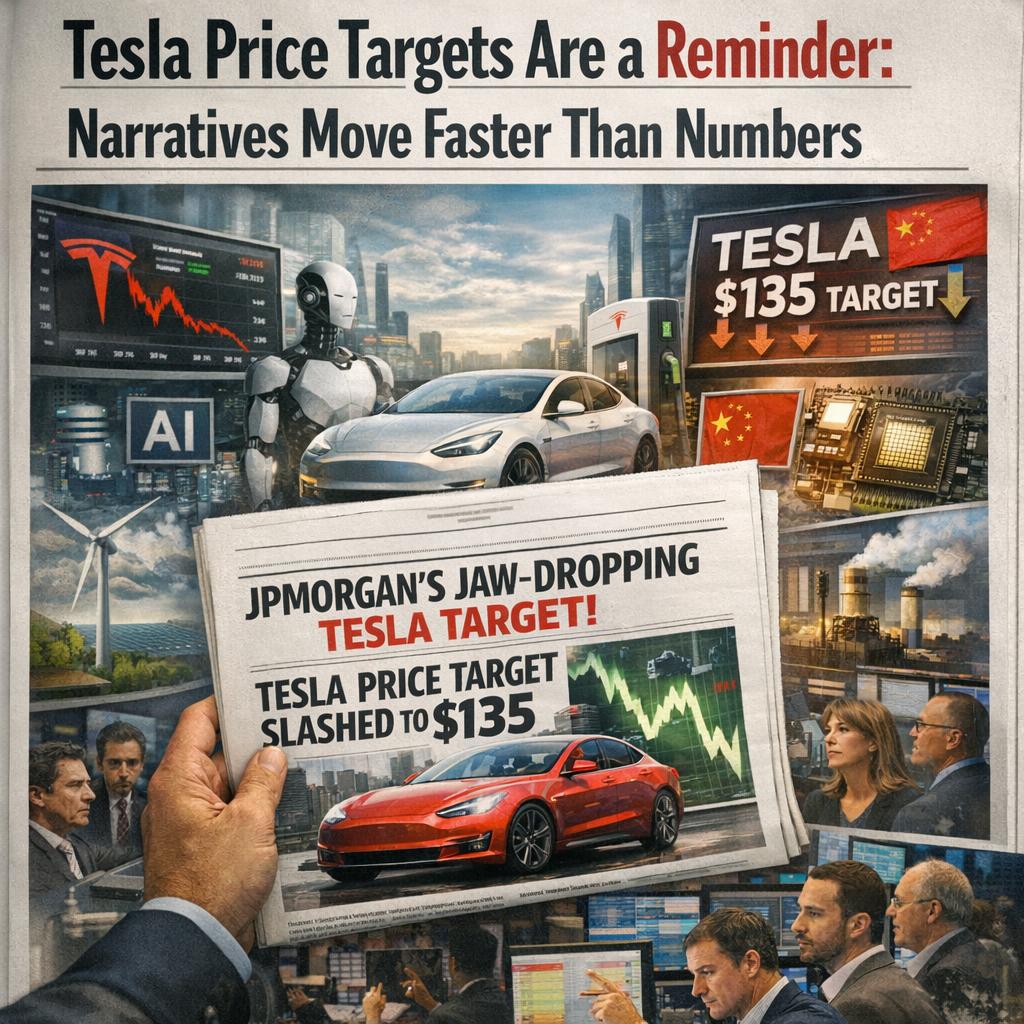
Tesla Price Targets Are a Reminder: Narratives Move Faster Than Numbers
Every so often, Wall Street drops a headline that’s designed to stop you mid-scroll. This week’s version came in the form of a “jaw-dropping” Tesla price target from JPMorgan. Whether you’re bullish, bearish, or completely exhausted by the Tesla discourse, these big target changes matter for one simple reason: they’re not just about one stock. They’re about how global investors process risk, growth, liquidity, and the stories we tell ourselves when prices move.
Tesla sits at the intersection of several mega-themes that dominate portfolios worldwide: AI, automation, EV adoption, China competition, US industrial policy, energy infrastructure, and the broader question of what a “tech” company should be worth in an environment where interest rates and cost of capital actually matter again. So when a major bank puts a dramatic marker down, it tends to ripple far beyond Tesla shareholders.
Why a single price target can move global sentiment
Price targets aren’t magic. They’re scenario work wrapped in a single number—assumptions about margins, volume, competition, regulatory credits, software attach rates, and how generous the market will be with valuation multiples.
But in practice, they act like signals:
1) They reset the debate
A big target (high or low) becomes the new reference point for commentary, recaps, and positioning. Even investors who ignore targets end up trading in a market where other participants don’t.
2) They influence flows, not just opinions
Large institutions, model-driven strategies, and even retail sentiment can respond quickly to high-profile calls. That can affect short-term liquidity and volatility, and volatility itself becomes an input into risk models.
3) They bleed into the “Magnificent” mindset
For many global investors, US mega-cap growth stocks have become the core equity exposure—either directly through indices or indirectly through ETFs and pension mandates. When one of the most watched names gets re-rated in the public conversation, people start asking whether other growth favorites should be re-rated too.
The real takeaway: Tesla trades on multiple futures at once
Tesla is unusual because it’s not priced like a normal automaker—and it hasn’t been for a long time. Investors are constantly choosing which “Tesla” they own:
– The car company (deliveries, pricing power, margins)
– The manufacturing and supply chain story (scale efficiency, vertical integration)
– The energy and storage platform (a steadier, underappreciated segment in some cycles)
– The autonomy and software option (high upside, high uncertainty)
– The robotics/AI narrative (long-dated, very hard to model)
When analysts put out dramatic targets, they’re often making an implicit statement about which “Tesla” they think the market will pay for over the next 12–24 months. If the call is cautious, it’s usually a bet that the market will focus more on near-term fundamentals: pricing pressure, competition, and margin realism. If the call is aggressive, it’s usually a bet that the market will re-embrace optionality: autonomy, software, and the idea that Tesla belongs in a different valuation universe.
What global investors should do with this kind of headline
This isn’t about copying a bank’s target. It’s about using the moment to tighten your process—especially if you invest across regions and asset classes.
1) Separate time horizon from conviction
If you own Tesla (or any high-narrative stock), be honest about whether you’re there for a 6-month trade, a 3-year compounding story, or a 10-year optionality bet. These are different positions, and they deserve different position sizing.
2) Watch the cost of capital backdrop
High-growth, long-duration equities are more sensitive to rate expectations than many people like to admit. If bond yields are rising or inflation persistence is creeping back into forecasts, price targets will keep swinging because the discount rate matters.
3) Look at what your index exposure is really doing
Many investors “don’t own Tesla” but hold it through global equity funds, US index trackers, tech-heavy ETFs, or thematic funds. A big move can still hit the portfolio via concentration risk.
4) Treat volatility as a tax
In globally connected markets, volatility in a flagship US name can spill into broader risk sentiment—especially during thin liquidity windows. If a position’s volatility forces you to sell at the wrong time, the long-term story won’t help you.
5) Don’t ignore second-order effects
When attention concentrates on Tesla, it can pull capital and headlines away from other EV players, battery suppliers, charging networks, and even unrelated growth stocks that trade as “risk-on proxies.” That matters if you’re building diversified exposure rather than single-name bets.
The bigger picture: we’re in an era of faster re-pricing
The most important point is this: markets are re-rating companies faster than they used to. Information travels instantly, positioning is more crowded, and many portfolios are built around the same benchmark-heavy exposures. In that environment, dramatic price targets are less about “who’s right” and more about how quickly expectations can shift.
For investors globally, the edge isn’t predicting the next headline. It’s building a portfolio that can survive the headline cycle without forcing bad decisions.
If you’re holding Tesla (or deliberately avoiding it), share your approach in the comments: are you treating it as a core long-term compounder, a trading vehicle, or a pure optionality bet?