Markets had a very familiar kind of day: the moment geopolitics offered even a hint of de-escalation, risk assets exhaled.
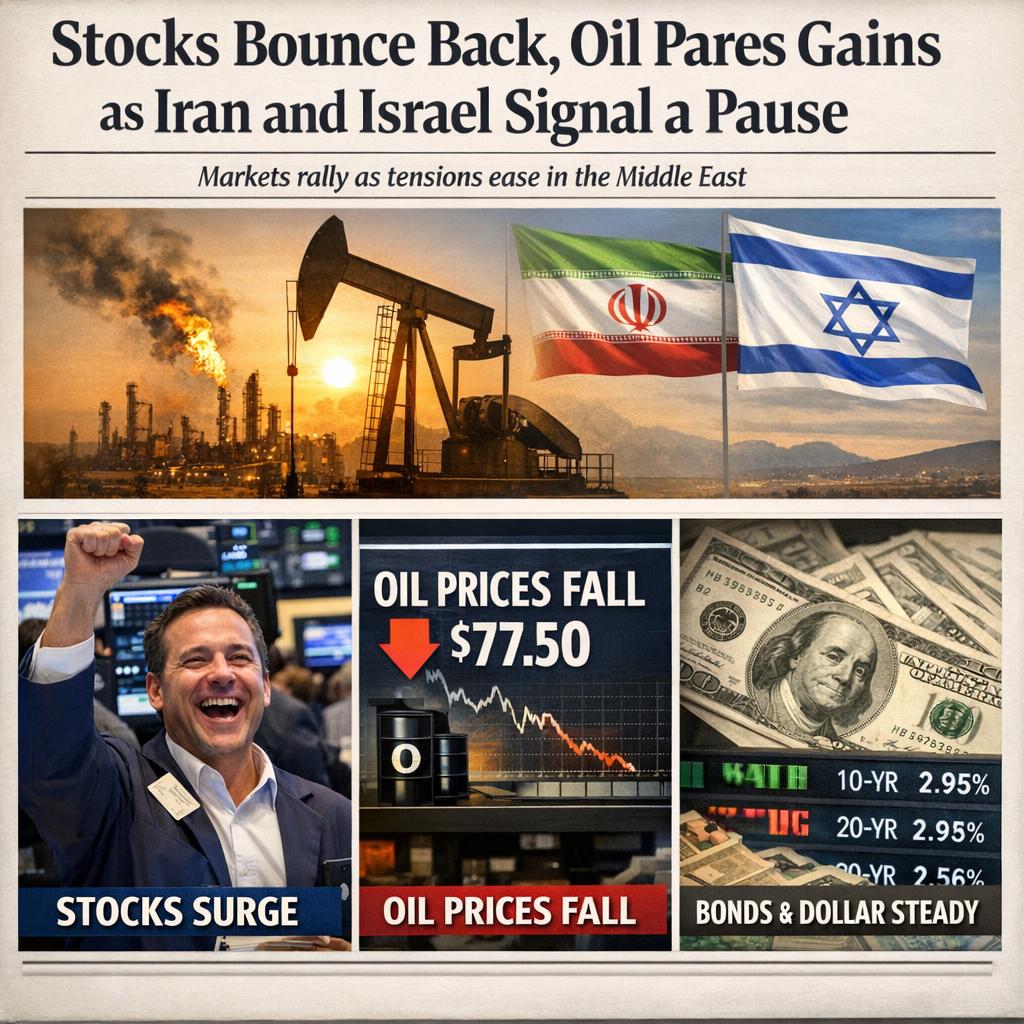
According to the Reuters report, stocks bounced back and oil pared its gains as Iran and Israel signalled a pause. On the surface, that sounds like just another “risk-on/risk-off” headline. But underneath it is a useful reminder of how quickly global portfolios can be repriced when the market is trying to answer one question: is this a supply shock, or just a scare?
Why equities bounced while oil cooled
When tensions rise in key regions, the market tends to react in layers.
First comes the energy impulse. Oil prices jump because traders immediately reach for the worst-case scenario: disrupted shipping lanes, tighter supply, higher insurance costs, and knock-on effects across logistics. That’s inflationary by nature.
Then comes the equity response. Higher oil acts like a tax on consumers and businesses. It pressures margins, raises transport costs, and can nudge central banks toward staying tighter for longer. Equity indices often wobble not just because “war is bad,” but because the macro consequences can be persistent.
So when the narrative shifts from escalation to pause, you often see the reverse: oil gives back some of the premium and equities recover as investors reduce the probability of an inflation shock.
The key word there is “probability.” The market rarely trades certainties. It trades changing odds.
What this means for investors globally (not just US stocks)
1) Inflation expectations move faster than inflation data
Even if consumer price indices won’t reflect anything for weeks, oil is a real-time input. A sharp move higher can lift inflation expectations quickly, which then filters into bond yields and equity valuations. When oil cools, that pressure can ease just as quickly.
For global investors, this matters because inflation expectations are a cross-border force. They don’t respect geography. A spike in crude can tighten financial conditions across markets, especially where currencies are fragile or imports are energy-heavy.
2) Bonds and currencies are doing the “serious” work
Equity moves get the attention, but rates and FX often reveal what professionals actually believe.
If the market thinks a geopolitical flare-up will be short-lived, you may see only a modest bid for safe-haven bonds and a contained move in the dollar. If the market thinks it’s structural, you often get more persistent duration buying (lower yields) and a stronger flight-to-safety dynamic.
This is why global investors should treat these events as multi-asset stories. Watch oil, yes—but also watch what happens to yields and the dollar. That’s where the second-order effects live.
3) Sector leadership can change overnight
Even when the overall index “bounces back,” the internal market can be telling a different story.
Energy and defence may outperform during escalation.
Airlines, travel, consumer discretionary, and parts of industrials can breathe during de-escalation.
If oil stays elevated, sectors with pricing power and strong balance sheets tend to be favoured.
If you’re allocating globally, this becomes a portfolio construction issue, not a headline-trading issue. The question isn’t “what will happen next?” The question is “am I comfortable with my exposure if oil stays higher for longer than expected?”
4) The geopolitics-to-earnings pipeline is shorter than it looks
People sometimes treat geopolitical risk as “noise.” But it can hit fundamentals quickly:
Input costs (fuel, shipping)
Demand sensitivity (consumer confidence, travel)
Capex decisions (companies delay investment under uncertainty)
Insurance and security costs (logistics, shipping, regional operations)
That’s why these episodes can change earnings expectations even without a long conflict. The uncertainty itself can be enough to alter guidance.
A practical takeaway: separate the bounce from the base case
Days like this can trick investors into thinking the risk is “over.” The reality is usually more boring and more useful: the market has simply moved from pricing “imminent disruption” to pricing “watchful uncertainty.”
That’s a different regime, but it’s still a regime.
If you’re a long-term investor, the playbook tends to be:
Avoid overreacting to the first move.
Stress-test positions for higher energy and higher volatility.
Stay diversified across regions and factors (quality, value, defensives) rather than making one big macro bet.
Use drawdowns to review conviction and position sizing, not to chase the bounce.
If you’ve been positioning around energy risk lately, or you’ve noticed certain sectors behaving differently than the headline indices, comment with what you’re seeing in your watchlist.