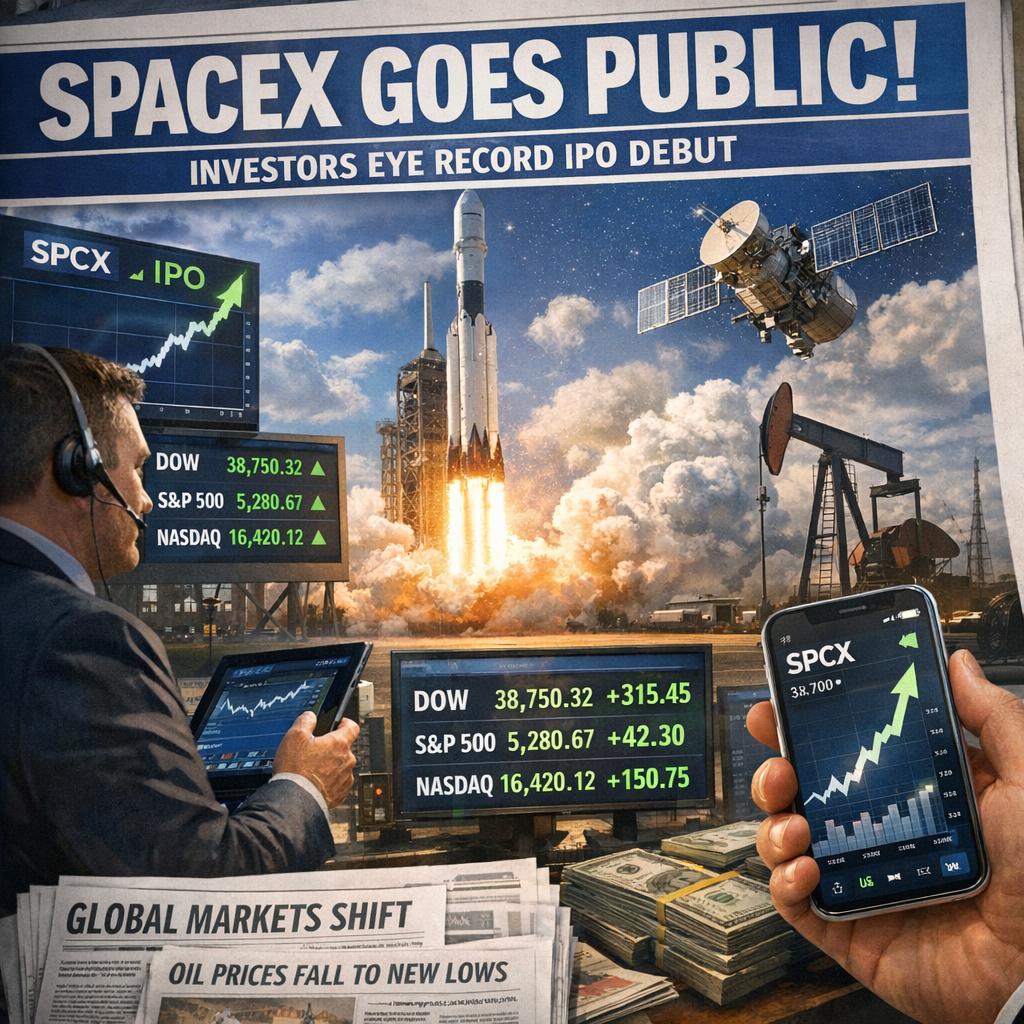
SpaceX Is Public: What This Debut Really Changes for Global Investors
SpaceX’s market debut is one of those moments that feels bigger than a single ticker. Yes, it’s a headline-grabbing IPO with the kind of brand recognition most listed companies would pay billions to manufacture. But more importantly, it’s a live stress test of today’s risk appetite—happening in a market tape that’s been drifting higher while macro headlines (rates, geopolitics, energy prices) still refuse to behave.
If you’re investing globally, the key isn’t whether SpaceX “pops” on day one. It’s what this listing signals about capital markets, valuations, liquidity, and where the next wave of crowding could form.
1) A new benchmark for “strategic” growth valuations
Space is a strange corner of the market because it sits at the intersection of:
– national infrastructure (launch, defense, communications)
– commercial platforms (satellite internet, launch services)
– optionality (moon/Mars narratives, future logistics, in-orbit manufacturing)
When an asset like that starts trading publicly, it becomes a reference point. Every adjacent company—satellite makers, aerospace suppliers, defense primes, telecom infrastructure, even certain semiconductor and materials names—will be compared to the new benchmark SpaceX sets.
For investors outside the US, this matters because it can pull global multiples around it. If SpaceX prints a rich valuation and holds it, it gives analysts and portfolio managers “permission” to underwrite higher multiples for comparable long-duration growth elsewhere. If it struggles, it can chill the entire complex and make fundraising harder for related ventures worldwide.
2) The “liquidity mirror” effect: IPOs reveal what the market really wants
There’s what investors say they want (“quality,” “cash flow,” “reasonable valuations”), and there’s what they actually buy when a cultural mega-asset hits the market.
Big debuts act like mirrors:
– If demand is broad and sticky, it tells you cash is looking for a home, and managers are under pressure to own what clients talk about.
– If demand is shallow (a burst, then fades), it tells you the market is still trading, not investing—and liquidity is more fragile than indices suggest.
That distinction matters globally because it influences everything from emerging market risk premiums to venture funding conditions to whether secondary offerings get absorbed smoothly. A strong, orderly debut can encourage issuance across regions. A messy one can cause boards and bankers to pull deals and wait for a calmer window.
3) SpaceX the company vs. SpaceX the trade
In the first weeks of trading, the market is rarely pricing “the business” in a clean way. It’s pricing positioning.
You can expect a tug-of-war between:
– long-only institutions trying to build starter positions without chasing
– momentum traders pushing the early narrative
– retail flows reacting to headlines
– arbitrage and hedging flows that create strange intraday moves
For global investors, this is where discipline matters most. The temptation is to treat the IPO like a once-in-a-decade pure-play. But the market often turns “once-in-a-decade” into “once-in-a-quarter volatility.”
The practical takeaway: early price action is information about sentiment and positioning, not necessarily about intrinsic value. If the stock becomes a proxy for “innovation risk-on,” it may start moving with broader tech appetite, not with company-specific fundamentals.
4) The second-order winners (and losers) may not be obvious
The obvious read is: aerospace and space supply chains benefit. Sometimes that’s true. But public markets love to front-run themes, and the first-order beneficiaries can be the most crowded trades.
Second-order effects to watch globally:
– Telecom and connectivity: if satellite broadband economics look increasingly credible, it can change the narrative for incumbents in certain regions and alter capex expectations.
– Defense and security: increased launch cadence and dual-use tech can reshape procurement conversations, which can support certain defense-adjacent names outside the US as well.
– Energy and industrials: if markets stay “risk-on” while oil slides on geopolitics easing, it can rotate money away from energy and into growth stories—especially those with strong narratives.
The point: SpaceX trading doesn’t just create one stock to analyze. It can reroute capital across sectors and regions, sometimes in counterintuitive ways.
5) The biggest risk isn’t technological—it’s valuation compression
SpaceX’s technology story is well-known. The market risk is simpler: paying too much for certainty you don’t actually have.
When a company is iconic, investors tend to assume:
– dominance is durable
– margins will eventually scale
– optionality will pay off
– competition is years away
But public markets are impatient accountants. If the stock is valued on far-future outcomes, then even small disappointments—guidance tone, contract timing, regulatory friction, capex intensity—can cause sharp rerating.
For global investors, valuation compression in a flagship growth name can spill into:
– other high-duration equities
– venture and private market marks
– sentiment toward thematic funds and innovation baskets
In other words, this isn’t just about SpaceX holders. It’s about what happens to the price of “future growth” across portfolios.
Closing thought
SpaceX’s debut is a milestone, but it’s also a message from the market: this is what investors are willing to pay for ambition right now. The real signal won’t be the opening print—it’ll be how the stock behaves after the first wave of excitement fades, and whether institutions keep supporting it at scale.
If you’re watching this one, I’d be interested to hear what you think matters more from here: the valuation it settles at, or the knock-on effects it has on the rest of the growth and innovation complex. Comment if you’re tracking it closely.