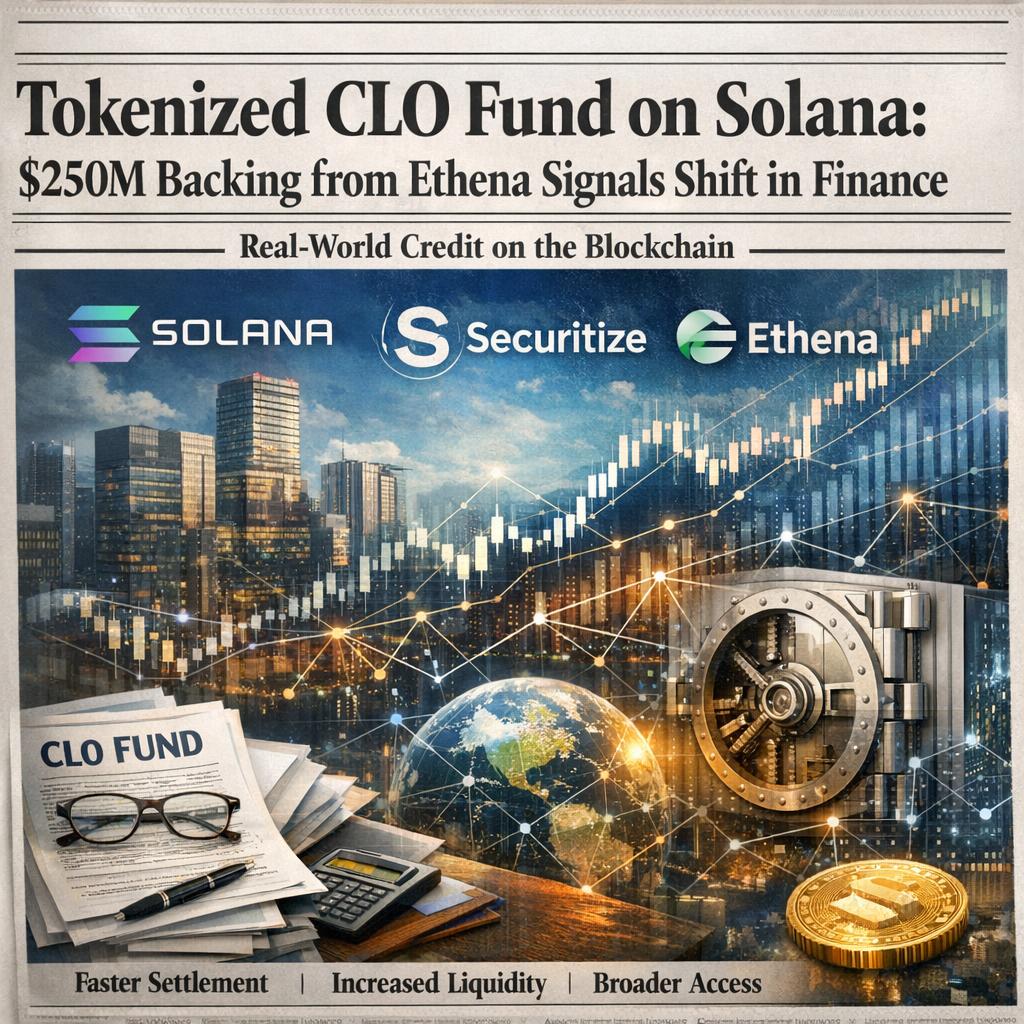
Securitize’s Tokenized CLO Fund on Solana: A Small Headline With Big “Plumbing” Implications for Global Investors
One of the most important market stories this week didn’t come from an earnings call or a central bank press conference. It came from the quiet, unglamorous layer of finance that most people only notice when something breaks: market infrastructure.
Securitize is bringing a tokenized CLO fund to Solana, backed by $250 million from Ethena. On the surface, it reads like another “crypto meets TradFi” announcement. But if you zoom out, it’s a signal that the conversation is shifting from speculative tokens to something far more consequential: putting real-world credit products on rails that can settle faster, trade more efficiently, and potentially reach a wider investor base.
That’s not a meme trade. That’s an attempt to modernize credit distribution.
First, what this actually means (in plain terms)
A CLO (Collateralized Loan Obligation) is essentially a packaged product built from pools of corporate loans, sliced into tranches with different risk/return profiles. It’s a staple of institutional credit markets.
Tokenizing a CLO fund is about representing ownership (and the fund’s mechanics) in an on-chain format. The “why” is where it gets interesting:
1) Settlement and operational efficiency
Traditional fund subscriptions, redemptions, and transfers can be slow and operationally heavy. Tokenized structures can, in theory, reduce friction: fewer intermediaries, cleaner record-keeping, and quicker settlement cycles.
2) Broader distribution (eventually)
Credit has historically been an insiders’ game. Tokenization is often pitched as a path toward expanding access—though in practice, access will still be shaped by regulation, suitability rules, and platform gatekeeping. But even the direction of travel matters: the same way ETFs broadened access to asset classes that used to be harder to reach.
3) Programmability
If the fund’s rules, transfers, and compliance checks can be embedded into the asset itself, you move from “trust us, we’ll reconcile later” to “the asset enforces the rules in real time.” That’s a profound change in how financial products can be administered.
Why Solana (and why now)
Choosing Solana is not just a tech preference; it’s a bet on throughput, cost, and user experience. Credit products don’t need the culture wars of crypto—they need reliability, predictable transaction costs, and systems that can support institutional-grade activity without grinding to a halt when the network is busy.
And “why now” is about yield.
In a world where investors have been hunting for income and defensiveness, credit strategies have remained in focus. Tokenization is arriving at a moment when the market is more receptive to structured yield stories than it was during the peak “number-go-up” era.
The Ethena backing is also notable. It suggests that parts of the crypto capital base are trying to rotate from pure crypto-native risk into structured, cashflow-linked exposure—without leaving the on-chain environment.
The global investor angle: what changes if this scales?
If this approach gains traction, the long-term impact isn’t just “crypto gets more respectable.” It’s that capital markets become more modular and more competitive.
Here are the ripple effects worth watching:
1) Fees and margins get pressured
When distribution and administration become cheaper, it becomes harder to justify old fee stacks. That’s good for end investors over time, but it challenges incumbents who rely on complexity and opacity.
2) Liquidity could improve, but don’t assume it
Tokenization can make transfer easier, but it doesn’t magically create buyers. True liquidity comes from market makers, transparent pricing, and investor confidence—especially for products as nuanced as CLOs. Early tokenized credit markets may still be “liquid on paper, thin in reality.”
3) Risk moves faster
This is the part that should keep investors disciplined. Faster settlement and easier transfer are advantages—until the market turns. When positioning can unwind quickly, volatility can show up in places that used to move more slowly. Efficiency cuts both ways.
4) The compliance layer becomes a competitive battleground
If tokenized funds are going to be globally relevant, the winners won’t just be the fastest chains or the slickest apps. They’ll be the platforms that can prove strong governance, robust compliance, clean reporting, and credible investor protections. In other words: the boring stuff.
What I’m watching next
This story matters less as a one-off product launch and more as a template.
I’m watching:
– Whether more credit managers follow with tokenized vehicles (and which chains they choose)
– Whether real secondary markets form with consistent pricing and volume
– How regulators respond as tokenized “real world assets” start to resemble mainstream financial products rather than niche experiments
– Whether this becomes a genuine distribution channel, or stays a wrapper around the same limited set of participants
The bottom line
Tokenizing a CLO fund is an attempt to upgrade the infrastructure of private credit and structured products—an area of finance that moves trillions globally and influences everything from corporate borrowing costs to portfolio construction.
If this works at scale, it won’t just be a win for one company or one blockchain. It will be a reminder that financial innovation is often less about flashy new assets and more about rebuilding the pipes that move capital around the world.
If you’re tracking the intersection of credit, fintech, and crypto market structure, I’d be interested to hear where you sit: is tokenization finally shifting from narrative to utility, or are we still too early for this to matter? Comment your take.