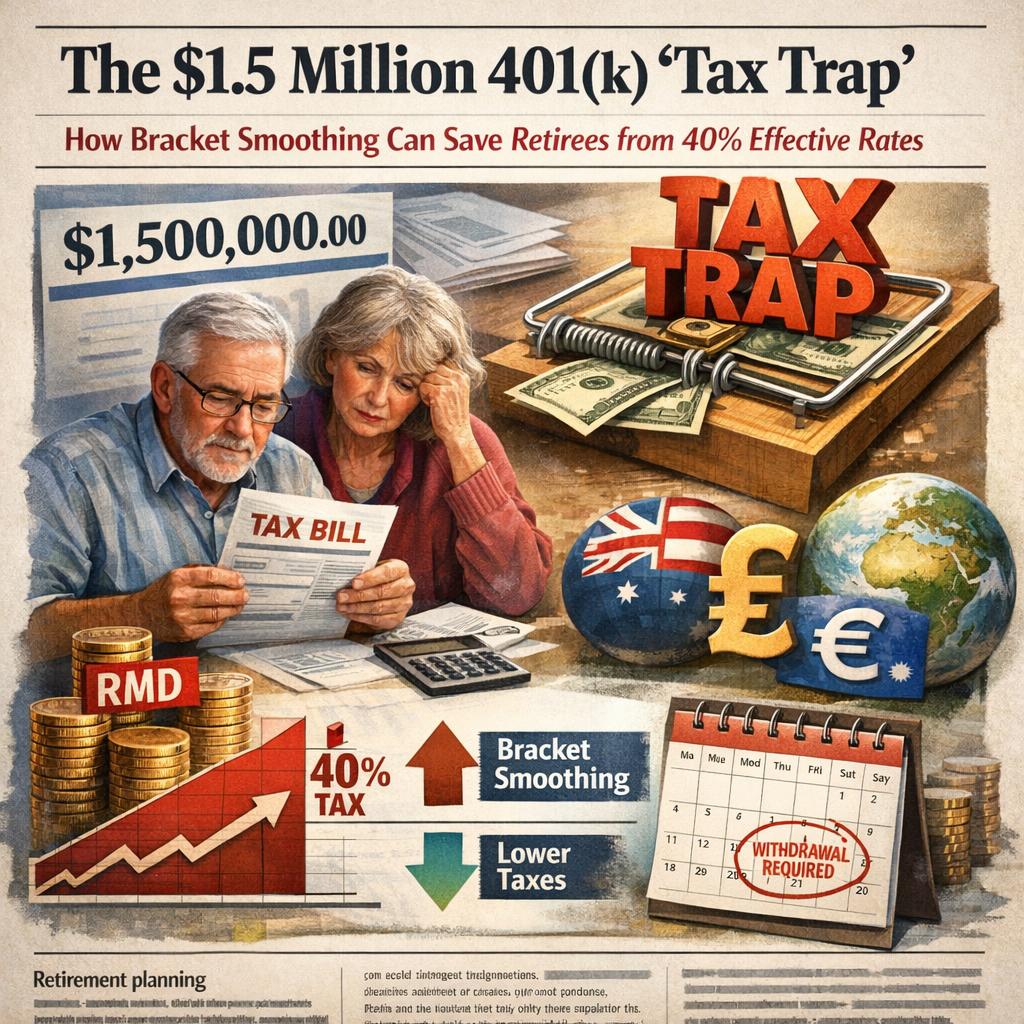
The $1.5 Million 401(k) “Tax Trap” Is a Global Investor Story (Even If You Don’t Live in the US)
One of the easiest mistakes to make in markets is to treat taxes as an afterthought—something you deal with later, once the “real” investing is done. But the story making the rounds about the $1.5 million 401(k) tax trap is a good reminder that taxes aren’t a footnote. They are a core driver of net returns, withdrawal strategy, and ultimately lifestyle risk in retirement.
And even though the headline is US-specific, the lesson travels well. Because the mechanics behind the trap—deferred taxes, bracket creep, forced distributions, and policy risk—show up in different forms across the UK, Europe, Canada, Australia, parts of Asia, and many offshore investor setups.
What the “tax trap” really is
At a basic level, large tax-deferred retirement pots can create a situation where the very success of your saving becomes the reason your effective tax rate spikes later.
The common pattern looks like this:
1) You contribute pre-tax for years.
2) The portfolio compounds quietly.
3) Then retirement arrives and withdrawals begin—often alongside other income streams (state benefits, pensions, rental income, dividends, part-time consulting, etc.).
4) At some point, “optional” withdrawals turn into “required” withdrawals due to age-based rules.
5) The stacked income pushes you into higher brackets, increases tax on benefits, and can trigger secondary surcharges depending on the jurisdiction.
The sting isn’t just the headline marginal bracket. It’s the combined effect of multiple thresholds activating at once. That’s how people end up shocked by effective rates that feel out of proportion to their lifestyle.
Bracket smoothing: the underappreciated investing strategy
The phrase doing the heavy lifting here is “bracket smoothing.” It sounds like tax-nerd jargon, but it’s actually one of the most practical retirement “alpha” concepts available to ordinary investors.
Bracket smoothing means planning withdrawals (and sometimes conversions between account types) in a way that deliberately fills lower tax bands over time, instead of letting income bunch up later and spill into higher bands.
In plain terms: you’re trying to spread taxable income across more years at more predictable rates, rather than letting the system force you into a big taxable spike in your 70s or 80s.
This is not about “beating the market.” It’s about controlling the shape of your taxable income. And that can have an impact that rivals (or exceeds) a lot of tactical portfolio decisions people obsess over.
Why global investors should care (even outside the US)
Even if you never touch a 401(k), three globally relevant forces are at play:
1) Demographics are pushing governments toward revenue
Aging populations mean higher healthcare and pension costs. That increases the odds of stealth tax rises, frozen thresholds, and means-testing. When investors model retirement, they often assume today’s rules persist. History says that’s a fragile assumption.
2) Tax thresholds often don’t rise as fast as wealth does
In many countries, tax bands and allowances fail to keep up with inflation or wage growth (or get politically “frozen”). That turns time into a tax headwind. Your portfolio can be growing in real terms while the tax system quietly tightens around you.
3) Retirement is increasingly multi-income
Modern retirees don’t rely on one single pension cheque. They have a mix: investment accounts, property cashflow, defined contribution pots, maybe a defined benefit pension, maybe a business sale, maybe inheritance. It’s the stacking effect that creates nasty surprises.
The investor takeaway: net returns matter more than gross returns
It’s tempting to talk about retirement investing like it’s purely an accumulation game: max contributions, buy diversified funds, stay the course. That’s solid—up to a point.
But once portfolios become meaningful in size, the problem changes. The key question becomes: how do you turn assets into spending power efficiently?
That’s where:
– account location (what you hold where),
– withdrawal sequencing (which pot you draw from first),
– and timing (what you do in low-income years vs high-income years)
can materially change outcomes.
Two investors with the same portfolio returns can end up with very different retirements purely because one planned the tax path and the other didn’t.
Market implications (yes, this can move capital)
When millions of households face the same incentives, flows change. If policy tweaks encourage Roth-style accounts, conversions, or earlier withdrawals, that can influence:
– household demand for muni-style tax-advantaged assets (where applicable),
– preference for dividend vs growth profiles,
– selling pressure timing (end-of-year behaviour),
– and even how retirees allocate between equities and bonds to manage taxable income volatility.
It’s not always obvious in the headlines, but retirement-tax policy is a slow-moving force that can shape long-term asset demand.
A simple framework investors can use (without turning this into a tax clinic)
You don’t need to calculate everything today, but you do need a framework:
– Map your future income “layers” (pensions, benefits, rentals, dividends, required withdrawals).
– Identify the years where income will be unusually low (early retirement, career breaks, relocation years).
– Consider whether those low-income windows can be used to reduce future tax spikes legally (through planned withdrawals, rebalancing, or conversions depending on your system).
– Stress-test your plan for policy risk: what if thresholds freeze, rates rise, or benefits become more means-tested?
This is the kind of planning that looks boring in a bull market—but feels genius when you’re trying to protect lifestyle in retirement.
If you’re building wealth across borders or expect to retire in a different country than where you earned, it’s even more important. Cross-border tax mismatches can turn “deferred” into “surprise.”
If you’ve seen tax planning (good or bad) make a real difference for someone’s retirement outcome, share it in the comments.