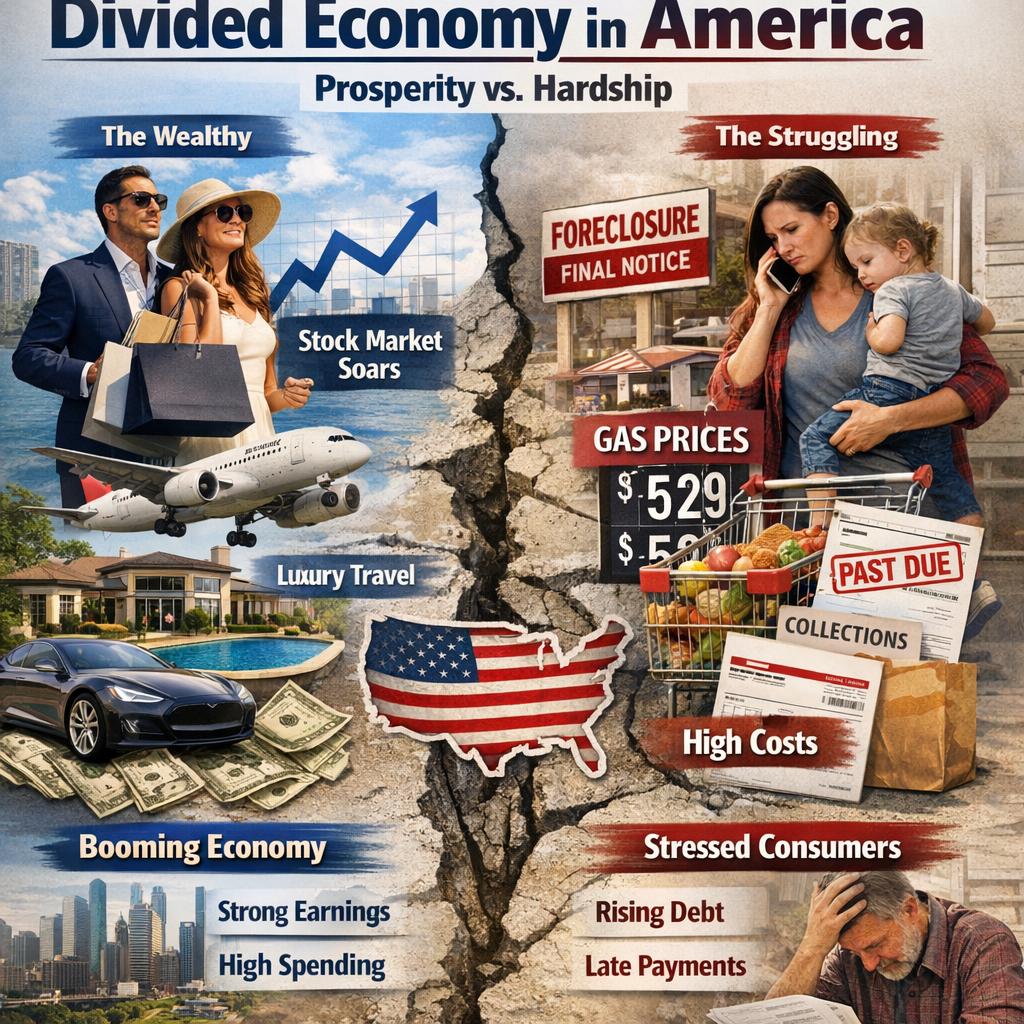
America Has “Two Economies” — and Investors Should Treat That as a Macro Signal, Not a Soundbite
One of the more revealing market stories floating around this week is Bank of America’s warning that the US is increasingly operating as two economies. On the surface, that can sound like a political talking point. But in market terms, it’s something more practical: a framework for understanding why headline growth can look “fine” while consumer stress, credit delinquencies, and spending patterns tell a very different story underneath.
And because the US still sits at the centre of global capital flows, this matters well beyond American borders.
What “two economies” really means in 2026
In simple terms, the split looks like this:
1) The asset-and-income economy
This is the world of households and businesses that benefit from rising financial asset prices, high savings buffers, strong wage growth at the upper end, and access to cheap(er) capital or attractive credit terms. This group can keep spending, keep travelling, keep investing, and keep bidding up the same parts of the market that have been working.
2) The cashflow-and-cost-of-living economy
This is the world where necessities bite harder: rent, insurance, utilities, food, car payments, childcare, and now higher-for-longer interest costs. In this lane, consumption becomes more selective, more price-sensitive, and more “trade-down” in behaviour. Even when jobs hold up, the feeling is fragile because the margin for error is small.
Markets often struggle when these two realities diverge, because the winners dominate the indices while the stress shows up later in the data.
Why investors should care: it changes how you read “strong” economic prints
If the top end of the economy is still spending freely, you can get decent-looking GDP and corporate earnings in the short run. If the lower and middle parts are squeezed, you can simultaneously see:
– weaker volume growth (people buy less)
– mix shifts (people buy cheaper alternatives)
– rising sensitivity to fuel, food, and financing costs
– increasing credit stress that doesn’t hit all at once, but spreads gradually across lenders and sectors
That combination can produce a market that looks resilient… right up until it doesn’t. Not because a single disaster happens, but because the “average” hides the distribution.
The most important investing implication: broad labels stop working
When the economy becomes more K-shaped, “consumer stocks” aren’t one trade. “US equities” aren’t one trade. Even “defensive” isn’t one trade.
You start needing to think in terms of who your end-customer really is.
– Brands positioned for affluent consumers can keep surprising to the upside.
– Value retailers can do well on trade-down (but margins can be a battle if input costs rise).
– Mid-tier discretionary can become the danger zone: not cheap enough to be a refuge, not premium enough to be insulated.
– Travel and experiences can stay strong at the top end, while everyday mobility (commuting costs, car repairs, insurance) becomes a growing pressure point.
– Credit becomes a more important variable than “demand.” The question becomes: can the buyer finance it, and at what rate?
This is also where earnings season becomes less about beats and misses, and more about what management says about customer mix, promotions, delinquency, and unit volumes.
Global spillovers: why this isn’t “just an America story”
A two-track US economy can export volatility globally through a few channels:
1) Dollar strength and capital flow concentration
If investors keep clustering into perceived “quality” and “winners,” capital can become more concentrated in the same mega-cap names and US assets. That can tighten financial conditions for emerging markets and smaller developed markets, especially those reliant on USD funding.
2) Multinational revenue exposure
European and Asian firms selling into the US don’t face one demand curve; they face two. Premium and enterprise demand may hold up while mass-market volume softens. That changes forecasting, inventory strategy, and ultimately equity multiples.
3) Commodity sensitivity
If the lower/middle-income side of consumption slows, certain demand signals weaken—yet supply shocks (energy, shipping, geopolitics) can still push prices up. That’s the uncomfortable mix: softer real demand with sticky input costs.
4) Policy uncertainty
Central banks and governments don’t love “two economies” because it complicates the mandate. Inflation can be sticky in essentials while discretionary cools. Growth can look okay while social pressure rises. That’s how you get policy that feels late, uneven, or politically constrained—exactly the kind of backdrop markets reprice quickly.
How I’m thinking about positioning (conceptually, not as advice)
In a split economy, the investing game becomes more about balance and selectivity than bold “risk-on / risk-off” declarations.
A few principles that tend to matter more in this regime:
– Pricing power is only real if customers can absorb it. Watch volumes.
– “Premium” can be defensive, but valuations still matter.
– Credit risk can show up in unexpected places (not just banks; also retailers, autos, housing-linked demand, and lenders adjacent to those).
– Regional diversification matters less if global indices are all leaning on the same narrow leadership.
– Quality balance sheets get a premium when uncertainty rises, because refinancing risk is no longer theoretical.
The bigger point: when Bank of America says “two economies,” investors should hear “two sets of fundamentals.” If you’re building a portfolio on averages, you can be right about the headline economy and still be wrong about the companies and sectors that actually drive your returns.
If you’ve noticed this split in your own tracking—earnings calls, consumer data, credit, or even what’s happening on the ground—feel free to comment with what indicators you’re watching most closely.