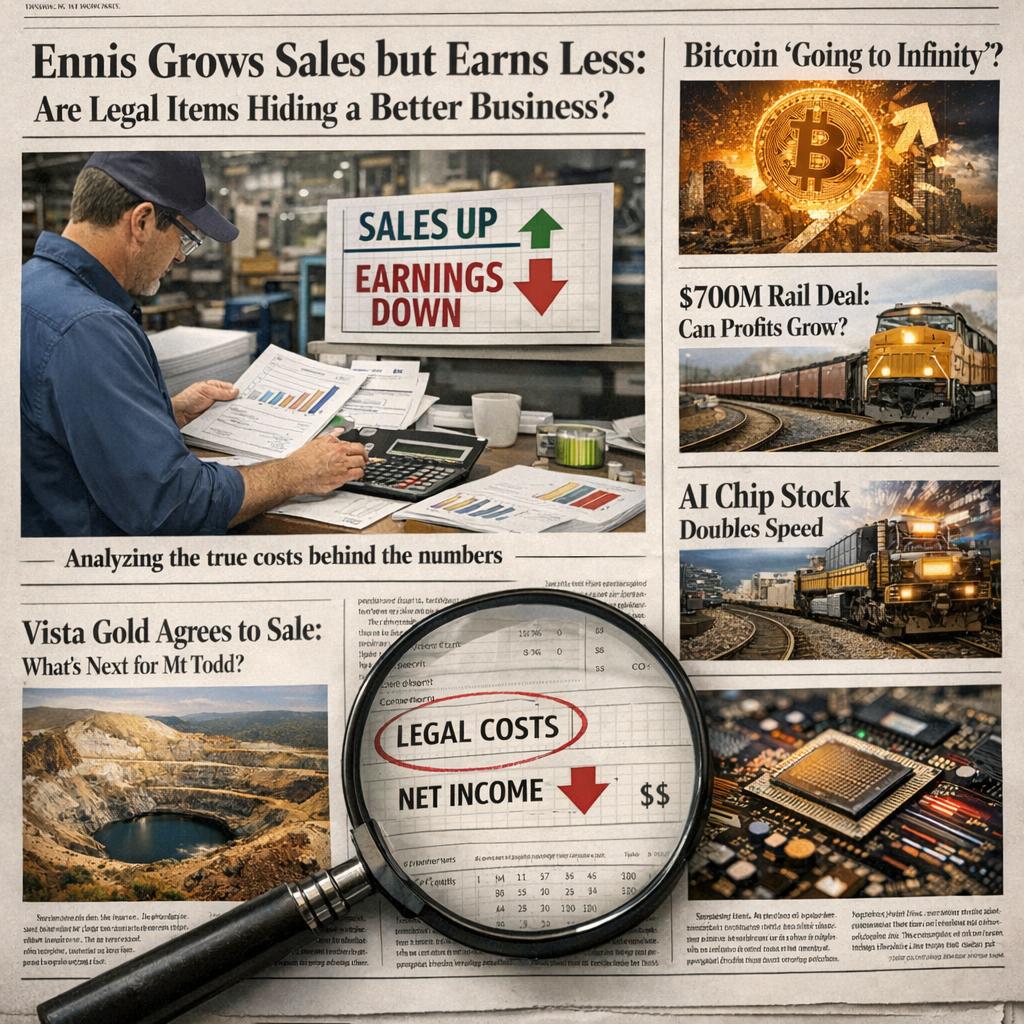
A scan of today’s market headlines reveals a fascinating dichotomy. On one side, the familiar, almost gravitational pull of transformative narratives: the relentless march of AI, the geopolitical chess game of semiconductor supply chains, and the apocalyptic allure of Bitcoin as a hedge against monetary debasement. On the other, a quieter, more granular reality: the fundamental, often messy, mechanics of individual businesses. Today, I find my attention pulled firmly toward the latter, specifically to a story that acts as a potent reminder for any investor navigating this complex landscape.
The article in question details the situation at Ennis, Inc. (EBF). The headline captures a classic, yet perpetually relevant, market conundrum: the company reported growing sales but declining earnings. The immediate question posed—and it’s an excellent one—is whether “legal items” are obscuring the true health of the underlying business.
This is where the rubber meets the road for fundamental analysis. In a market increasingly driven by macro narratives and thematic bets, the Ennis report serves as a necessary grounding exercise. It forces us to look past the top-line figure, the headline revenue growth that so often captivates casual observers and momentum traders. Growth is, of course, a vital signal, but it is not the only signal. The path from revenue to net income is fraught with variables—cost inflation, operational efficiency, one-time charges, and yes, legal settlements or provisions.
When a company’s earnings move inversely to its sales, it prompts a forensic examination. Are these “legal items” truly non-recurring, isolated events, or are they symptomatic of deeper, systemic issues within the company’s operations or industry? For Ennis, a manufacturer of business forms and apparel, the answer to that question radically alters the investment thesis. If the legal overhang is a one-time cost clearing the decks for more profitable growth, the current dip might represent a value opportunity. If, however, it points to a deteriorating competitive position, ongoing litigation risks, or poor cost management, then the sales growth is merely a facade, a temporary reprieve before margins compress further.
This single data point from a mid-cap industrial company connects to several broader themes evident in today’s news flow. Look at the deal announced by Westinghouse Air Brake (WAB), a $700 million-plus rail services contract. The immediate analyst question is, “Can profits grow?” This echoes the Ennis dilemma but from the opposite side. Here, the top-line expansion is clear; the market’s focus instantly shifts to the bottom-line conversion. Will operational leverage kick in? Or will execution costs erode the value of the deal? It’s the same fundamental principle: revenue is a promise, earnings are the fulfillment.
Similarly, the news around Vista Gold (VGZ) agreeing to a sale, with the follow-up question about the buyer’s ability to fund a project, highlights another layer of this analysis. A transaction generates a headline, but the real work for an investor begins afterward, assessing the quality of the consideration and the credibility of the future plan. It’s about peeling back the initial announcement to scrutinize the sustainability and profitability of what comes next.
This focus on the fundamental mechanics stands in stark contrast to the other major narratives swirling through the markets. The breathless speculation around Bitcoin “going to infinity” based on macroeconomic doom scenarios, or the frenetic activity in AI chips and optics, where stocks like Lumentum jump 10% on technological benchmarks, operate on a different plane. They are narratives of potential, of paradigm shifts, of multiple expansion driven by future expectations. There’s undeniable money to be made there, but the risk profile is fundamentally different.
The Ennis story is a masterclass in the discipline of due diligence. It reminds us that for every company riding a secular tailwind, there are dozens navigating the arduous, unglamorous work of incremental improvement, cost control, and balance sheet management. Their stories may not dominate financial news cycles, but they form the bedrock of diversified portfolios. For global investors, the lesson is universal: whether you’re looking at a manufacturing firm in Texas, a rail supplier in Pennsylvania, or a gold miner in Australia, the principles of scrutiny remain the same. Look past the headline. Understand the bridge between sales and earnings. Distinguish between a one-time obstacle and a chronic problem. In a noisy market obsessed with the next big thing, there is immense value in understanding the current real thing. I’m curious to hear how others approach these kinds of fundamental disconnects in their own analysis.