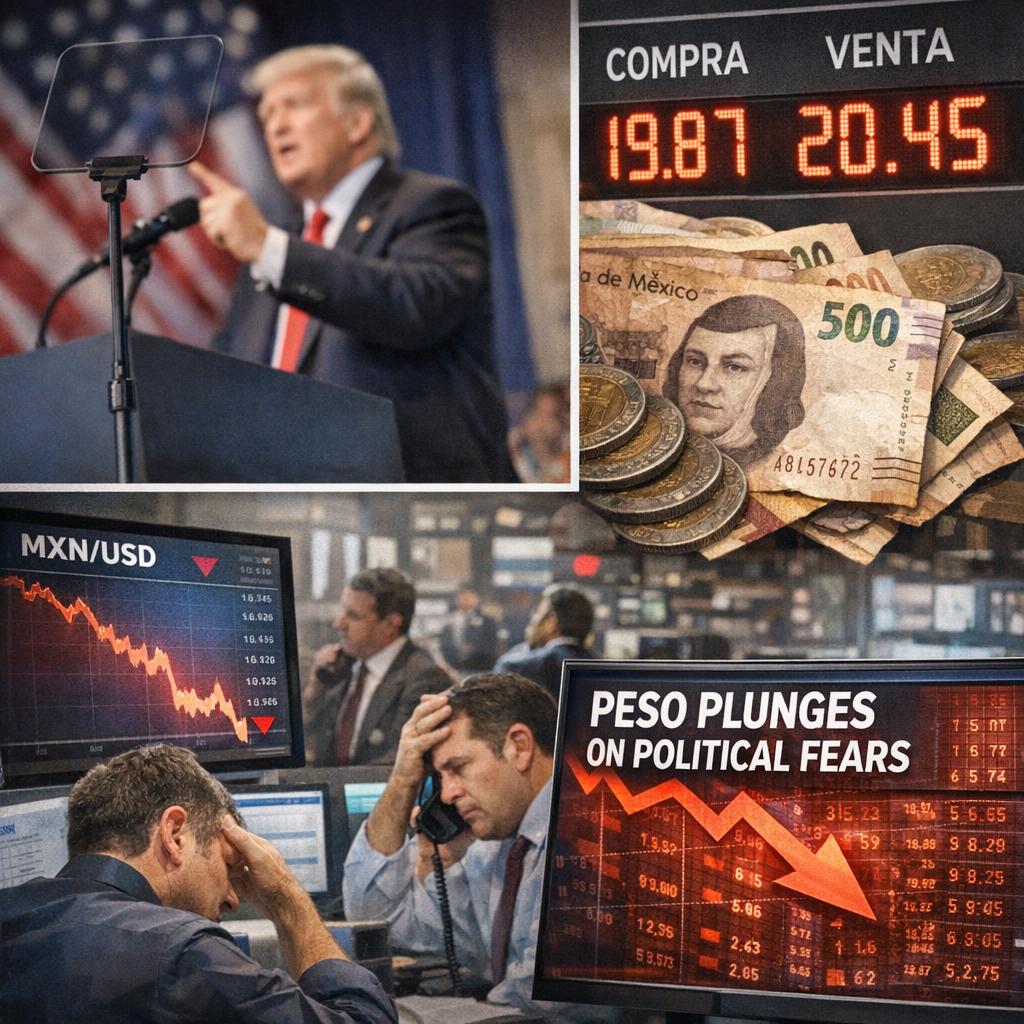
This week, the spotlight in financial markets swung firmly away from the quiet mechanics of monetary policy and onto the raw, emotive power of political rhetoric. The story that has dominated my analysis is not found in a quarterly earnings report or a central bank balance sheet, but in the transcripts of speeches and the resulting, violent gyrations in currency markets. Specifically, the dramatic, multi-percentage point plunge in the Mexican Peso following comments from a leading US presidential candidate serves as a stark, real-time case study in how political narratives are now immediate and potent market-moving forces.
For decades, the textbook drivers of a currency’s value were clear: interest rate differentials, trade balances, inflation rates, and relative economic growth. Analysts would pour over economic data releases, forecasting central bank moves. While politics was always a backdrop—a source of long-term uncertainty—it was often a slow-burning fuse. The market’s reaction this week demonstrates that this model is, in many ways, obsolete. The fuse has been replaced by a live wire, where a single sentence uttered on a campaign trail can trigger billions of dollars in capital flight within hours.
The mechanics of this are worth examining. The comment in question proposed a policy that directly threatened a foundational pillar of the Mexican economy. Markets did not wait for a policy white paper, a congressional vote, or an implementation timeline. They priced in the perceived risk immediately. High-frequency trading algorithms, scanning news feeds for keywords, executed sell orders at a pace no human trader could match. This wasn’t just speculation; it was a pre-emptive derisking by institutional money managers who cannot afford to be caught flat-footed. The Peso became a proxy for betting on a specific political outcome, transforming it from a currency into a political futures contract.
This episode is not an isolated one. It is a magnification of a trend that has been building for years, where market volatility is increasingly correlated with political event risk rather than purely economic cycles. We’ve seen similar, though perhaps less abrupt, reactions in European currencies during election cycles, in the British Pound during Brexit negotiations, and in various emerging market currencies tied to commodity prices influenced by geopolitical strife. What makes the recent move so instructive is its speed and its direct link to a campaign promise, not an enacted law.
For investors globally, this evolving dynamic demands a recalibration of risk assessment. The traditional toolkit—discounted cash flow models, price-to-earnings ratios, macroeconomic indicators—remains essential, but it is now incomplete. A new layer of analysis is required: political narrative risk. This involves monitoring not just policy platforms, but the language, tone, and frequency of statements from key political figures. It means understanding which sectors or national economies are most frequently cited as targets in political discourse, as they have become the most likely flashpoints for sudden volatility.
Furthermore, this shifts the concept of diversification. Holding a basket of international stocks may no longer be sufficient to mitigate risk if political shocks begin to correlate across borders through contagion or retaliatory policy announcements. True hedging may now require instruments that specifically bet against volatility itself or seek shelter in assets perceived to be outside the immediate line of fire of these political narratives, though identifying such safe havens is becoming paradoxically harder.
The ultimate takeaway is that the market is no longer just an economic forecasting machine; it is a real-time barometer of political sentiment and fear. The Mexican Peso’s tumble is a clear signal that for capital allocators, the political calendar is now as critical as the economic data calendar. In this environment, the most valuable skill for an investor might not be advanced calculus, but nuanced political analysis and the temperament to navigate markets that can be swayed as powerfully by a speech as by a statistic.
As we move forward, watching how other currencies and asset classes react to political discourse will be telling. This is the new frontier of market risk. I’m keen to hear your perspective on how you are adjusting your own frameworks in light of this shift. Feel free to share your thoughts in the comments.