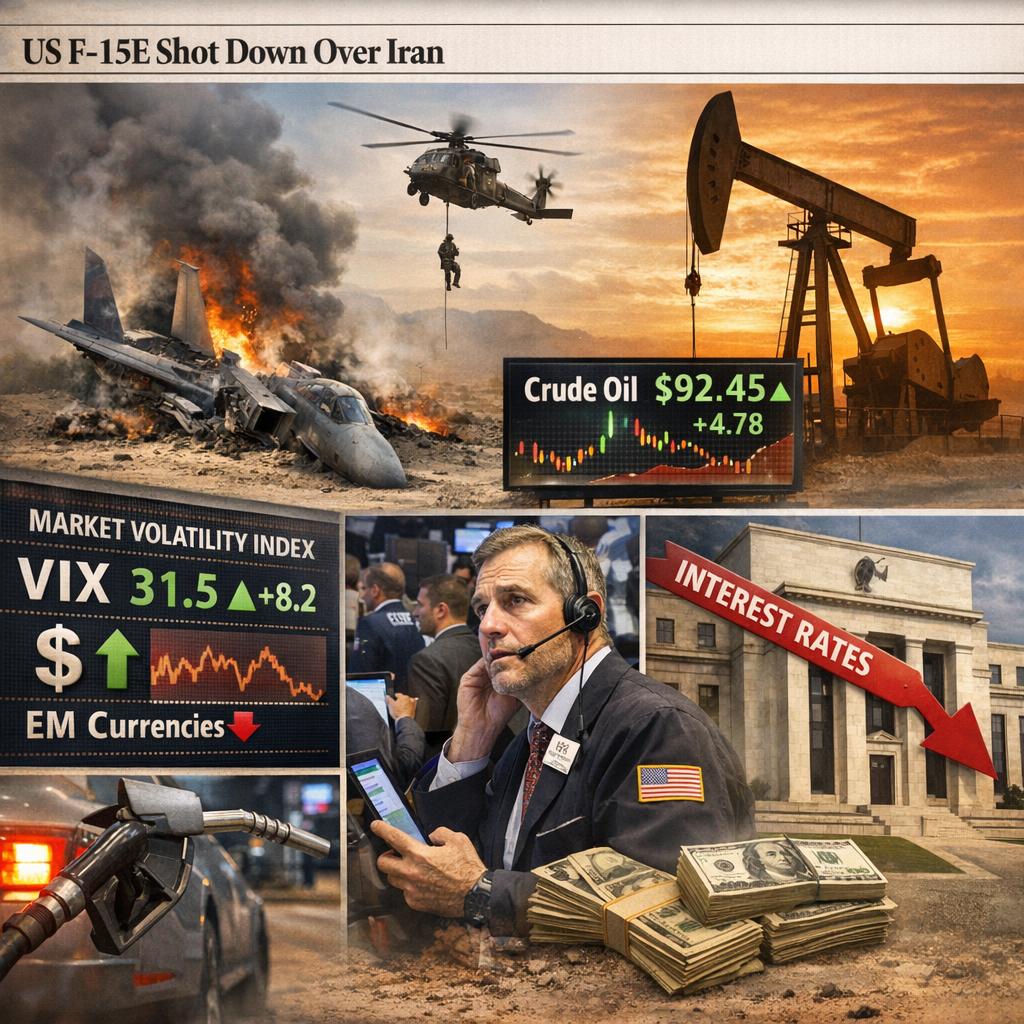
Markets have a funny way of turning a single headline into a full repricing of risk. The report that a US F-15E was shot down over Iran — with one crew member rescued and another still being searched for — is one of those moments. Even if the immediate military details stay contained, the financial signal is clear: the probability distribution around “what happens next” just got wider, and that’s what investors end up paying for.
This is how geopolitical shocks actually transmit into portfolios: not through certainty, but through second-order effects and risk premia that appear first in the most liquid markets and then bleed outward.
1) The immediate trade: volatility first, fundamentals later
When conflict escalates, the first assets to react are usually the ones that can be repriced in seconds:
– Energy (crude oil, refined products, energy equities)
– FX (safe havens vs higher-beta and import-dependent currencies)
– Rates (flight-to-quality bids, then inflation worries)
– Credit spreads (especially in weaker balance-sheet sectors)
The key point is that the market doesn’t need shipping lanes to close tomorrow for prices to move today. It just needs the odds of disruption to rise. That “insurance premium” gets embedded into oil, volatility, and funding conditions quickly.
2) Oil is not just an energy story — it’s a macro story
A jump in oil doesn’t stay neatly inside the energy sleeve of a portfolio. It spills into:
– Inflation expectations (headline inflation re-accelerates faster than core)
– Central bank reaction functions (rate cuts get delayed; “higher for longer” gets stickier)
– Corporate margins (transport, chemicals, airlines, consumer staples all feel it differently)
– Emerging markets (especially importers with current account pressure)
Investors globally should think less in terms of “will oil spike?” and more in terms of “how does a higher oil risk premium change the path of growth and policy?” Even a modest, sustained move can shift the narrative from soft landing to sticky inflation.
3) The dollar’s role: tightening by reflex
In episodes like this, the dollar often strengthens not because US fundamentals suddenly improved, but because global capital moves toward liquidity and perceived safety. That can quietly tighten financial conditions for the rest of the world:
– Dollar funding becomes more expensive at the margin
– EM central banks face tougher trade-offs (defend currency vs support growth)
– Companies with USD liabilities feel the squeeze first
This is one reason geopolitics can hit far away from the conflict zone: currency is the transmission line.
4) What tends to get mispriced: duration and “quality”
There’s a trap investors fall into during geopolitical shocks: assuming bonds will always rally and defensive equities will always outperform. Sometimes they do — but if the energy impulse feeds inflation, long-duration assets can struggle even while risk appetite falls.
In practice, the market can end up in an awkward mix:
– Risk-off in equities and credit
– Upward pressure on breakevens and inflation-linked instruments
– Choppy rate moves as growth fears fight inflation fears
That’s when portfolio construction matters more than conviction calls. Correlations can behave badly right when you need diversification most.
5) Practical portfolio takeaways (without pretending to predict)
This kind of event is a reminder to stress-test rather than forecast. A few things investors typically revisit in moments like this:
– Energy sensitivity: not just energy holdings, but energy as a cost input across the book
– FX exposure: especially if revenues and liabilities are mismatched by currency
– Liquidity: can you rebalance if spreads gap and vol spikes?
– Concentration: geopolitical shocks punish crowded trades more than they punish “bad ideas”
None of that requires a dramatic repositioning. But it does reward clarity: knowing what you own, why you own it, and what scenario actually breaks it.
Where I think the market is right now
The bigger story isn’t the single incident — it’s the reminder that geopolitical escalation risk is not theoretical, and it doesn’t arrive on a schedule that central banks or earnings seasons can accommodate. Investors don’t need to become geopolitical analysts, but they do need to price the world as it is: messy, reflexive, and prone to sudden regime shifts in volatility.
If you’re watching this from a portfolio perspective, I’d be interested to hear what you think gets hit first in the next leg: growth expectations, inflation expectations, or credit. Feel free to comment.