Dollar Debt Is Getting Weird Again — And It Matters More Than Most Portfolios Admit
One of the more underappreciated stories in markets right now is what’s happening underneath the surface of “dollar debt”.
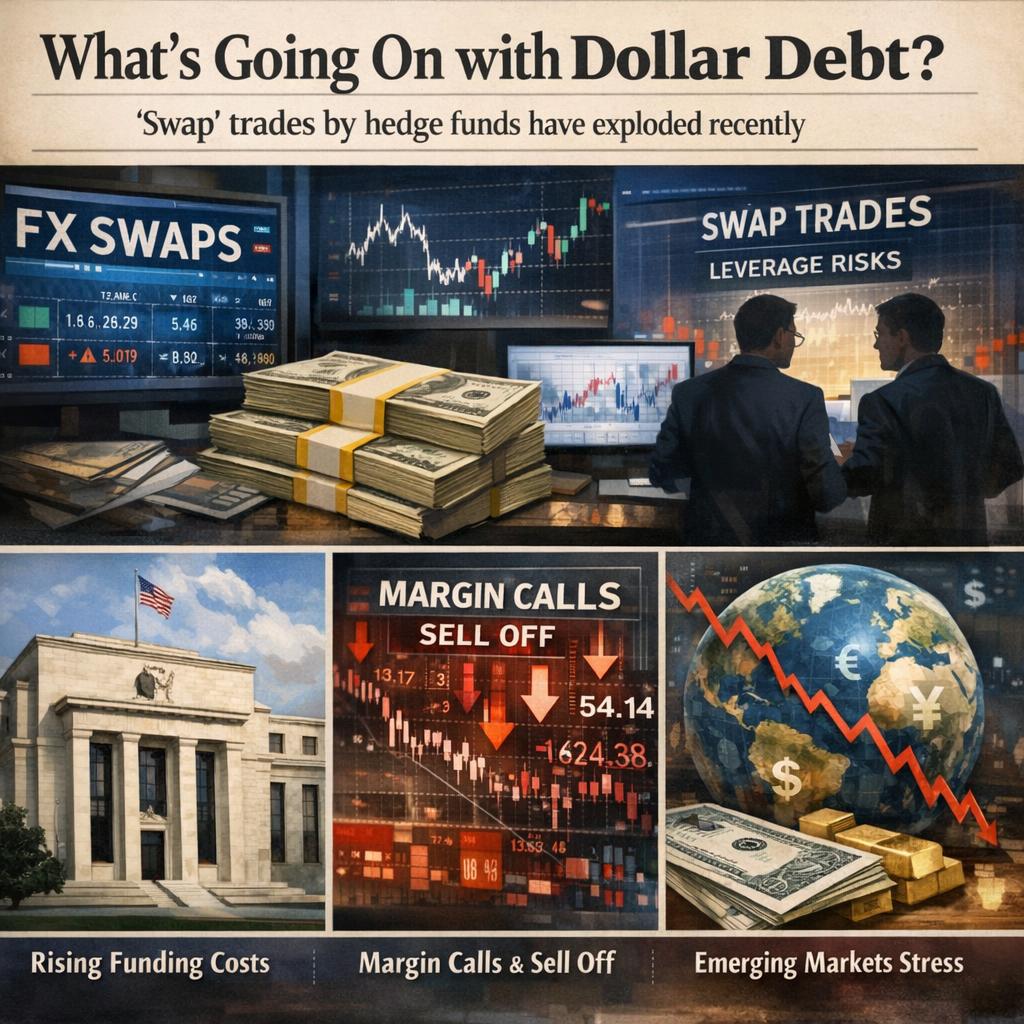
On paper, the US dollar system looks straightforward: US rates set the global tone, the dollar is the world’s funding currency, and cross-border borrowers tap it when it’s cheap and liquid. In practice, a huge amount of modern dollar exposure is synthetic — built through derivatives, basis trades, and “swap”-driven financing structures that can expand quickly when volatility is low… and then behave very differently when stress hits.
That’s why the recent surge in swap-related activity and hedge fund “swap” trades is worth taking seriously. Not because it guarantees a blow-up, but because it changes the geometry of risk for everyone else.
Here’s the key point: the global financial system doesn’t just borrow dollars. It rents them.
1) The hidden plumbing: why swaps can become the real dollar market
When investors think “dollar tightening,” they usually think of Fed hikes and Treasury yields. But many global institutions (banks, insurers, funds, corporates) manage their dollar needs through FX swaps and cross-currency swaps — essentially borrowing dollars short-term by swapping local currency funding into dollars.
This market is enormous, and it’s mostly invisible to casual observers because it doesn’t show up the way cash borrowing does. The price you pay is the “basis” — the extra cost (or discount) embedded in swapping into dollars versus what interest rate parity would suggest.
In calm markets, this plumbing hums along. In stressed markets, it can become the transmission belt for contagion.
When the basis moves sharply, it effectively changes the real cost of dollars for non-US borrowers and leveraged strategies. That can force repositioning fast — and repositioning in the swap market often bleeds into cash markets (Treasuries, credit, EM FX, equities) through hedging and margin dynamics.
2) Why hedge funds piling into swap trades can matter systemically
A growing share of “dollar debt” and “Treasury demand” is tied up in relative-value strategies: trades that look low-risk in isolation but can become highly correlated when funding costs jump or volatility spikes.
If hedge funds are putting on more swap-driven positions, you typically get:
– More balance sheet being used indirectly (through primes and dealers)
– More sensitivity to funding spreads, not just outright yields
– More potential for crowded exits if the basis moves the wrong way
– More collateral and margin call feedback loops when volatility rises
This doesn’t mean “crisis tomorrow.” It means the market’s center of gravity shifts from “macro views” (growth, inflation, Fed) to “micro mechanics” (funding, liquidity, dealer balance sheet).
And those mechanics can move faster than fundamentals.
3) The global investor takeaway: this is a currency story, a rates story, and a credit story
It’s tempting to file swap-market chatter under “specialist plumbing.” But the knock-on effects are very investable:
A) FX hedging costs can reshape international flows
When it becomes more expensive to hedge USD exposure, foreign investors may reduce unhedged dollar buying, or rotate into different maturities, or demand more yield to compensate. That has implications for Treasury curve dynamics and cross-border asset allocation.
B) Emerging markets feel it first
A lot of EM balance sheets are effectively short dollars, either directly (USD debt) or indirectly (imports, commodities, tourism receipts, banking system funding). If synthetic dollar funding tightens, EM risk premia can reprice quickly — even when the local story hasn’t changed.
C) Credit spreads can gap on “liquidity” rather than defaults
When funding stress appears, investors sell what they can, not what they should. That often means high yield, leveraged loans, and “liquid” credit ETFs get hit early. The macro narrative becomes secondary to the need to de-risk.
D) Treasuries can rally for the “wrong” reasons
Sometimes Treasuries rally because growth is slowing. Sometimes they rally because there’s a scramble for collateral, dollar liquidity, and balance sheet efficiency. Those rallies can be sharp, technical, and prone to reversal once stress is addressed.
4) What I’m watching (practically) as a read-through for global portfolios
If you’re managing or allocating capital, the useful question isn’t “will swaps blow up?” It’s “are we entering a regime where funding spreads drive risk assets?”
A few practical indicators that tend to matter in these moments:
– Persistent widening in cross-currency basis (especially for JPY and EUR into USD)
– Signs of dealer balance sheet constraint (wider bid-ask, poorer depth)
– Rising repo stress or collateral scarcity dynamics
– EM FX underperformance that doesn’t match commodity moves
– Credit underperforming equities (a classic early warning when liquidity is the issue)
5) Positioning implication: diversification needs to be real, not cosmetic
This is where portfolios can get caught out.
If your “diversifiers” are all implicitly funded the same way — leveraged credit, rate-sensitive equity factors, EM carry, vol selling — then a funding-driven shock can make them correlate at exactly the wrong time.
It’s not about going risk-off permanently. It’s about recognising when the system’s marginal price setter becomes funding and liquidity rather than earnings and growth.
In that regime, the winners tend to be:
– High-quality collateral
– Strong balance sheets
– True liquidity
– Simpler structures with less hidden leverage
And the losers tend to be:
– Crowded trades
– Funding-dependent strategies
– Assets that require continuous refinancing confidence
If you’ve been watching this “dollar debt” story too, I’d be interested in what you’re using as your main stress gauge right now — basis, repo, credit spreads, EM FX, or something else.