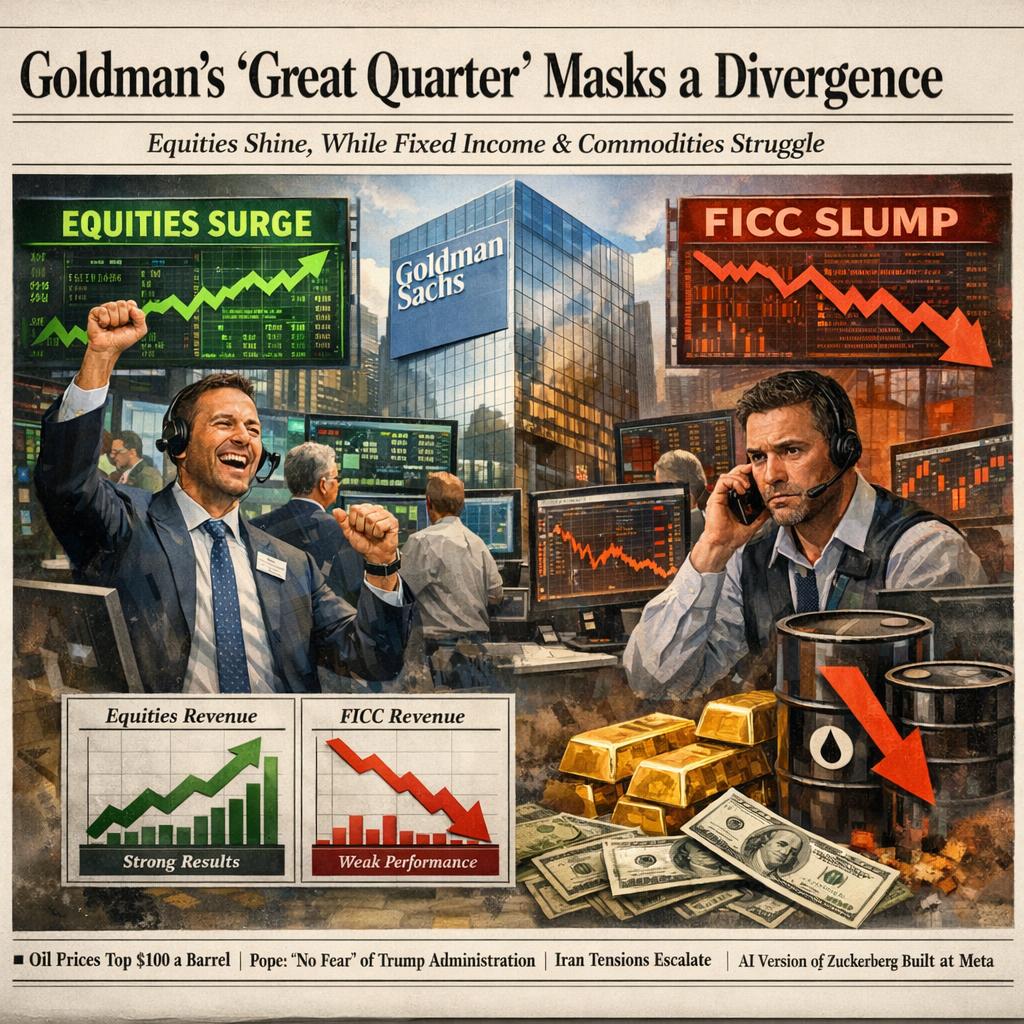
Goldman’s “Great Quarter” Is a Reminder: Investors Don’t Buy Headlines, They Buy Mix
One of the easiest traps in markets is to look at a big bank’s earnings headline and assume it tells you something clean about “the economy” or “market direction.” But the more you follow bank results closely, the more you realise the story is usually in the mix: which engines are working, which ones are misfiring, and what that says about risk appetite, liquidity, and the price of uncertainty.
That’s why the latest update from Goldman Sachs is worth sitting with. The overall quarter looks strong on the surface, powered by its equities business. Yet the fixed income, currencies and commodities side (FICC) came in notably weaker than expected. That contrast matters far beyond one ticker, because it’s a window into what kind of market we’re actually in right now.
Two businesses, two different worlds
Goldman has always been a good “market temperature” stock because it’s exposed to the plumbing of finance: client positioning, hedging demand, volatility, and deal flow. When the equities unit has a standout quarter, it often tells you that:
1) Equity volumes are healthy (people are trading, reallocating, expressing views).
2) Volatility may be supportive in a “tradable” way (enough movement to create opportunity, not so much chaos that everyone freezes).
3) There’s still appetite for equity risk, even if it’s selective.
But when FICC lags badly at the same time, it suggests a different set of conditions:
1) Rates and FX may be difficult to trade profitably (either too range-bound, too jumpy, or simply not offering clean two-way flow).
2) Client hedging might be uneven: some participants rushing for protection while others step back, creating choppier, less reliable liquidity.
3) Commodities can be a tough environment for market-makers if moves are violent, gaps appear, or positioning becomes one-sided.
In other words: a bank can post “strong earnings” while simultaneously telling you that key parts of the market feel awkward, expensive to hedge, and harder to intermediate.
Why this matters to global investors (even if you don’t own GS)
Big banks are more than stocks; they’re transmission mechanisms. When a firm like Goldman sees weakness in FICC, it can have knock-on effects across portfolios worldwide:
1) Liquidity isn’t just a buzzword
If a major dealer is having a tougher time in rates/FX/commodities, it can reflect thinner liquidity or more cautious risk-taking. That feeds into wider bid-ask spreads, higher hedging costs, and more slippage for everyone—from pension funds to corporates to retail investors using “safe” instruments.
2) “Diversification” can get stress-tested
Many portfolios lean on bonds or FX hedges to stabilise equity risk. If the rates or FX landscape becomes less predictable (or more expensive to hedge), diversification still works in theory, but the path can become bumpier in practice. That matters if you’re running balanced strategies, risk parity, or anything that assumes smooth bond behaviour during equity drawdowns.
3) Volatility is being priced differently across asset classes
A great equities quarter alongside a weak FICC quarter can hint at a market where equity risk is being actively traded and warehoused, while macro risk (rates, FX, commodities) is more fractured. For investors, that can mean equity valuations remain supported even as macro hedges become less straightforward—an uncomfortable combo if you’re trying to protect downside cheaply.
4) It reshapes leadership inside financials
Not all banks have the same exposure. A result like this can widen dispersion across the sector: firms with stronger equities franchises may look better positioned than those relying heavily on FICC, or vice versa, depending on the macro regime. “Financials” stop being a single trade and become a collection of very different business models.
What I take away from it
The main lesson here isn’t “Goldman good” or “Goldman bad.” It’s that markets are increasingly regime-based. Different desks thrive in different conditions, and the conditions can diverge across asset classes more than people expect.
Equities can be buoyant and liquid while macro markets are simultaneously stressed, jumpy, or simply harder to intermediate profitably. That divergence can persist for longer than investors are comfortable with—especially when macro narratives shift quickly and positioning becomes crowded.
For portfolio construction, it’s a nudge to think in layers:
– Are you relying on bonds to hedge equity risk? If so, what happens if rates volatility stays high?
– Are your “defensive” positions truly defensive, or just historically defensive?
– Are your assumptions about liquidity realistic in the instruments you’d actually use in a fast sell-off?
If you’ve been watching bank earnings this season, I’d be interested to hear what you think matters more right now: the headline profitability, or the underlying message about liquidity and risk appetite across asset classes. Comment your take.