The Strait of Hormuz Blockade: When a Thin Blue Line Becomes a Thick Red Risk Premium
One of the most market-moving stories right now isn’t coming from an earnings call or a central bank podium. It’s coming from a narrow stretch of water.
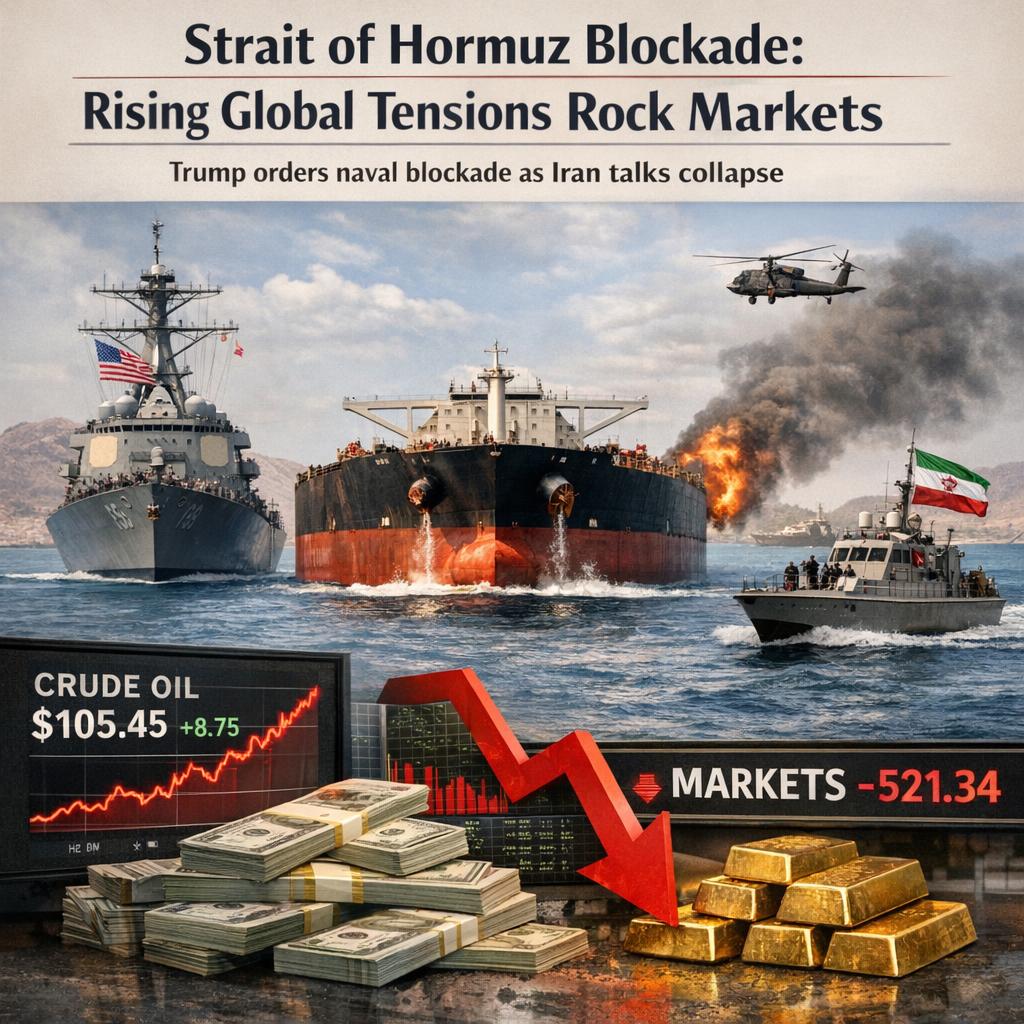
With reports that President Trump has announced a naval blockade of the Strait of Hormuz after peace talks with Iran failed, markets have been forced to do what they always do in moments like this: reprice risk, fast. Not just in oil, but across everything that ultimately depends on energy, shipping, confidence, and liquidity—which is to say, most of the investable world.
Why this matters so much (even if you never trade oil)
The Strait of Hormuz is one of those geographic choke points that turns geopolitics into a line item on an income statement. A meaningful share of globally traded oil and energy products flows through it. When passage becomes uncertain—whether through physical disruption, toll disputes, interdictions, or insurance constraints—prices don’t move because barrels have already disappeared. Prices move because the probability distribution changes.
Investors aren’t paying for today’s supply. They’re paying for tomorrow’s reliability.
In practical terms, a blockade (or even the credible threat of one) injects three immediate shocks into markets:
1) A supply/transport shock
Even if oil still moves, it may move slower, under escort, rerouted, or with higher friction. That translates into higher freight costs, higher insurance premiums, and wider bid-ask spreads in physical markets. Those costs don’t stay in the shipping lane. They leak into everything from jet fuel to plastics to fertilizer.
2) An inflation shock
Energy is a headline component and a psychological component. When energy prices jump, inflation expectations often tick up, and central banks become less flexible. Even if policymakers look through “temporary” spikes, markets tend to test their resolve.
3) A risk-off shock
When investors can’t confidently forecast macro conditions, they demand a higher return to hold risky assets. That’s when you see correlations tighten: equities wobble, credit spreads widen, volatility gets bid, and “quality” becomes the default trade.
The oil move is only the first chapter
In these moments, it’s tempting to watch the crude chart and think that’s the whole story. But the more important question for global investors is: how persistent does the shock become?
If disruption looks short-lived, the market can treat it like a volatility event—painful, but tradable. If it starts to look structural (extended interdictions, tit-for-tat escalation, damaged infrastructure, a broader regional risk premium), then you start getting second-order effects that can last quarters:
– Airlines and logistics firms face margin compression as fuel costs rise faster than ticket or contract repricing.
– Chemical manufacturers and industrials see input costs climb, with uneven ability to pass them on.
– Consumer sectors get squeezed as discretionary spending is crowded out by energy bills and broader cost-of-living pressure.
– Emerging markets that import energy see currency and current account stress, especially where reserves are thin or politics are fragile.
– Energy producers and oilfield services get a revenue tailwind, but with a policy overhang: windfall taxes, price caps, or political pressure can quickly follow.
The uncomfortable twist: even the “winners” carry new risks
Energy equities can rally hard in a supply scare, but investors shouldn’t ignore the volatility of the policy response. When prices surge during crisis, governments often reach for tools that can cap upside: strategic reserve releases, pressure on OPEC+, temporary tax measures, subsidy expansions that strain budgets, or regulatory interventions. So the payoff profile for “oil as the hedge” is rarely linear.
At the same time, safe-haven flows can be trickier than they look. Yes, defensive positioning often helps, but if inflation expectations jump sharply, duration risk reappears. That’s when long-dated bonds can behave less like a shelter and more like a second source of volatility.
Volatility has a destination: bank trading desks
Another notable ripple effect is how quickly volatility migrates into financials—particularly large banks with big trading operations. When rates, FX, commodities, and credit all start moving at once, market-making revenues can surge. But there’s a flip side: not everyone is positioned correctly, and liquidity can vanish in corners of the market that look deep until they don’t.
In other words, the same storm that boosts trading income can also expose hidden fragilities in leveraged strategies, commodity hedging programmes, and cross-asset risk models built for calmer seas.
What investors should be watching next (the “tell” signals)
In a situation like this, headlines matter, but market plumbing matters more. A few indicators tend to separate a temporary spike from a regime shift:
– Shipping and insurance: War-risk premiums and insurance availability can tighten supply even if no tanker is physically stopped.
– Forward curves: Backwardation vs contango tells you whether the market thinks the pain is immediate and transient or persistent and storage-worthy.
– Inflation expectations: If breakevens rise while growth expectations fall, stagflation fears start to creep in.
– Credit spreads: Watch high yield energy (for euphoria) and high yield ex-energy (for stress). Divergence is informative.
– FX stress in importers: Weakness in energy-importing EM currencies can be an early warning sign of broader risk aversion.
Positioning, not panic
For long-term investors, the goal usually isn’t to “trade the news.” It’s to understand whether your portfolio is accidentally concentrated in one macro assumption: stable energy, stable shipping, stable inflation, stable policy. When those assumptions wobble at the same time, diversification that looked fine on paper can behave like one big bet.
That doesn’t mean abandoning risk. It means being honest about exposures:
– How sensitive are your holdings to energy input costs?
– How much of your “defensive” allocation is actually exposed to inflation surprises?
– Are you relying on liquidity in instruments that widen dramatically under stress?
– Do your hedges hedge the thing that’s actually hurting you?
This is one of those moments where the market is reminding everyone that geopolitics isn’t a side show. It’s a pricing engine.
If you’re watching this unfold, I’m curious what you think the market is underestimating right now: the duration of the disruption, the inflation spillover, or the policy response. Comment with what you’re tracking.