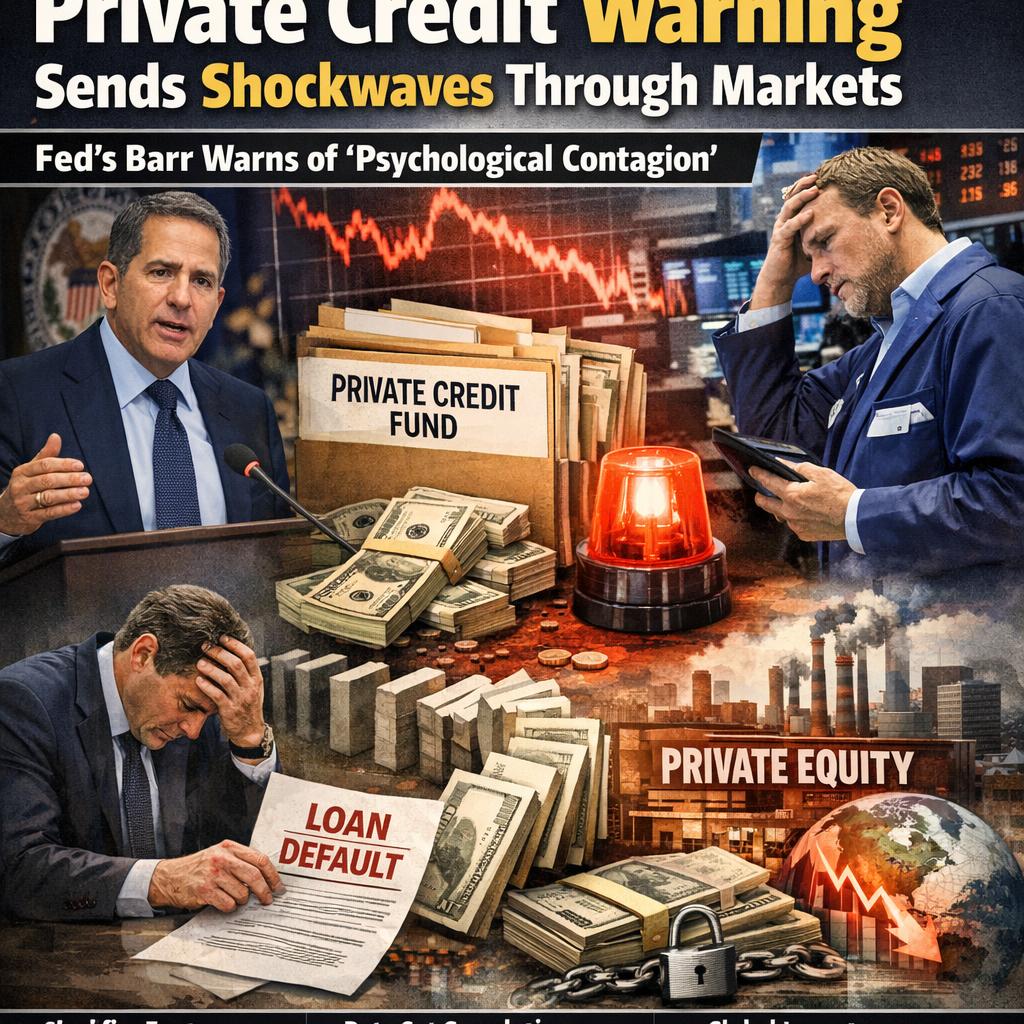
Private credit just flashed a warning light — and global investors should pay attention
One of the most important market stories this week didn’t come from the S&P 500 or a flashy earnings call. It came from a quieter corner of the financial system that has grown very large, very fast: private credit.
Reuters reported comments from the Fed’s Michael Barr warning that stress in private credit could spark “psychological contagion.” That phrase matters because markets don’t only move on fundamentals. They move on confidence, positioning, and the speed at which fear travels when investors realise they might all be holding variations of the same risk.
What private credit actually is (and why it ballooned)
Private credit is lending that happens outside traditional banks and public bond markets. Think direct loans to mid-sized companies, sponsor-backed deals, and a wide range of private financing structures packaged inside funds.
It expanded rapidly for a few reasons:
1) Higher regulation and tighter capital rules made some banks less willing to hold certain types of loans.
2) Investors, hungry for yield, liked the idea of “equity-like returns” with “debt-like risk.”
3) The low-rate era encouraged leverage and refinancing cycles that made private lending feel stable and predictable.
In other words: a lot of capital flowed into an area that’s less transparent, less frequently priced, and often harder to exit quickly.
Why “psychological contagion” is the right term
In public markets, price discovery is brutal but immediate. In private markets, pricing is smoother—until it isn’t.
The risk isn’t that every private credit portfolio suddenly collapses. The bigger risk is the perception shift:
– If a few funds report unexpected losses, gate redemptions, or mark down assets, investors start asking who else is exposed.
– When information is limited, people assume the worst.
– When people assume the worst, funding costs rise, liquidity dries up, and even healthy borrowers get treated like they’re guilty by association.
That’s contagion: not necessarily a direct chain of defaults, but a rapid spread of distrust that tightens financial conditions across the board.
How this can hit investors globally (even if you’ve never bought a private credit fund)
1) Equity markets feel it through “risk-off” rotations
When credit stress shows up, investors tend to de-risk broadly. That often means selling cyclical stocks, smaller companies, and anything that relies heavily on cheap financing. Even large-cap indices can wobble if liquidity becomes the story.
2) It changes the rate narrative and central bank reaction functions
If private credit stress starts to look systemic, it effectively “does the Fed’s job” by tightening conditions without an official rate hike. That can pull forward expectations of rate cuts—or at least increase volatility around the path of policy. For global investors, that spills into currencies, bond yields, and emerging market flows.
3) It impacts private equity, and then the real economy
Private credit is closely linked to private equity-backed companies. If refinancing becomes harder or more expensive, you can get knock-on effects:
– Slower deal activity
– More down-rounds and restructurings
– Reduced hiring and capex at leveraged firms
That eventually finds its way into public earnings, consumer sentiment, and GDP expectations.
4) It exposes a liquidity mismatch that markets punish quickly
Many private credit vehicles offer periodic liquidity, but the underlying loans are not liquid in the way public bonds are. If redemptions surge, managers may be forced to sell what they can (often the best assets) and hold what they can’t (often the riskier assets). That dynamic can accelerate drawdowns and worsen headlines—again feeding the psychological loop.
What I’m watching next (the practical investor checklist)
– Fund terms and gating language: Investors should understand what they actually own—especially liquidity provisions.
– Default rates vs. recovery rates: Rising defaults matter, but recoveries tell you how painful the cycle really is.
– Refinancing walls: Watch maturities over the next 12–24 months. The companies that need to refinance in a higher-rate world are where stress concentrates.
– Bank spillover: Even if private credit is “non-bank,” banks still touch parts of the ecosystem via lines of credit, derivatives, and exposure to sponsors.
– Market breadth: If stress is contained, strong companies keep trading strong. If breadth deteriorates, risk aversion is spreading.
The bigger point
Private credit has been treated like a modern solution to bank retreat and investor yield needs. That can be true—right up until the moment liquidity and confidence become the only two variables that matter. Barr’s wording is a reminder that the financial system doesn’t need a giant blow-up to cause damage; sometimes it just needs investors to stop believing the story at the same time.
If you’re watching this space too, I’d love to hear what you think is the key trigger: refinancing pressure, fund redemptions, or a specific pocket like commercial real estate or sponsor-backed leverage.