Hormuz Risk Is Back on the Tape — and Markets Are Treating It Like a Live Wire
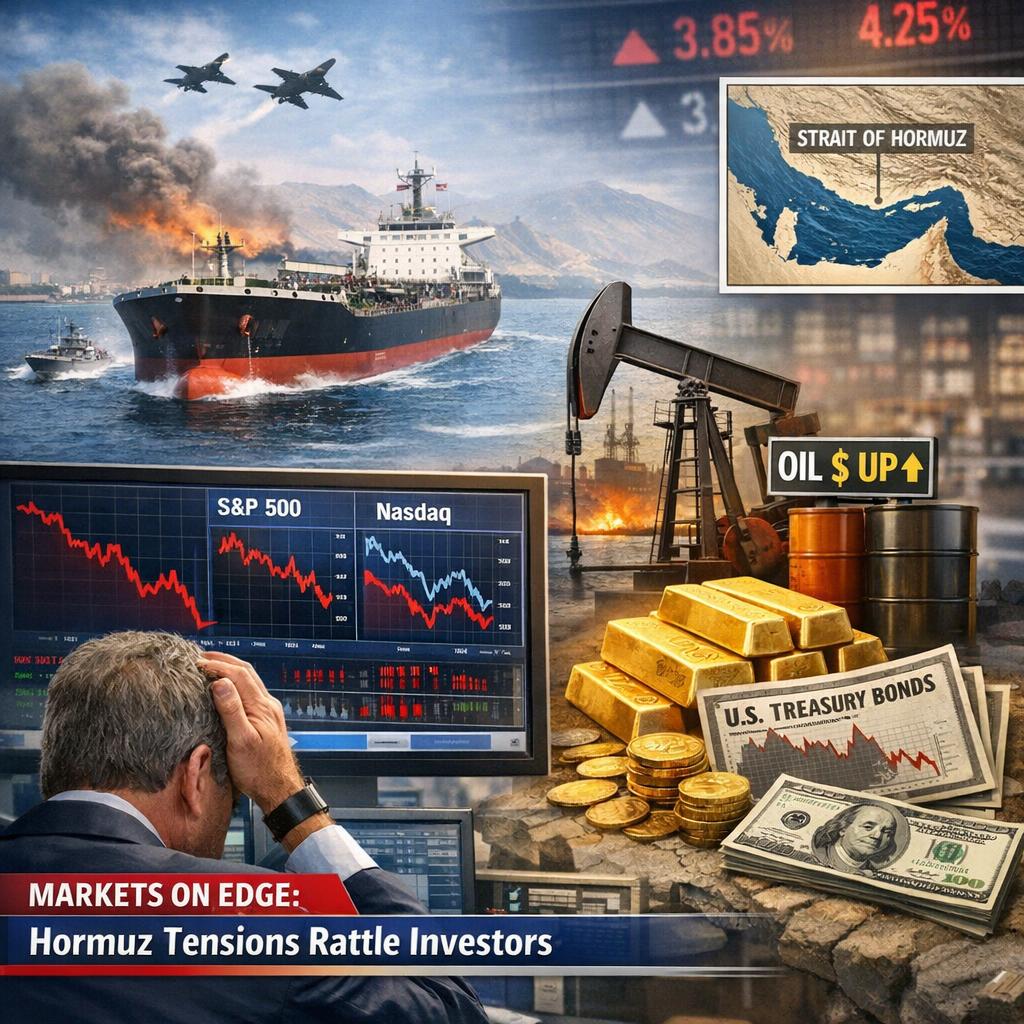
A familiar pattern showed up in markets as headlines around the Strait of Hormuz heated up: the Dow sagged while the S&P 500 and Nasdaq wavered, and you could almost feel investors collectively shifting from “earnings and growth” mode into “risk management” mode.
That matters because Hormuz isn’t just another geopolitical flashpoint. It’s a pressure point in the global financial system. When tensions rise there, markets don’t wait for a full-blown disruption. They price the possibility of one—quickly, sometimes violently, and often across asset classes.
Why Hormuz moves portfolios (even if you don’t trade oil)
The Strait of Hormuz is one of the world’s most critical energy corridors. If the risk of disruption rises, investors immediately start running the second-order effects:
1) Energy prices and inflation expectations
Higher crude prices can bleed into transport costs, manufacturing inputs, and household energy bills. Even the perception of tighter supply can push oil up. Once oil rises, inflation expectations can reawaken—especially if the market was getting comfortable about disinflation.
For investors, that can change the rate narrative fast. Bond yields may move, and “long duration” growth equities can wobble as discount rates get repriced.
2) Central banks don’t get to ignore oil shocks
Rate cuts aren’t just about economic growth—they’re about inflation staying contained. If oil spikes and inflation breakevens drift higher, central banks face a messier trade-off. Even if they still cut eventually, the path becomes less predictable.
And markets hate unpredictability more than they hate bad news.
3) Risk-off positioning hits more than just stocks
When geopolitical risk rises, the market often reaches for classic defensives: certain currencies, gold, short-duration government bonds. But it’s rarely a clean move. If inflation expectations jump at the same time, you can get an uncomfortable mix: equities down, oil up, and bonds not giving you the protection you expected.
That’s when diversification gets tested.
The investor takeaway: this is a correlation regime story
Most investors spend a lot of time thinking about what they own. Hormuz-style risk is about how things behave together when volatility picks up.
If energy rises sharply, some areas can benefit (energy producers, certain commodity-linked exposures), while others feel the squeeze (airlines, transport-heavy businesses, consumer discretionary, segments of tech that are especially rate-sensitive). Broad indices can “waver” because leadership fractures: defensives hold up, cyclicals wobble, and mega-cap tech can either cushion the index or amplify the move depending on the rates channel.
In other words, the question isn’t only “Will the market go down?” It’s “What stops acting like a hedge when stress hits?”
How I’d think about positioning in this kind of tape (without pretending to predict headlines)
1) Respect energy as a macro input again
Even if you don’t buy energy stocks, energy prices can change inflation, rates, margins, and consumer sentiment. It’s worth tracking crude not as a commodity chart, but as a driver of equity and bond behavior.
2) Don’t confuse calm indices with low risk
A flat-to-wobbly S&P can mask serious internal rotation. Watch what’s leading and what’s lagging. When geopolitical risk rises, breadth and sector performance can tell you more than the index headline.
3) Know your portfolio’s “hidden bet” on rates
A lot of global portfolios, especially those tilted toward growth, are implicitly long lower yields and stable inflation. If Hormuz risk pushes the market toward higher inflation expectations, that hidden bet becomes visible.
4) Stress test liquidity and drawdowns
Periods like this expose weak hands. If you’re overextended, under-diversified, or reliant on a narrow slice of the market, “waver” days can quickly turn into “gap” days.
The bigger picture
What’s striking is how quickly the market’s focus can switch from micro stories (earnings, guidance, product cycles) to macro plumbing (energy corridors, shipping risk, inflation expectations). That switch is exactly what global investors need to be prepared for—because it doesn’t just impact US equities. It spills into European risk assets, emerging market FX, credit spreads, and commodities in a single session.
If you’re watching this week’s price action, don’t just look at where the indices closed. Look at what the market is trying to insure against.
If you’re tracking this too, share what you’re watching most closely right now—oil, yields, gold, sector rotation, or something else.