PayPal Beat Earnings… and Still Got Hit. That’s a Very 2026 Market Signal.
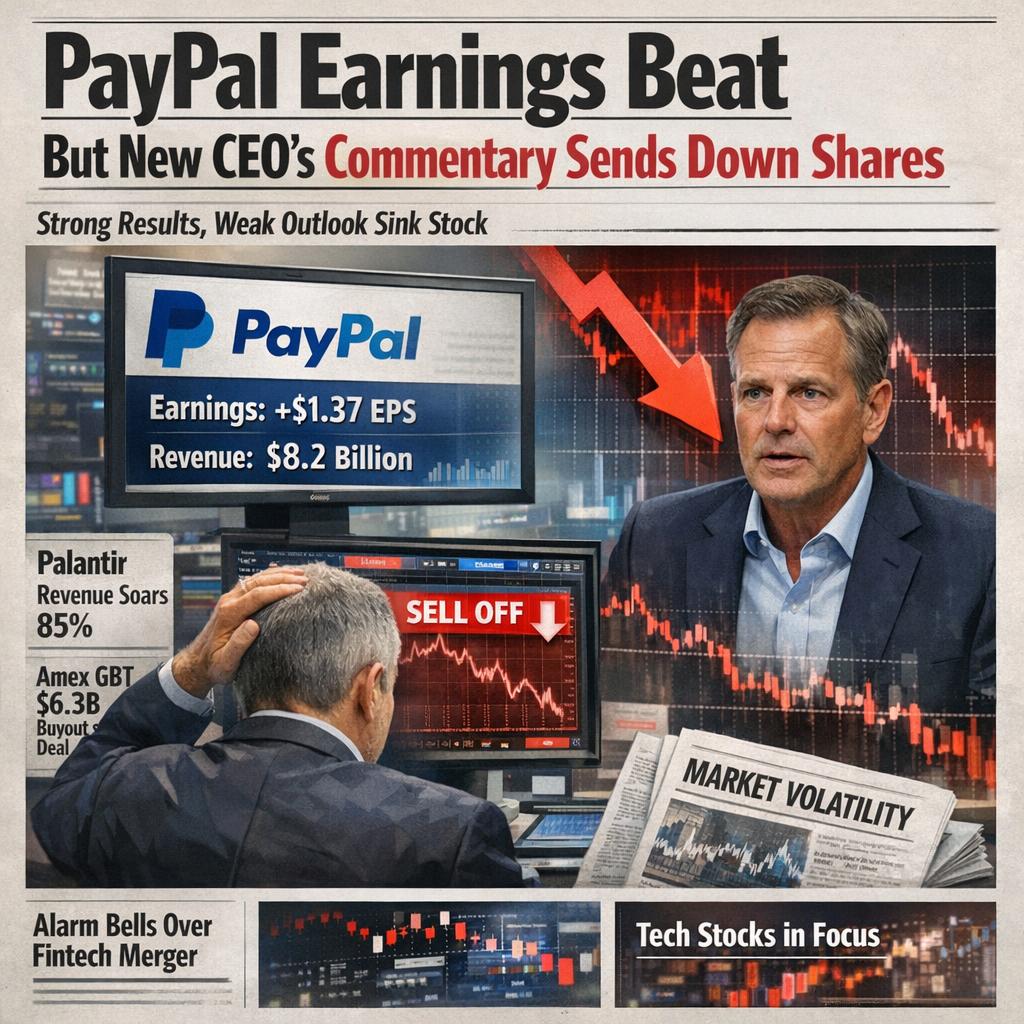
One of the more telling market stories this week wasn’t an index move or a macro surprise. It was PayPal: earnings came in better than expected, yet the stock still moved lower after the new CEO’s commentary.
If you’ve been watching markets closely, you’ll recognise the pattern. In this tape, “beat and raise” is no longer a free pass. Guidance, positioning, and credibility matter as much as the headline numbers—and sometimes more.
Why a Beat Isn’t Enough Anymore
For years, investors could lean heavily on simple earnings mechanics: revenue up, margins up, EPS beat, stock up. But the market has become far more selective, especially across mature tech and fintech names.
PayPal is a good example of a company that sits in a crowded intersection:
– It’s not a start-up with unlimited narrative runway.
– It’s not a regulated utility with predictable cash flows.
– It’s a scaled platform business that has to prove it can still grow profitably in a world where payments are increasingly embedded everywhere.
So when management commentary hints at tougher competition, slower growth, heavier investment needs, or uncertainty around the path forward, the market quickly re-prices the story—even if the quarter itself looks fine.
The Market Is Pricing “Next” More Than “Now”
This reaction tells you something important about investor psychology right now: investors are paying for the next 12–24 months, not the last 90 days.
A strong quarter can be backward-looking confirmation. But the multiple you’re willing to pay is forward-looking belief. If the CEO’s tone suggests that the easy wins are gone, that customer acquisition costs are rising, or that product strategy needs a reset, investors stop treating the business like a smooth compounding machine and start treating it like a turnaround—or at least a “prove it again” situation.
That distinction drives valuation, and valuation drives everything.
What This Means for Global Investors (Not Just PayPal Shareholders)
Even if you don’t own PayPal, this matters because it’s a clean read-through on how global equity markets are judging risk:
1) Guidance is the new earnings
In volatile or uncertain regimes, markets can forgive a messy quarter if the outlook is strong. But they punish uncertainty fast—especially when leadership is new and investors are listening for consistency.
2) Competitive moats are being re-tested
Payments is a battlefield: big tech, banks, card networks, BNPL players, and regional “super apps” are all fighting for share. That pressure isn’t limited to the US. It’s global, and it’s forcing every payments player to justify margins.
3) “Quality” now includes communication
This is underrated. In 2026, narrative discipline is part of fundamentals. Clear priorities, measurable targets, and a coherent capital allocation message can stabilise a stock. Vague messaging can undo a good print in minutes.
4) Stock selection is back in a big way
Broad beta has helped at times, but markets are increasingly differentiating between companies that have a clean growth + margin story and those that feel like they’re still searching for the next chapter.
How I’d Frame It as an Investor
The key takeaway isn’t “PayPal is bad” or “PayPal is good.” It’s that the market is acting like a strict underwriting committee.
If you’re investing globally—whether in US large caps, UK-listed fintech, European payments firms, or emerging-market platforms—this is the lens to keep in mind:
– What is management actually promising?
– What are they implicitly admitting is harder than before?
– How much execution risk is being introduced?
– And is the valuation paying you to take that risk?
Because the market is no longer paying up for “we’ll figure it out.” It’s paying for evidence.
If you’re following fintech closely, share your take in the comments: do you think the market is being too harsh on post-earnings commentary, or is this exactly the discipline investors needed after years of easy narratives?