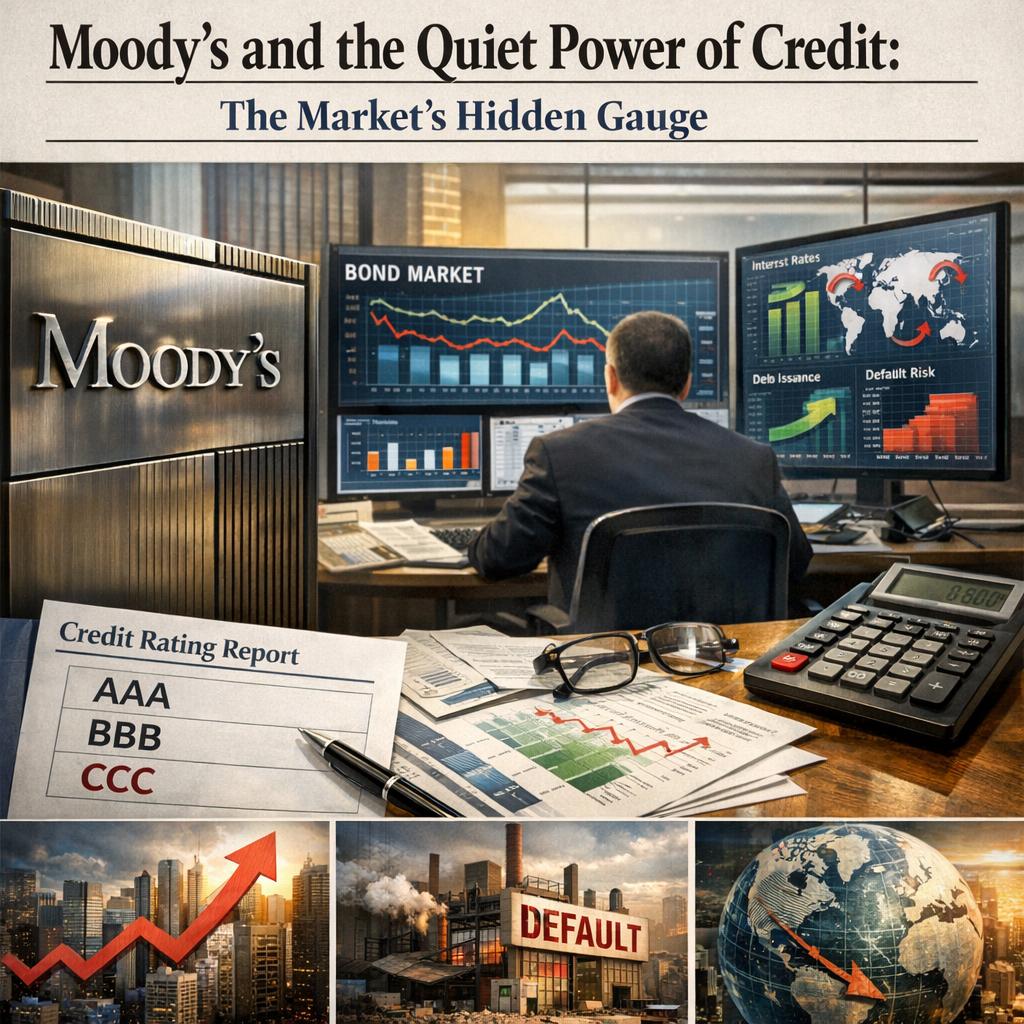
Moody’s and the Quiet Power of Credit: Why One “Boring” Stock Often Says More About Markets Than the S&P
Most market headlines focus on the loud stuff: AI, mega-cap earnings, meme rallies, or whichever sector is having its moment. But one of the more useful signals for global investors often comes from a place that feels almost… administrative.
Credit ratings.
A recent piece making the rounds about Moody’s (MCO) is a good excuse to zoom out and talk about what matters here isn’t just whether the stock looks attractive on a valuation model. It’s what Moody’s represents in the plumbing of global capital markets—and why that plumbing becomes more important, not less, when uncertainty rises.
Moody’s isn’t just a “financials” name
It’s easy to put Moody’s in the “services” bucket and move on. But the company sits at the intersection of three huge forces:
1) The cost of money (interest rates and credit spreads)
2) The supply of new debt (issuance by companies and governments)
3) Risk appetite (how much investors demand to be paid for taking credit risk)
When those three are humming, debt markets are active, deals get done, and ratings activity tends to be robust. When they seize up, it shows up quickly in issuance volumes—and the knock-on effects ripple globally because so much funding is intermediated through bond markets.
In other words: Moody’s is a way to watch the business cycle through the lens of credit.
Why credit matters to every investor (even equity-only investors)
Even if you never buy a bond, credit markets still set the rules of the game.
– Corporate borrowing costs shape profit margins. Refinancing at 7% instead of 4% is not a rounding error.
– Capex decisions depend on credit availability. Higher spreads can pause expansion plans.
– Defaults don’t stay contained. They hit lenders, suppliers, employment, and sentiment.
– Equity valuations are anchored (directly or indirectly) to discount rates and financial conditions.
So when people track “risk-on/risk-off,” it’s not just vibes. A lot of it flows through credit.
The global angle: US credit is the world’s weather system
The US dollar credit market is effectively a global reference point. When US spreads widen, or when Treasury yields climb, you often see pressure travel outward:
– Emerging market dollar borrowers feel it first (refi risk and currency pressure)
– European and Asian issuers reprice next (even if their local fundamentals are fine)
– Global equity multiples compress as the “risk-free” benchmark moves
That’s why a company like Moody’s can be indirectly tied to everything from infrastructure financing to housing affordability to sovereign debt sustainability.
Moody’s as a “cycle” tell
Here’s the part many investors overlook: Moody’s revenue mix tends to reflect whether we’re in a risk-tolerant environment (lots of issuance, lots of structured finance activity) or a risk-cautious one (more focus on surveillance, refinancings, and credit deterioration).
In a world where investors are still debating whether we’re heading for a soft landing, a growth re-acceleration, or a delayed slowdown, credit is one of the cleaner scoreboards.
Watch for:
– Rising issuance: usually indicates confidence and functioning capital markets
– Tightening spreads: markets are getting comfortable taking risk
– Higher default expectations: stress building under the surface
– More downgrades than upgrades: the cycle is turning, even if equities are still levitating
You don’t need to trade any of this day-to-day. But it helps frame whether the market rally is being supported by fundamentals—or just liquidity and positioning.
So… is Moody’s “a good stock to buy now”?
That depends on what you believe about the next 12–24 months.
Moody’s tends to look best when:
– Issuance is recovering (or about to)
– Credit stress stays contained
– Markets stabilize enough for companies to refinance and fund growth plans
It tends to look more fragile when:
– Rates stay restrictive longer than expected
– Spreads widen meaningfully
– Defaults rise and issuance dries up
The key point for global investors is this: whether or not you buy MCO, paying attention to credit conditions will make you better at reading equities, FX, and even commodities. Credit is where optimism becomes funding—or fails to.
If you’re watching markets right now, are you seeing signs that credit is loosening… or quietly tightening? Comment with what indicators you’re tracking (spreads, issuance, downgrades, bank lending data, anything).