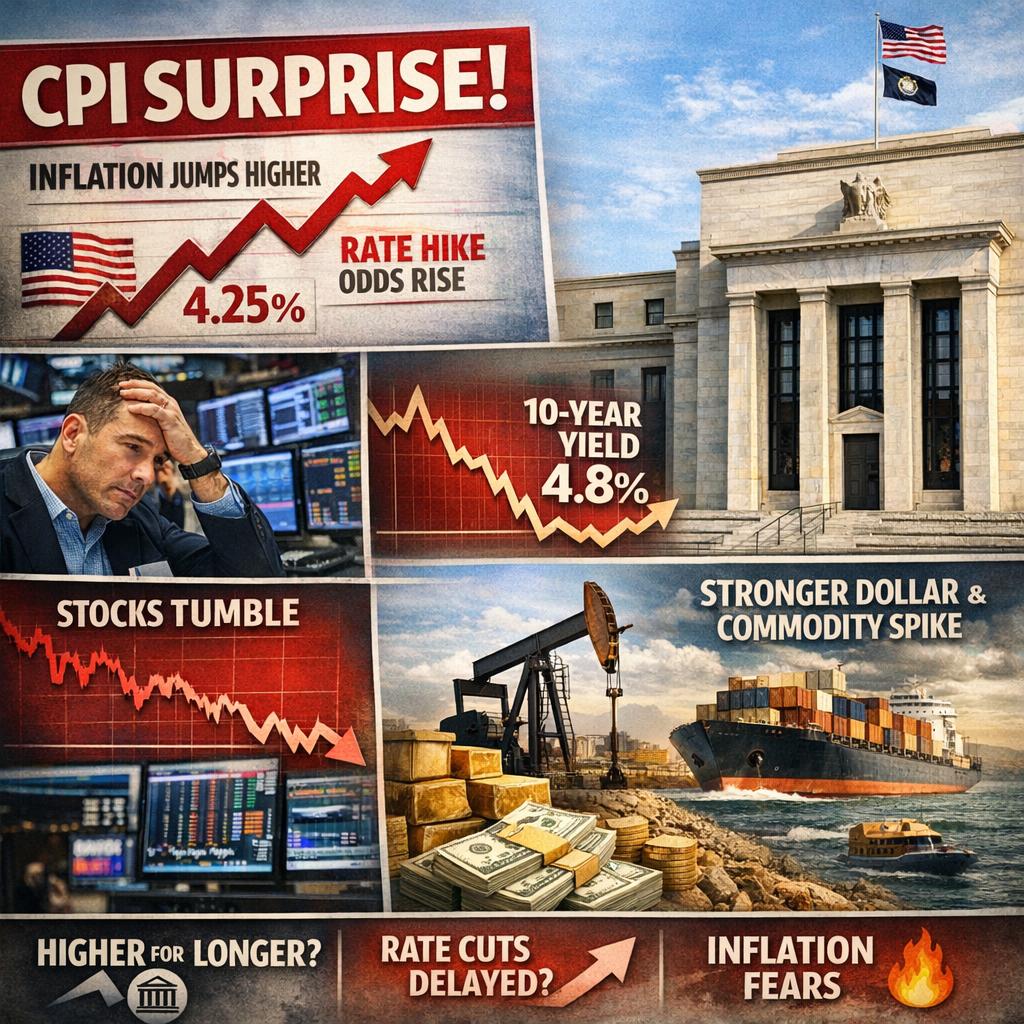
Hot CPI, Rising Yields, and the New “Higher for Longer” Trade
A hotter-than-expected CPI print does more than jolt a single trading session. It resets the market’s internal clock—pushing out the timeline for rate cuts, reviving rate-hike probabilities at the margin, and forcing investors globally to reprice everything from equities to currencies to credit.
At the core of today’s reaction is a simple message: inflation isn’t cooling neatly on schedule, and the Fed can’t afford to declare victory too early.
Why this CPI matters (even if you don’t trade US assets)
US inflation data is still the world’s most influential macro release because the US risk-free rate is the anchor for global financial pricing. When CPI runs hot, the market tends to do three things quickly:
1) Mark up the expected path of Fed policy
Even a small shift in the “terminal rate” conversation can have oversized effects. Investors aren’t only thinking “cuts delayed.” They’re also thinking “the bar for cuts just got higher” and “the probability of another hike is no longer zero.”
2) Reprice the long end of the curve
It’s not just about the next meeting. Hot inflation tends to push longer-dated Treasury yields higher because it increases uncertainty around future inflation and the real rate investors demand for holding duration. That becomes a headwind for long-duration assets everywhere.
3) Rebuild the inflation risk premium
When inflation proves sticky, the market starts charging a premium again for uncertainty. That can show up as wider credit spreads, weaker multiples for growth stocks, and a stronger dollar—especially if other central banks look closer to easing than the Fed does.
The global ripple effects investors should actually watch
If you’re investing internationally, the key isn’t simply “US stocks down, bonds down.” It’s the second-order impacts that follow a hot CPI print.
A stronger dollar changes the playing field
A repricing toward tighter US policy typically supports the dollar. That matters because it can:
– Tighten financial conditions for emerging markets (especially those reliant on USD funding)
– Raise the local-currency cost of commodities priced in dollars
– Put pressure on countries importing energy or food, potentially feeding their own inflation
Equity leadership can rotate fast
Hot CPI + rising yields tends to punish long-duration equity cash flows—think high-multiple growth where much of the valuation rests on distant earnings. Meanwhile, areas with nearer-term cash flows, pricing power, and real-asset linkage often hold up better. This doesn’t guarantee a “value rally,” but it does mean the market becomes far more selective.
Credit becomes the quiet stress point
When yields rise, refinancing becomes more expensive. The immediate pain usually shows up in high yield and leveraged loans, but the broader point is that higher-for-longer increases default risk over time, not overnight. Investors should pay attention to:
– Companies with near-term maturity walls
– Floating-rate debt exposure
– Weak interest coverage ratios
Because the equity story often breaks after the credit story starts whispering.
Commodities and energy complicate the inflation picture
If inflation is hot while oil is also rising, central banks get boxed in. Energy-driven inflation can seep into transport, food, and services, making it harder for inflation to fall organically. That’s when “higher for longer” stops being a slogan and becomes a positioning regime.
So what does this mean for portfolio thinking right now?
This kind of macro moment usually rewards investors who separate “story” from “sensitivity.”
– Duration sensitivity: Know how exposed your portfolio is to rising yields (long bonds, rate-sensitive REITs, high-multiple tech).
– Pricing power: Favor businesses that can pass through costs without destroying demand.
– Balance sheet quality: In higher-for-longer environments, leverage becomes a performance factor.
– Global currency awareness: If you hold international assets, your returns may be dominated by FX moves as much as fundamentals.
Most importantly: avoid assuming the next CPI print will “fix” this one. Once the market starts worrying about persistence, it typically demands a run of evidence—not a single cooler month.
If you’re positioning for the next quarter, are you treating this as a temporary bump in the data, or as the start of a longer inflation tail? Share your take in the comments.