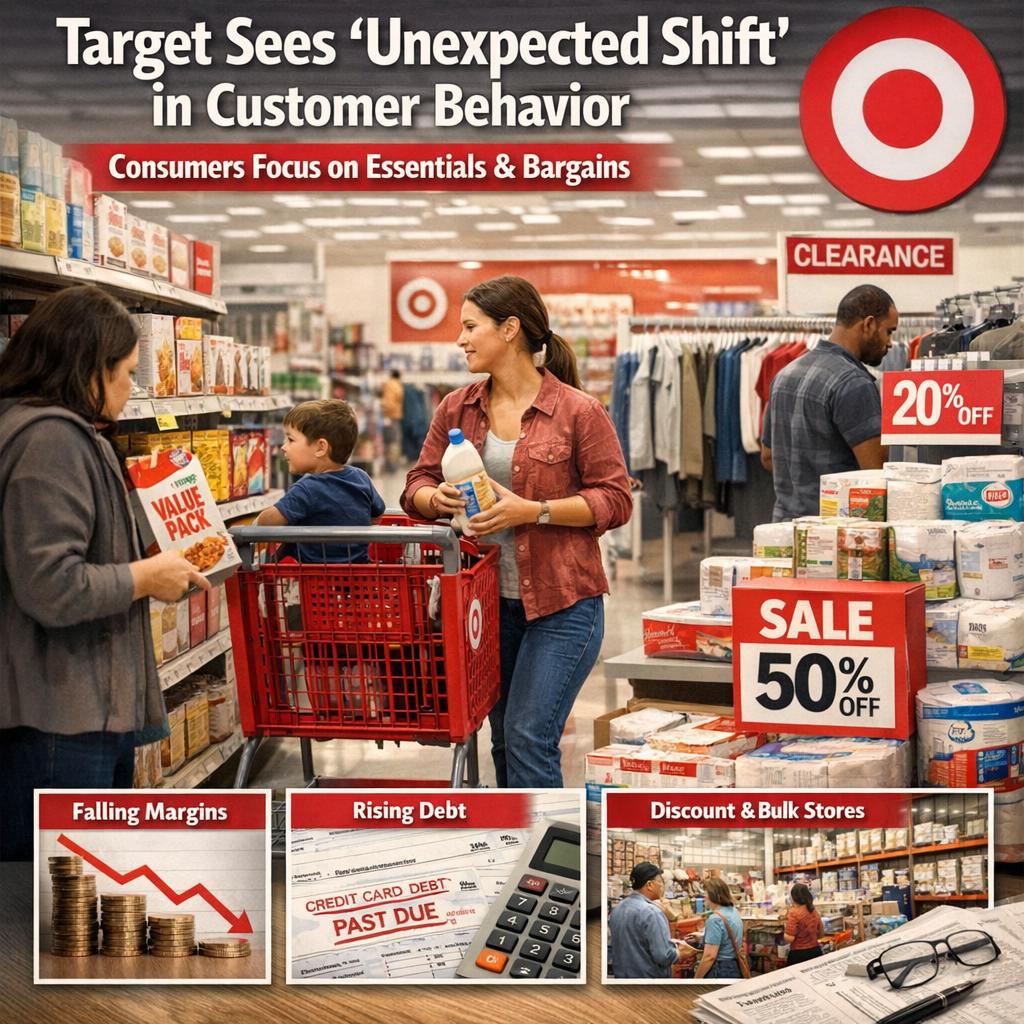
Target’s “unexpected shift” is a reminder that the consumer isn’t back to “normal” — and that matters for portfolios everywhere
One of the most useful market signals doesn’t come from a central bank meeting or a flashy tech launch. It comes from a big, boring, everyday business telling you what people are actually doing with their money.
That’s why the latest update around Target’s customer behavior is worth more attention than it will probably get.
When a mass-market retailer flags an “unexpected shift,” it’s rarely about a single quarter. It’s often an early snapshot of how households are adapting to the next phase of the cycle: still spending, but spending differently. More trade-down. More substitutions. More “I’ll buy it, but only if it’s on promotion.” More essentials, fewer impulse add-ons. And, critically, a sharper divide between higher-income shoppers who keep moving and everyone else who has to think twice.
Investors should care because this isn’t just a Target story. It’s a global positioning story.
1) The consumer is becoming more tactical, not necessarily weaker
Markets love clean narratives: “the consumer is strong” or “the consumer is breaking.” Reality tends to be messier.
What we’re seeing across many developed markets is a consumer who’s learned to optimize. People will still spend, but they’ll hunt value harder, delay discretionary purchases longer, and lean into promotions more aggressively. That doesn’t always show up immediately as a collapse in headline sales, but it shows up clearly in:
– Margin pressure (because promotions cost money)
– Mix shifts (more essentials, fewer high-margin discretionary items)
– Inventory risk (because demand becomes harder to forecast)
For equity investors, that’s the key: revenues can look okay while profitability quietly deteriorates.
2) “Value migration” is a competitive weapon — and a warning sign
When shoppers start migrating toward value, the winners aren’t always the brands you expect.
Discounters, warehouse clubs, and grocers with strong private-label offerings typically benefit. Retailers positioned in the middle can get squeezed: they’re not cheap enough to be the default value choice, and not premium enough to be insulated by loyalty.
This affects global investors because US retail is often an early indicator for other consumer-led markets. Multinationals selling household goods, apparel, and packaged foods watch this data closely. If the shift becomes persistent, it can change:
– Pricing power assumptions for consumer staples and discretionary names
– Earnings expectations for brands exposed to North American demand
– FX translation sensitivity as companies chase volume in different regions
3) The inflation hangover shows up in margins and credit, not just CPI
Even if inflation prints cool, households remember the higher baseline cost of living. That “memory” changes behavior.
At the same time, higher interest rates work with a lag. The longer rates stay elevated, the more pressure shows up in:
– Credit card delinquencies (especially among lower-income segments)
– Buy-now-pay-later stress
– Reduced tolerance for discretionary add-ons
Retailers can often see this before the macro data screams it. When a company like Target observes a shift, investors should translate it into second-order effects: advertising demand, logistics volumes, packaging orders, supplier pricing, and even commercial real estate dynamics.
4) What this means for portfolio positioning (without overreacting)
This is not a call to panic-sell retail or declare a recession. It’s a call to tighten the lens you use to evaluate consumer exposure.
A few practical implications investors globally may want to consider:
– Be more skeptical of margin forecasts that assume a quick return to “full-price” demand.
– Watch companies with heavy promo exposure and inventory sensitivity; volatility can rise quickly if demand gets choppy.
– Give extra credit to businesses with genuine cost advantages (scale, logistics, private label, membership models).
– In consumer staples, separate “must-have” categories from “nice-to-have” ones; not all defensives defend equally when consumers trade down within the aisle.
– Pay attention to management language about “mix,” “shrink,” “traffic,” and “promotions.” Those are often the real story.
The broader point: the market can be fixated on rates, AI, and geopolitics, but the everyday consumer still decides a huge portion of earnings outcomes. And right now, that consumer is behaving with more precision than confidence.
If you’re tracking retail and consumer names this year, I’d be interested to hear what you’re watching most closely: margins, traffic, or credit trends.