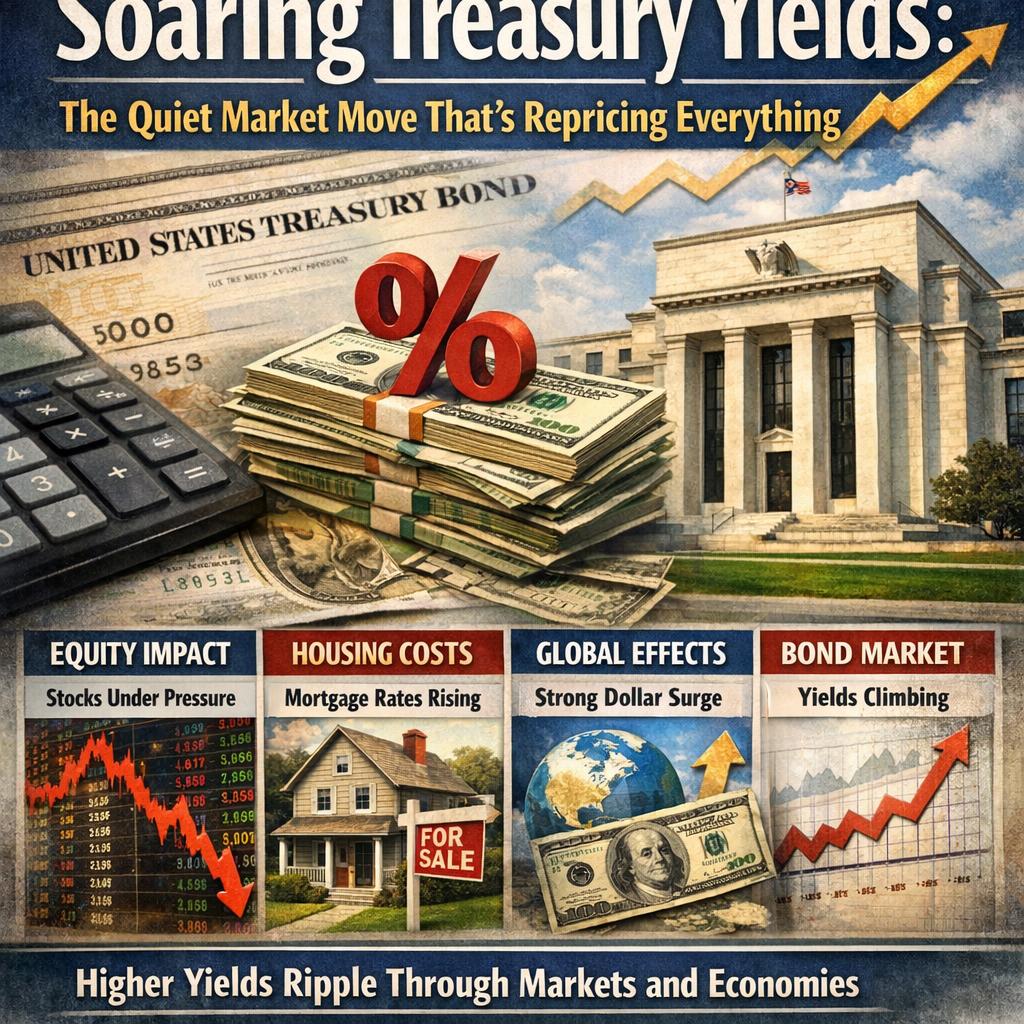
Soaring Treasury Yields: The Quiet Market Move That’s Repricing Everything
One of the most important stories in markets right now isn’t about a single stock ripping higher or a flashy earnings beat. It’s the less glamorous but far more consequential move in US Treasury yields—and how that shift ripples through global portfolios, currencies, and even everyday borrowing costs.
When Treasury yields rise meaningfully, it’s not just “bond market stuff.” It’s a reset button on the price of money. And because the US sits at the centre of global capital flows, that reset rarely stays contained within American borders.
Why yields matter more than headlines
Treasuries are the baseline “risk-free” reference point used across finance. They influence:
1) Discount rates (what investors use to value future cash flows)
2) Borrowing costs (mortgages, corporate debt, consumer credit)
3) Currency dynamics (especially the US dollar)
4) Risk appetite (whether investors prefer safety or reach for returns)
So when yields climb, the market is effectively saying: “Capital is more expensive now.” And that single sentence forces repricing almost everywhere.
The equity impact: valuation gravity returns
Higher yields create a tougher environment for equities in two key ways.
First, valuation pressure. Stocks are ultimately valued on expectations of future earnings. The higher the discount rate, the less those future earnings are worth today. This is why long-duration assets—think high-growth tech, software, and businesses where profits are weighted further into the future—tend to be more sensitive when yields rise. Even if nothing changes operationally inside the company, the math changes outside it.
Second, competition for capital. If investors can earn more in relatively safe government bonds, the “required return” for owning riskier assets rises too. That can compress multiples and make it harder for stocks to expand on valuation alone. In a rising-yield world, equity performance often has to be earned the old-fashioned way: with real earnings growth, strong margins, and credible guidance.
The bond impact: income looks better, but volatility can bite
For years, many investors were conditioned to view bonds as low-return ballast. Higher yields change that. On the surface, the case for adding quality duration becomes more attractive because new buyers can lock in higher income.
But there’s a catch: the path matters. If yields are rising quickly, existing bond prices fall, and that mark-to-market drawdown can be uncomfortable—especially for investors who assumed bond allocations would always “stabilise” their portfolios.
The practical takeaway is simple: in this regime, bond investors need to think more deliberately about maturity exposure, reinvestment timelines, and whether they’re being paid enough to take duration risk.
The global impact: the dollar, emerging markets, and capital flows
This is where rising US yields become a worldwide story.
When US yields rise, global capital is often pulled toward dollar-denominated assets. That can strengthen the US dollar, tightening financial conditions abroad. For emerging markets in particular, this can be a double squeeze:
– A stronger dollar can make dollar-denominated debt more expensive to service
– Capital can rotate out of riskier markets back into US assets offering improved yields
Even developed markets feel it. Higher US yields can pressure other central banks and sovereign curves, especially if inflation expectations or term premiums start shifting globally. In plain terms: the US bond market can export tighter conditions.
The consumer and corporate impact: refinancing risk is real again
In the post-zero era, a lot of balance sheets were built on the assumption that refinancing would remain cheap and accessible. Rising yields disrupt that.
For households, it shows up in mortgage rates and consumer credit pricing. For companies, it shows up in interest expense and refinancing schedules. Businesses that relied heavily on cheap debt—or that need frequent access to capital markets—can find themselves under pressure even if revenues are stable.
This is one reason credit selection matters more when yields climb: not all “healthy-looking” companies have the same liability structure underneath the hood.
What I’m watching as an investor
In periods like this, I pay less attention to daily noise and more attention to a few signals:
– Are yields rising because growth expectations are improving, or because inflation/term premium is re-accelerating?
– Is the yield move orderly or disorderly (steady repricing vs. sudden shocks)?
– Are credit spreads widening (a sign stress is moving beyond rates into risk)?
– Is the dollar strengthening fast enough to tighten conditions globally?
Those answers shape whether higher yields are a manageable headwind—or the start of a broader risk-off shift.
Positioning isn’t one-size-fits-all, but the mindset matters
This isn’t a call to abandon equities or hide entirely in cash. It’s a reminder that when the risk-free rate moves, the hurdle rate for everything moves with it. The market can still do well, but the playbook changes. Quality cash flows matter more. Balance sheet discipline matters more. And paying “any price” for growth becomes harder to justify.
If you’ve been navigating this yield environment in your own portfolio—whether through bonds, equities, or currency exposure—feel free to share what you’re focusing on in the comments.