Records on the screen, risk in the background: why geopolitics is quietly reshaping the AI trade
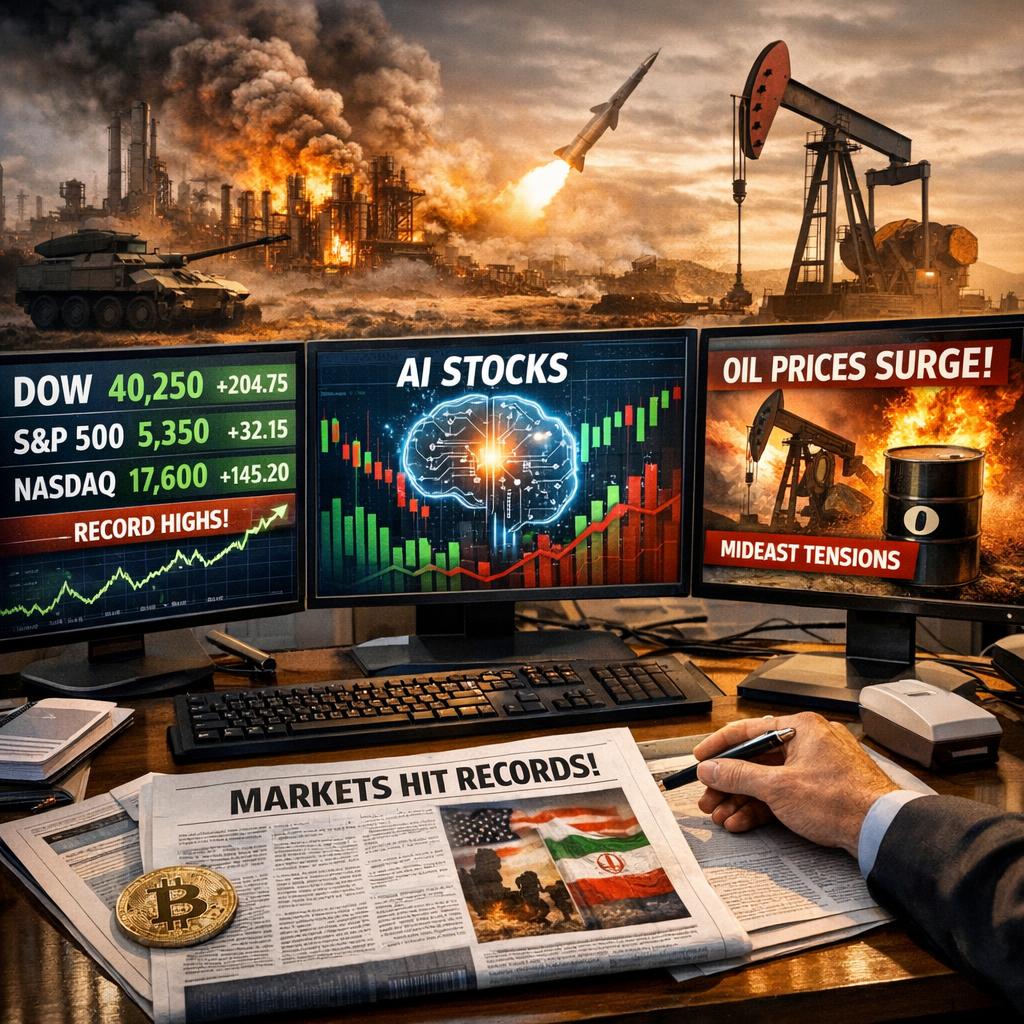
US equities are doing what they’ve done so well in this cycle: pushing higher, printing fresh records, and daring investors to stay underweight. But one detail in the latest market coverage is worth sitting with: even as the Dow, S&P 500, and Nasdaq build on new highs, the tone around AI optimism is being tempered by renewed US-Iran tensions.
That combination matters, because it highlights a reality many global investors keep relearning the hard way: markets can rally and still be fragile.
1) When indices hit records, “the market” becomes narrower than it looks
At new highs, it’s easy to assume breadth is healthy and the rally is “everywhere.” In practice, record levels often reflect the strength of a relatively small set of mega-cap names and a handful of crowded themes. AI has been the centre of gravity for a long time now, pulling passive flows, concentrated active bets, and retail enthusiasm in the same direction.
When geopolitics enters the frame, it doesn’t have to crash the party to change behaviour. It simply needs to raise the discount rate investors apply to future earnings (via uncertainty) or threaten the inputs those earnings depend on (via energy, supply chains, or export controls). That’s why you can get the odd-looking mix of “new highs” alongside a clear sense of caution under the surface.
2) US-Iran tensions are an energy story first, and an inflation story second
For global portfolios, the quickest transmission channel from Middle East tension to your brokerage account is energy pricing. You don’t need a full-blown supply shock for markets to notice. Oil simply needs to become more volatile, and suddenly:
– Inflation expectations can drift up.
– Central banks get less flexibility.
– Bond yields can reprice.
– Equity valuations—especially long-duration growth—feel the pressure.
This is where the AI angle becomes important. Many of the market’s most loved AI names are priced on multi-year expectations. When the “risk-free” part of the valuation equation moves, the growth part has to work harder.
Investors often talk about AI as if it’s detached from the physical world. It isn’t. Data centres consume vast electricity, chip supply chains are global, and capex cycles are sensitive to financing conditions. If energy costs rise or financial conditions tighten, the market starts asking tougher questions about timelines, margins, and just how smooth this adoption curve will be.
3) Geopolitics doesn’t just move commodities—it changes positioning
There’s a portfolio-behaviour element here that’s easy to miss. At record highs, many managers are already sitting on meaningful gains in the year’s winning trades. When geopolitical risk rises, they don’t need to become bearish to take action. They can simply:
– Trim the most crowded winners to lock in gains.
– Rotate into defensives or value.
– Add hedges via options.
– Increase cash slightly.
– Rebalance towards assets that benefit from volatility (or at least suffer less from it).
That can create choppier price action even in a market that ultimately keeps grinding higher.
4) Why this matters globally (even if you don’t own US stocks)
US equities sit at the centre of global risk appetite. When the US market is at records, it influences everything from European cyclicals to emerging market flows to currency risk-taking. If geopolitical tension makes US investors more defensive, it can ripple outward through:
– A stronger US dollar (as a default “safety” bid).
– Tighter financial conditions for dollar-indebted economies.
– Softer appetite for higher-beta markets and small caps.
– A renewed premium on liquidity and “quality.”
In other words, even diversified investors outside the US can feel the effects through FX moves, commodity-linked exposures, and shifts in global correlations.
5) What I’m watching from here
Not predictions—just the indicators that tend to matter when markets are euphoric but risk is rising:
– Oil volatility and any sustained move higher, not just a one-day spike.
– US real yields: if they climb alongside equity records, that’s a classic stress test for growth valuations.
– Breadth and leadership: are gains broadening out, or narrowing further into the same names?
– Semis and infrastructure enablers: do the “picks and shovels” keep confirming demand, or start lagging?
– Credit spreads: equities can be optimistic longer than credit will allow.
None of this is a call to abandon risk. It’s a reminder that at record highs, the margin for error shrinks—especially when the market’s favourite theme is priced like execution will be near-perfect.
If you’re investing globally, this is one of those moments where being thoughtful about diversification, position sizing, and what you actually own inside “AI exposure” can make a bigger difference than trying to time a headline.
If you’re watching the same tension between new highs and rising geopolitical risk, feel free to comment with what you’re tracking most closely right now.