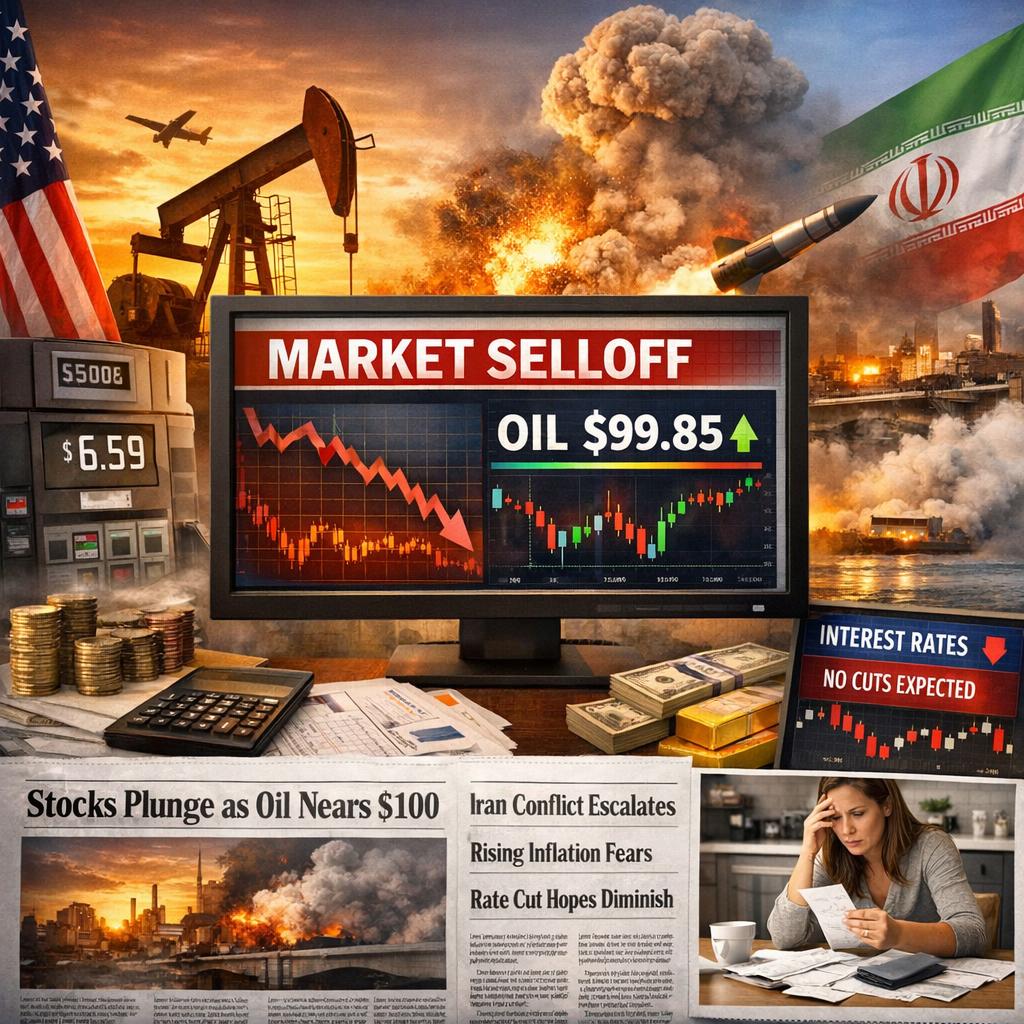
Oil Near $100 Again: The Quiet Portfolio Stress Test Hiding in Plain Sight
Markets have a funny way of reminding us what actually sits underneath every earnings report, every AI headline, every “soft landing” narrative: energy and geopolitics. The latest bout of escalation around Iran, paired with crude pushing toward $100, is one of those moments where the price chart is doing more than reacting to news—it’s forcing investors to re-run their assumptions about inflation, rates, and risk.
This isn’t just an “oil story.” It’s a cross-asset story.
Why $100 Oil Matters More Than the Headline
When oil climbs this fast, investors immediately start pricing in second-order effects:
1) Inflation expectations get sticky
Even if core inflation is behaving, higher energy costs bleed into transportation, manufacturing, and eventually consumer prices. That matters because central banks don’t need inflation to surge again to stay cautious—they just need it to stop improving.
2) Rate cuts can get delayed without anyone “changing their mind”
The market’s rate path is often a confidence game. Oil spikes are one of the easiest ways to turn a smooth forecast into a “wait and see” stance. If policymakers think energy could re-ignite broader price pressures, they’ll hesitate. If they hesitate, valuations that depend on easier financial conditions start to look more fragile.
3) Consumer resilience gets tested in the real world
A lot of recent optimism globally has rested on the idea that households are still spending and employment is holding up. But higher fuel and energy bills are a direct tax on consumers. It’s not theoretical. It hits quickly and unevenly—and it tends to show up first in sentiment and discretionary spending.
Stocks Falling Isn’t the Point—Correlation Shifts Are
One of the most important things investors can watch during these moments is not whether equities dip on the day. It’s whether relationships between assets start to change.
When oil jumps and stocks slide at the same time, it’s usually because the market is treating the shock as growth-negative and inflation-positive. That’s an uncomfortable mix. It can pressure bonds, too, if investors worry inflation stays elevated—even as equities are already wobbling.
This is where diversification either proves itself or disappoints. If the classic “stocks down, bonds up” cushion doesn’t show up, portfolios feel the stress faster than many people expect.
Who Wins, Who Feels It, and Why That Matters Internationally
Energy shocks don’t hit everyone the same way, and this is where global investors need to zoom out.
Energy exporters vs. importers
Countries that export oil and gas can see improved fiscal outlooks and stronger currencies. Energy-importing countries often face the opposite: worsening trade balances, currency pressure, and tougher inflation trade-offs. That currency piece matters a lot because it changes the return profile for international investors even if the local market index is flat.
Sector-level winners and losers
– Potential beneficiaries: integrated energy firms, certain defense and security-linked names, and parts of commodities.
– Potential losers: airlines, logistics-heavy businesses, consumer discretionary, and any industry with thin margins and limited pricing power.
The key isn’t to treat these as permanent rotations. It’s to recognize that when oil is the driver, fundamentals can get repriced quickly—especially for companies that were already relying on “everything going right.”
The Bigger Risk: Narrative Drift in a Market Built on Confidence
In calm markets, investors can hold multiple optimistic beliefs at once: inflation is falling, rates will come down, growth will remain decent, and earnings will keep rising.
An oil spike challenges that bundle. It forces the market to choose which belief is most fragile:
– If inflation stops improving, rates stay restrictive.
– If rates stay restrictive, growth cools faster.
– If growth cools, earnings expectations need adjusting.
You don’t need a recession for repricing to happen—you just need the probability weights to shift.
How I’m Thinking About Positioning (Without Getting Cute)
This kind of environment usually rewards discipline over prediction.
– Respect energy as a portfolio input, not a headline. If you’re globally diversified, check how much of your risk is effectively a hidden bet on stable energy prices.
– Focus on balance sheet strength and pricing power. Companies that can pass costs through, or that have structural demand, tend to hold up better when macro gets noisy.
– Watch inflation expectations and credit spreads. Equity volatility grabs attention, but credit conditions often tell the cleaner story about whether stress is contained or spreading.
– Be careful with crowded “perfect scenario” trades. When the market is priced for smooth outcomes, shocks create sharper moves.
None of this is about panic. It’s about recognizing that oil near $100 is not just a commodity print—it’s a test of the market’s confidence in the path ahead.
If you’re watching this closely too, comment with what you’re tracking most right now: inflation expectations, central bank pricing, energy equities, or something else entirely.