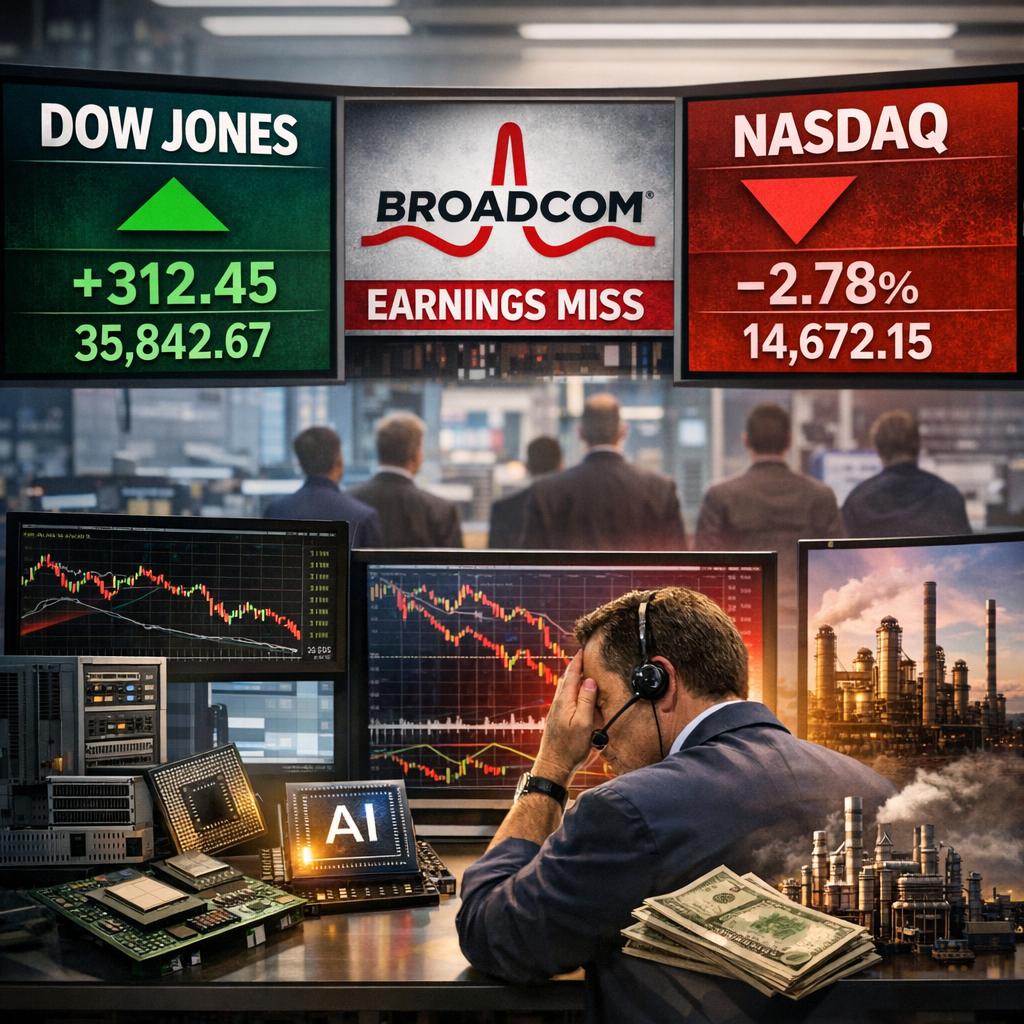
Broadcom’s Earnings Miss Is a Reminder: The AI Trade Still Runs on Expectations, Not Just Revenue
Markets delivered a classic split-screen session this week: the Dow looked healthy, while the Nasdaq took a hit after Broadcom’s earnings disappointed. On the surface, it’s “just one company.” In reality, moments like this expose something bigger about the current market regime: in growth-heavy indices, narrative and forward guidance can matter as much as the numbers investors can see today.
Why Broadcom moved the whole mood
Broadcom sits in the critical plumbing of modern tech: semis, networking, infrastructure software, and the kind of enterprise exposure that often gets treated as a proxy for broad-based AI demand. When a name with that positioning fails to meet expectations, it doesn’t simply reset one stock. It forces investors to reprice the confidence that’s been embedded across the wider AI and mega-cap complex.
That’s why you often see a “Dow up, Nasdaq down” day in these situations. The Dow’s composition leans more toward industrials, defensives, and value-tilted earnings streams. The Nasdaq is where duration lives. And “duration,” in equity terms, is basically shorthand for “how much of this stock’s value depends on profits far into the future.”
When expectations wobble, duration gets punished first.
The real issue: guidance sensitivity and valuation gravity
In a market where AI is both a productivity story and a capex arms race, investors are hypersensitive to any hint that the adoption curve might be less explosive than priced in, or that margins might be constrained by competition, customer concentration, or simply the cost of keeping up.
Even if the long-term thesis remains intact, a single earnings season can change the near-term path:
1) Multiple compression risk
If investors decide the “right” valuation multiple is lower, stocks can fall even if earnings are fine.
2) Spillover into adjacent names
Suppliers, partners, peers, and any company “AI-adjacent” can trade down in sympathy because portfolios are often built as baskets, not isolated picks.
3) Rotation, not panic
This isn’t always a market meltdown. Often it’s a rotation: money shifts from high-multiple growth into cashflow-heavy, dividend-paying, or economically resilient names.
What this means for global investors (not just US traders)
Even if you’re investing outside the US, Nasdaq-led swings travel fast:
Currency and flows: A tech-led risk-off move can strengthen the dollar in the short run, tighten financial conditions globally, and pressure emerging market assets.
Index effects: Global funds often benchmark to US tech heavyweights. When they rebalance, it affects allocations across regions—sometimes regardless of local fundamentals.
Sentiment contagion: The AI trade has become a global positioning story. When confidence dips in one bellwether, it influences how investors price growth everywhere—from European software to Asian hardware supply chains.
A practical takeaway: diversify your “growth” exposure
One lesson I keep coming back to is that “AI exposure” isn’t a single theme—it’s a stack. Chips, networking, data centers, software, cybersecurity, cloud, enterprise services. These layers don’t move in perfect lockstep, and their earnings drivers can diverge quickly.
If your portfolio’s growth sleeve is essentially one crowded lane (a handful of mega-cap tech names or a single sector ETF), days like this are your stress test. Not because the story is over, but because the market is reminding everyone that pricing matters, and guidance is fragile.
If you’ve been watching this rotation play out, comment with what you think the next leadership shift looks like: back to mega-cap growth, or a broader market baton pass into industrials, financials, and defensives?