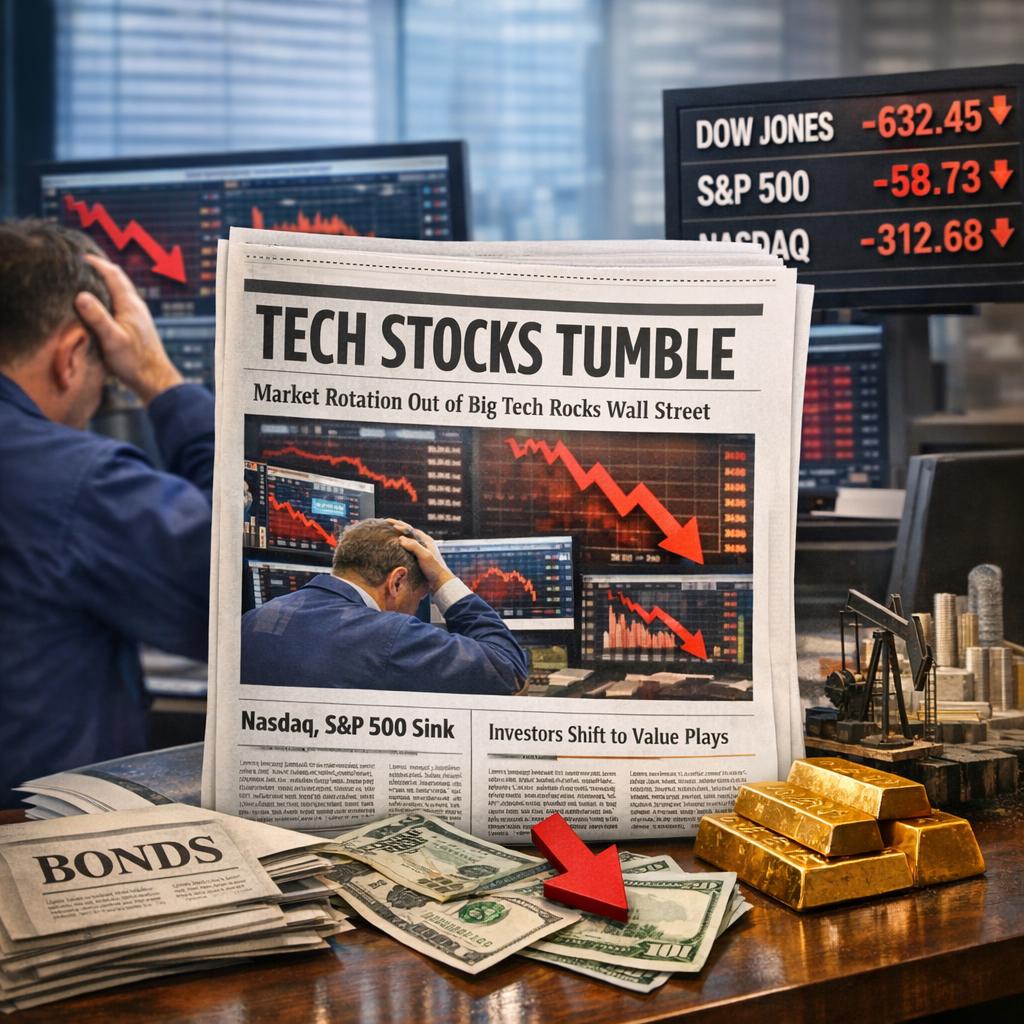
The Rotation Back Out of Tech Isn’t Just a “Trade” — It’s a Reminder About What Actually Moves Markets
One of the more important market stories right now is the renewed rotation out of big tech, pulling the major US indices lower as money shifts away from the same crowded winners that have carried so much of the recent rally. On the surface, days like this look like noise: a red session, a few sharp moves, commentators blaming “profit-taking,” and everyone waiting for the next catalyst.
But the deeper signal for global investors is this: leadership is becoming less stable, and that changes how you should think about risk, diversification, and what “safe” even means in an equity-heavy world.
Why this rotation matters more than the headline
For a while, tech (and especially AI-linked mega caps) has played two roles at once:
1) Growth engine: the part of the market people believe can compound regardless of the macro.
2) Defensive hiding place: the “quality” trade when investors don’t like the look of cyclicals, small caps, or consumer-sensitive names.
When those same stocks start to wobble together, it does two things:
– It exposes how concentrated performance has been.
– It forces investors to re-price the idea that the biggest names are automatically the least risky.
This isn’t a moral judgement on tech. It’s just portfolio math. When everyone owns the same thing, correlations rise at the exact moment you want them to fall.
What typically drives these shifts
Rotations don’t happen in a vacuum. Even when there’s no single dramatic headline, the usual drivers sit in the background:
Valuation gravity
When a segment gets priced for perfection, it becomes fragile. You don’t need bad news — you just need “not good enough.” A slight change in guidance, a modest move in bond yields, or a soft patch in demand can trigger a reassessment.
Rates and real yields
Growth stocks are long-duration assets: a larger share of their value sits in future cash flows. If real yields edge higher, the discount rate rises and those future cash flows are worth less today. Even small moves can have outsized effects when positioning is crowded.
Earnings dispersion and narrowing tolerance
As the cycle matures, investors become less forgiving. “Beat and raise” gets rewarded; “beat but cautious” can still get punished. That creates a market where guidance and tone matter as much as numbers — and where leadership can change quickly.
Rebalancing and risk control
Large allocators don’t just chase stories; they target risk levels. When volatility rises or concentration gets uncomfortable, systematic selling and rebalancing can amplify moves.
The global impact: why investors outside the US should care
Even if you don’t own US mega-cap tech directly, a rotation in US leadership can ripple across portfolios worldwide:
Index linkage and passive flows
Global funds benchmarked to US-heavy indices feel the drawdown immediately. If the biggest weights fall, the “market” falls, and risk budgets tighten elsewhere too.
FX and capital flows
A tech-led selloff can strengthen or weaken the dollar depending on whether the move is “risk-off” or “rates up.” That matters for emerging markets, commodities, and any company with USD funding or USD revenue exposure.
Second-order effects on global tech and suppliers
From semiconductors to cloud infrastructure to ad-tech, global supply chains are tied to US demand and sentiment. A pullback in the leaders can compress multiples across the ecosystem, even for firms that are executing well.
Narrative shift = multiple shift
Markets often move faster on narrative than fundamentals. If “AI is the only growth that matters” quietly becomes “growth is fine, but price matters again,” that’s a multiple-compression environment. And multiple compression is a global language.
How I’m thinking about it as an investor
I’m not treating this rotation as a sign that tech is “over.” I’m treating it as a reminder to separate three things that often get blended together:
1) Great businesses
2) Great stocks
3) Great entry prices
You can have a great business that becomes a mediocre stock for a period if it’s priced too optimistically. And you can have neglected sectors that start working simply because expectations are low and cash flows are real.
Practically, this kind of tape tends to reward:
– Balance, not bravado: less reliance on one theme.
– Quality across sectors: not just “quality equals big tech.”
– Liquidity awareness: crowded trades unwind faster than people expect.
– A plan for volatility: position sizing matters more than predictions.
If you’re watching this rotation closely, I’d be interested to hear how you’re positioning: are you adding to tech on weakness, rotating into value/cyclicals, or keeping exposure but reducing concentration? Comment with how you’re thinking about leadership risk right now.