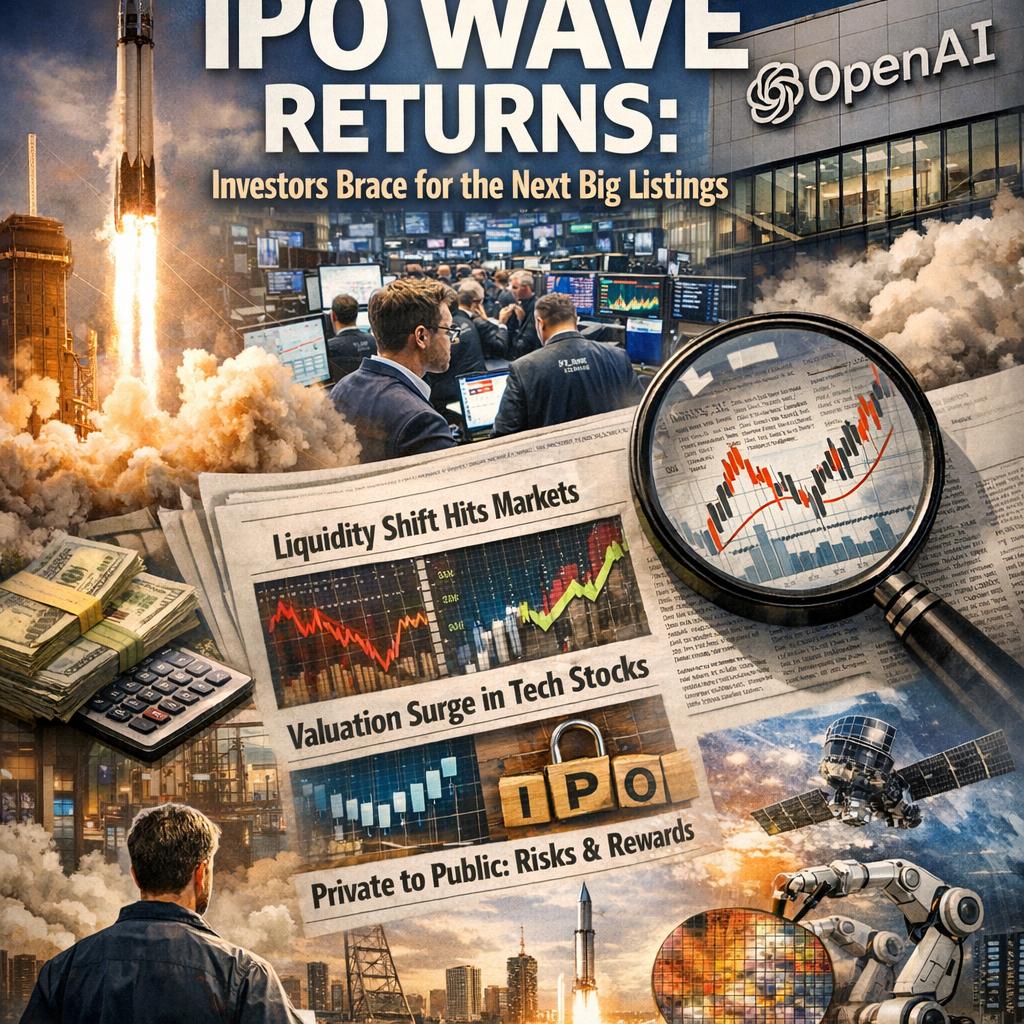
The “IPO Wave” Narrative Is Back — and It’s About More Than Excitement
There’s a familiar kind of mood creeping back into markets: the sense that the next big opportunity is about to list, and that investors need to position themselves early or risk missing the move. When names as culturally dominant as SpaceX and OpenAI get discussed in the same breath as a potential IPO wave, it does something powerful to sentiment. It pulls attention, it pulls capital, and it quietly resets what people think “growth” should look like.
But the most important thing for global investors isn’t the hype. It’s the second-order effects.
Because even before a single share is publicly traded, a high-profile IPO cycle changes behaviour across the market in ways that can either help your portfolio — or blindside it.
1) IPO waves tighten liquidity in unexpected places
A blockbuster listing doesn’t just create a new stock. It creates a funding gravity well.
If institutions and wealth managers believe a “must-own” IPO is coming, they start preparing. That preparation often looks like raising cash, trimming positions that have done well, and reducing exposure to less liquid parts of the market. It can be subtle, but the impact is real: you’ll sometimes see perfectly healthy companies drift lower simply because capital is being reallocated toward “the next thing.”
For everyday investors, this matters because it can distort signals. A drawdown in a mid-cap name might not be about fundamentals at all. It might be about positioning.
2) The valuation playbook gets rewritten — and then copied badly
The minute investors start anchoring to the idea of an OpenAI or SpaceX-level listing, valuation conversations shift from “what is this business worth today?” to “what could this be worth if the market gives it a premium multiple?”
That’s not automatically irrational. Some companies do deserve premium multiples. The problem is what happens next: the premium logic spreads. It bleeds into companies adjacent to the theme (AI software, semiconductors, cloud infrastructure, data centers, robotics), and then into companies that are simply good at using the right words on earnings calls.
This is where discipline becomes a competitive advantage.
If you’re investing globally, you’ll see the “premium multiple contagion” jump borders fast. US narrative often sets the tone, but the repricing shows up in UK and European tech, in Asian supply chains, and in emerging market firms positioned as beneficiaries. Capital chases the story in multiple currencies at once.
3) Private-market winners don’t automatically make public-market winners
One of the most underappreciated truths in investing is that the private-market version of a company and the public-market version can be two different animals.
Private investors are buying into long time horizons, controlled information flows, structured rounds, and negotiated terms. Public investors are buying into quarterly scrutiny, daily price discovery, and a market that can turn impatient very quickly.
So when people say “I can’t wait to buy this at IPO,” what they often mean is “I can’t wait to buy the story at the moment it becomes easiest to access.” That moment can be the most emotionally expensive time to buy.
If a major IPO does come, the key question won’t be “is this a great company?” It’ll be “is this a great price, in this market regime, given what’s already priced into expectations?”
4) The real opportunity may be in the ecosystem, not the headline
When investors focus on one or two potential mega-listings, it’s easy to miss the quieter positioning happening around them.
If the market believes an AI and space-related IPO wave is coming, the picks-and-shovels trade often resurfaces: compute, power, networking, data infrastructure, advanced manufacturing, and the suppliers that can scale. In many cases, those businesses have clearer revenue visibility and more measurable unit economics than the “icon” company everyone is waiting for.
That doesn’t mean the ecosystem names are “safe.” It means they can be analysed with a different toolkit: margins, capex cycles, backlog quality, customer concentration, and pricing power.
5) What investors should do now (before any listing)
Not to front-run hype — but to reduce the odds of making an emotional decision later.
Here are the practical steps I think matter most:
A) Decide your rule for buying new listings in advance
Will you buy at IPO pricing, wait for the first earnings report, or only buy after a 20–30% pullback? Whatever your approach is, write it down now while you’re calm.
B) Stress-test your exposure to one narrative
If you already own AI-heavy positions, the “IPO wave” may increase correlation risk. In plain terms: if the theme sells off, everything you own could move together. Diversification isn’t about number of holdings; it’s about different drivers.
C) Watch the liquidity tells
Rising enthusiasm for big offerings can coincide with softness in speculative corners, higher volatility in unprofitable growth, and stronger demand for cash-flow certainty elsewhere. Those rotations are often more important than the headlines.
D) Keep your time horizon honest
If your horizon is 3–5 years, you can tolerate post-IPO volatility. If your horizon is 3–5 months, you’re trading sentiment, not investing in a business. Both are valid, but they require different sizing and risk management.
The bigger takeaway
A potential SpaceX–OpenAI IPO wave isn’t just “two exciting names.” It’s a sentiment regime change, and those shifts ripple globally. They affect liquidity, valuations, sector leadership, and the stories investors tell themselves about what’s worth owning.
If you’re positioning for what comes next, the edge won’t come from being the first person to feel excited. It’ll come from having a process that still works when excitement peaks.
If you’re watching this space too, feel free to comment with what you think matters most in a major IPO cycle: valuation, timing, or the ecosystem opportunities around it.