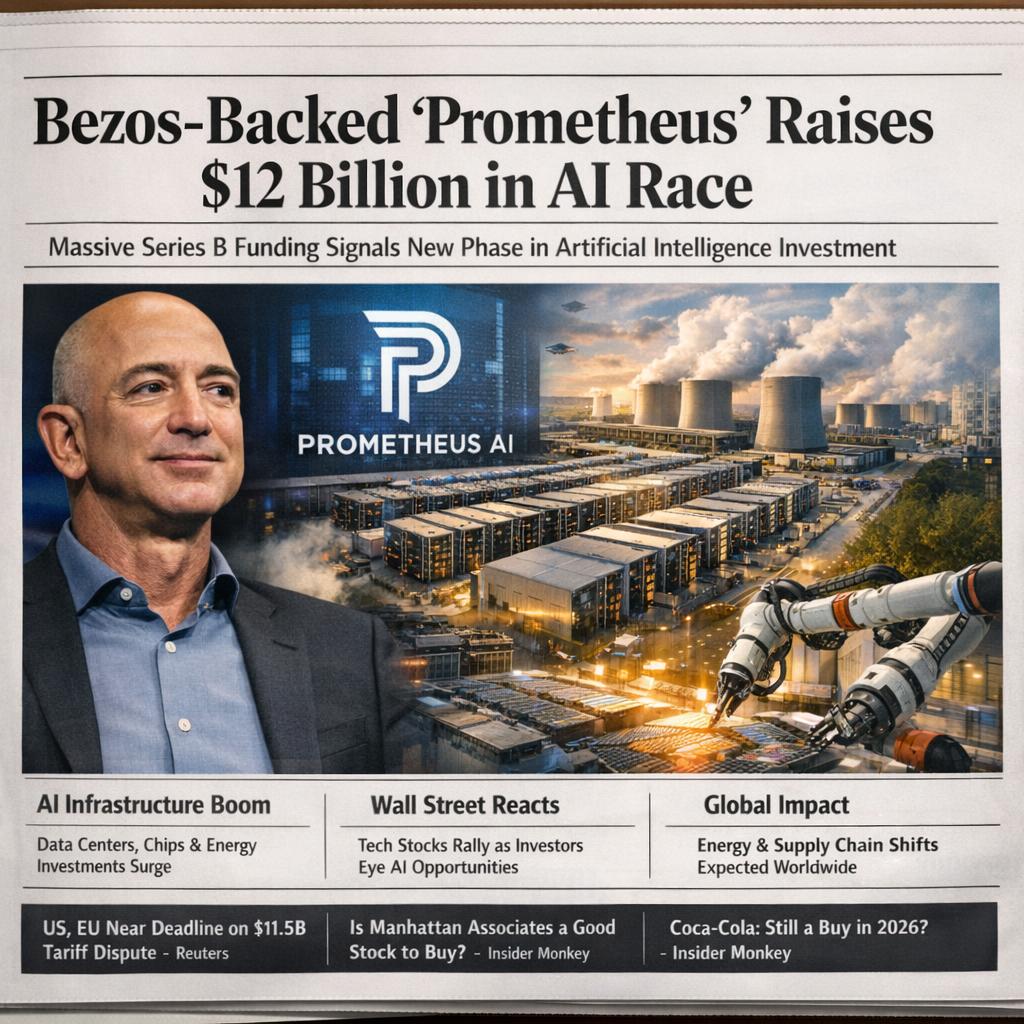
Jeff Bezos-Backed “Prometheus” Raising $12 Billion: What It Signals for Global Investors in the AI Cycle
One of the most market-moving stories today isn’t a rate decision or an earnings beat—it’s private capital. Reports that Jeff Bezos-backed Prometheus, an AI startup, has raised a massive $12 billion Series B is a reminder that the center of gravity in technology funding has shifted again, and it matters for public-market investors everywhere.
This isn’t just a headline about a single company. It’s a signal about how investors are underwriting the next phase of AI: bigger infrastructure needs, longer time horizons, and a widening gap between the “AI story” and the “AI cash flow.”
1) The AI buildout is getting more capital-intensive
When a company can raise $12 billion at Series B, it tells you something fundamental: the bottleneck isn’t only talent or ideas—it’s compute, data pipelines, energy, and distribution. The AI arms race increasingly looks like industrial-scale spending.
For public-market investors, this reinforces a few second-order realities:
– The near-term winners can be the “picks and shovels” beneficiaries: semiconductors, networking, data-center components, cloud capacity, and power/thermal management.
– The competitive moat is increasingly about access to infrastructure and unit economics at scale, not just model quality.
– Many AI applications may take longer to mature into predictable earnings than the market narrative implies—because the cost base is simply heavier.
2) Late-stage private rounds are a quiet competitor to public markets
Mega-rounds like this can delay IPO timelines and reduce the urgency for companies to list. That changes the opportunity set for everyday investors: some of the most valuable growth may stay in private hands for longer, while public investors get exposure later, often at a stage where growth is steadier but the upside is less explosive.
This dynamic can influence market structure in subtle ways:
– Public tech valuations can be supported when “pure-play” AI scarcity increases.
– Public companies may lean harder into acquisitions to buy capabilities that are scaling privately.
– Retail and institutional portfolios may concentrate more into a smaller number of listed AI bellwethers, increasing crowding risk.
3) It raises the bar for everyone else in the AI ecosystem
A $12 billion Series B doesn’t just fund one balance sheet—it resets expectations. Competitors may feel pressure to match spending, expand partnerships, or vertically integrate. That can compress margins across parts of the sector as companies race to secure compute and distribution.
For investors, the key is to distinguish between:
– Companies with genuine operating leverage (where AI improves margins over time), and
– Companies with permanent “AI rent” (where ongoing model/infrastructure costs eat the value created).
In other words: not every business becomes more profitable just because it adopts AI. Some become more dependent on a cost stack they don’t control.
4) Global impact: AI capex spills into energy, supply chains, and policy
AI’s capex wave doesn’t respect borders. Data centers need chips, servers, cooling, real estate, and above all reliable power—often driving demand for grid upgrades and long-term energy contracts. That can ripple across markets globally, influencing everything from industrials to utilities to commodities.
It also increases the chance of policy attention: energy usage, competition concerns, and national strategic interests in AI capacity. Policy risk isn’t just about regulation of models—it’s also about the infrastructure that makes them viable.
What I’m watching from here
This kind of fundraising is a strong “temperature check” on risk appetite—but it’s also a clue about where the next constraints will emerge: power, chips, and distribution. For public-market investors, the playbook isn’t automatically “buy anything with AI in the press release.” It’s tighter than that: focus on who captures the economics after infrastructure costs, and who gets squeezed by them.
If you’re positioning for the next 12–24 months, I’d be interested to hear in the comments: do you think mega-rounds like this make public AI leaders stronger (via ecosystem gravity), or more vulnerable (via new, well-funded competition)?