Intercontinental Exchange’s Quiet Push Into Predictive Markets — and Why Global Investors Should Pay Attention
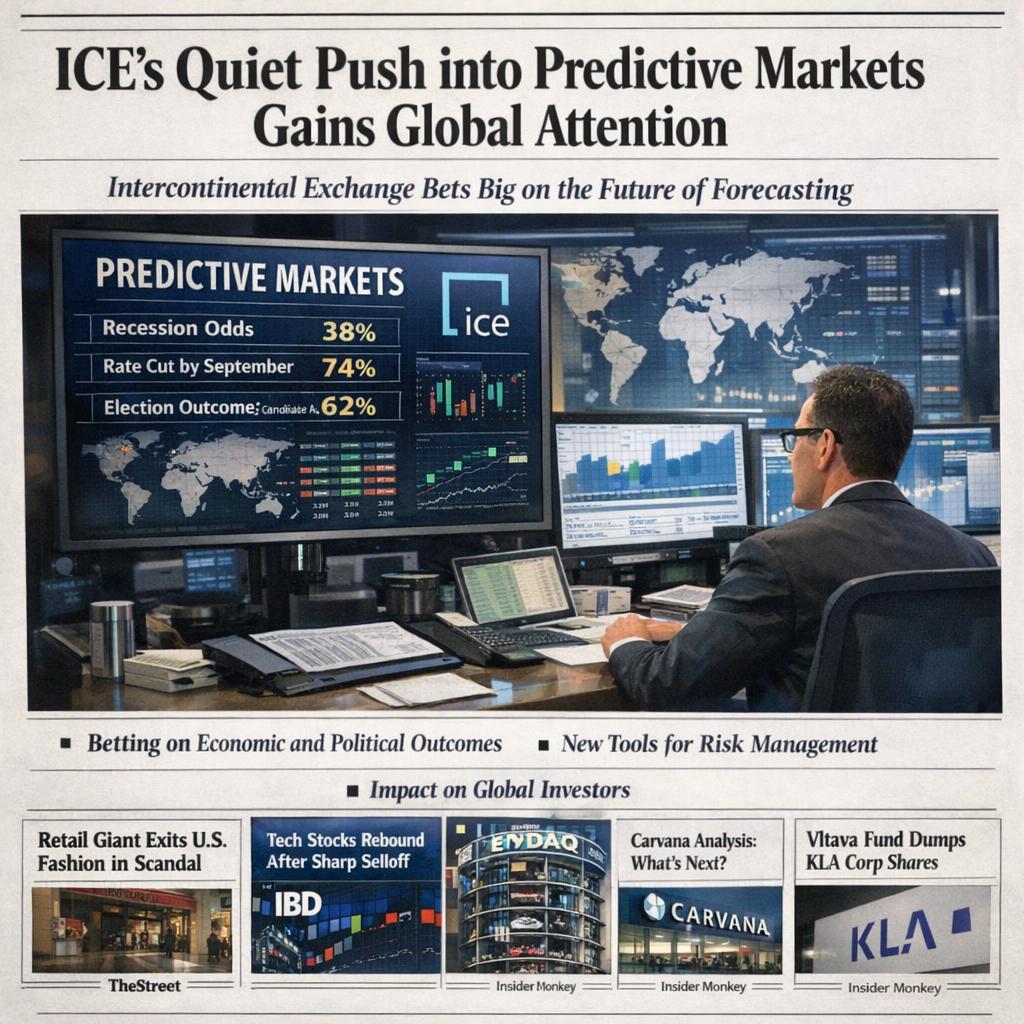
One of the more underrated shifts happening in markets right now isn’t about a single stock ripping higher, or a surprise inflation print. It’s about infrastructure. Specifically: Intercontinental Exchange (ICE) making a strategic move into predictive markets.
On the surface, that can sound like a niche corner of finance. In reality, it sits right at the intersection of trading, information, and risk — which is why it matters far beyond the U.S., and far beyond “event contracts” as a product category.
Predictive markets are really about pricing uncertainty
A simple way to think about predictive markets is that they turn real-world outcomes into tradeable prices.
Those outcomes could be macro (recession/no recession), political (election outcomes), policy (rate cuts by a certain meeting), or even sector-specific (regulatory approvals, deadlines, milestones). When a market forms around an outcome, you get something extremely useful: a live, continuously updated probability implied by buying and selling pressure.
That probability is not “truth,” and it can be wrong. But it becomes a signal. And markets run on signals.
Why ICE entering this space is a big deal
ICE isn’t a loud, hype-driven player. It’s a behind-the-scenes pillar of global finance: exchanges, clearing, data, and the plumbing that allows markets to function with trust.
So when an entity like ICE leans into predictive markets, it does two things at once:
1) It legitimises the category for institutional money.
A lot of big capital won’t touch products that feel unregulated, fragmented, or operationally messy. ICE’s presence brings a different standard: governance, compliance frameworks, clearing discipline, and distribution. That’s how “interesting” becomes “investable.”
2) It pulls predictive pricing closer to the core of risk management.
If these markets become more standardised, their outputs won’t just sit on the sidelines as a curiosity. They’ll increasingly show up in dashboards next to FX, rates, credit spreads, and volatility measures — because they’re another lens on uncertainty.
For global investors, that’s the key: more usable, real-time measures of probability.
The global angle: information travels faster than portfolios
Even if you never trade a predictive contract, the signal can still impact your book.
If predictive markets begin to influence how traders price policy risk, that can flow through to:
– Currency positioning (especially for countries sensitive to U.S. policy and rate paths)
– Sovereign yields and term premium (as policy probabilities shift)
– Equity sector rotations (defensives vs cyclicals, financials vs growth, energy vs consumer)
– Volatility pricing (when “tail risks” become more measurable and more tradeable)
In other words: once a probability is visible and tradeable, it tends to leak into everything else.
And if ICE helps deepen liquidity and improve market structure, those signals may become harder for global investors to ignore — particularly in moments where headlines are noisy but positioning needs to be precise.
There’s also a second-order effect: hedging gets more granular
Most investors hedge with blunt instruments:
– broad index options
– duration exposure
– gold / USD proxies
– sector tilts
– volatility products
Predictive markets introduce the possibility of outcome-specific hedging.
Instead of “I’m worried about risk-off,” it becomes “I want to hedge the probability of a specific decision/event.” Done well, that can reduce hedging costs and improve precision. Done poorly, it can encourage overtrading narratives.
That trade-off is exactly why the entry of a mature market operator matters: product design and guardrails will shape whether predictive markets become useful tools or just another arena for impulse speculation.
What I’ll be watching next
Three things matter if predictive markets are going to become a serious part of the global investing toolkit:
Liquidity: Without depth, prices are noisy and manipulable.
Market structure: Clear rules on settlement, disputes, and data integrity.
Regulatory clarity: Not just to “allow” markets, but to define what belongs where (and who it’s for).
If ICE can help push those forward, predictive markets may evolve from a novelty into something that genuinely improves price discovery — the core function that all markets are supposed to serve.
If you’re tracking this space too, comment with your view: do predictive markets become a mainstream risk signal over the next few years, or do they stay on the fringe despite big-name infrastructure getting involved?