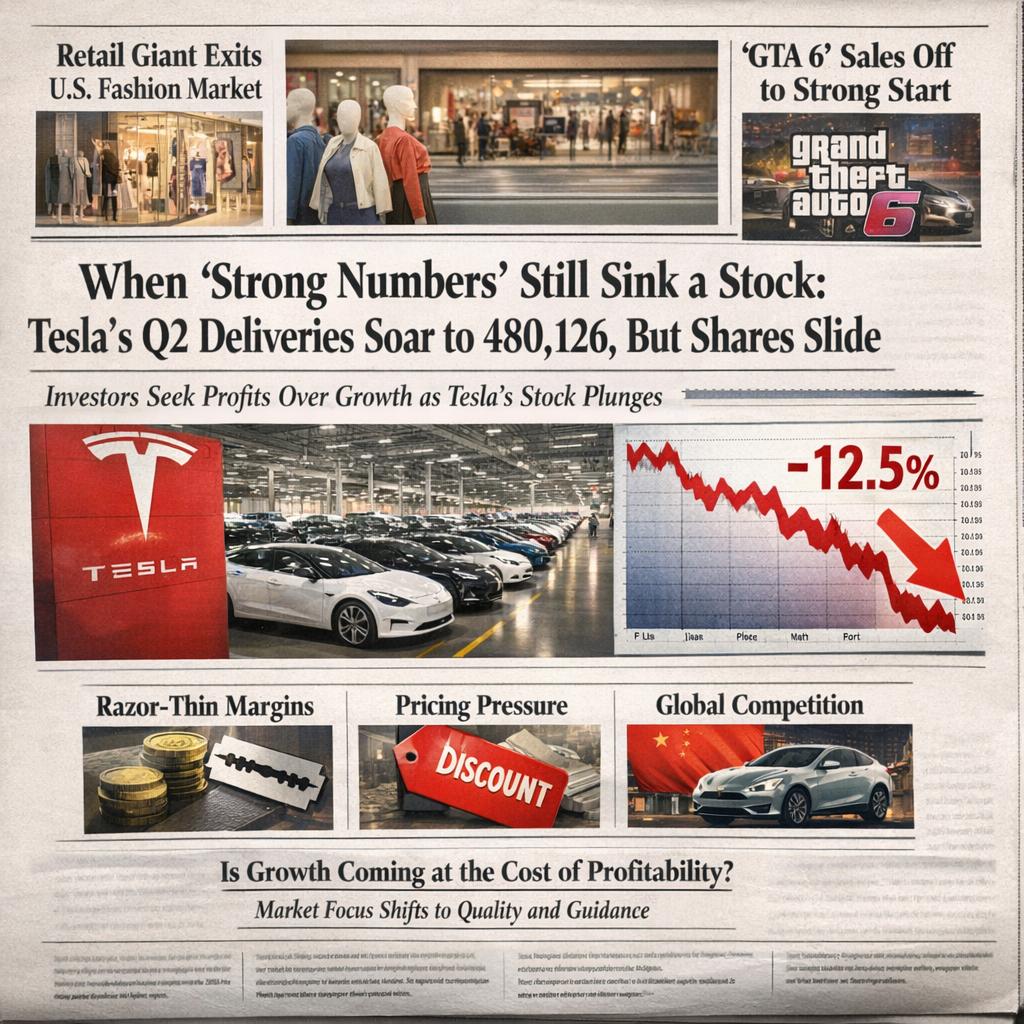
When “Strong Numbers” Still Sink a Stock: Tesla’s Q2 Deliveries and the New Bar for Market Confidence
One of the most useful reminders in markets this week came from Tesla. Deliveries jumped to 480,126 in Q2—an attention-grabbing operational result by any traditional yardstick. Yet the stock still slid.
That gap between performance and price is worth sitting with, because it captures a broader shift investors across the world are dealing with right now: the market isn’t simply rewarding growth. It’s rewarding the “right kind” of growth, delivered with the “right kind” of margins, guidance, and credibility.
The market isn’t trading the quarter. It’s trading the narrative.
For years, a clean headline number—deliveries up, revenue up, users up—could be enough to lift the whole complex around it. Increasingly, that’s not how this game is played. The bar has moved from “Are you growing?” to “Are you growing without sacrificing profitability, pricing power, and cash flow resilience?”
With Tesla, investors are rarely just valuing cars shipped. They’re valuing a bundle of expectations: product cycle momentum, pricing discipline, competitive pressure, regulatory credits, and the long-dated optionality around autonomy, energy, and software. If any one of those pillars looks shakier—even with a strong delivery print—the stock can fall.
This is a pattern we’re seeing well beyond EVs.
Globally, equity markets have become far more sensitive to second-order effects:
– Pricing: Is growth driven by demand strength, or by discounting and incentives?
– Margins: Are unit economics improving, or is the company “buying” volume?
– Mix: Are higher-end products holding up, or is the shift toward lower-margin segments accelerating?
– Forward guidance: Is management confident enough to raise, or careful enough to avoid overpromising?
– Competitive intensity: Are rivals forcing a race to the bottom, or is the category rational?
In other words, markets are asking not “What happened?” but “What does this imply?”
Why this matters for investors outside the U.S.
Tesla is a U.S.-listed stock, but the way it trades affects global portfolios because it sits at the intersection of multiple themes that are widely owned: growth, AI-adjacent optimism, electrification, China supply chains, and consumer demand. When a stock like Tesla drops on seemingly good news, it sends a message through global risk appetite—especially for high-multiple names.
For international investors, there are a few practical implications:
1) Expect more headline whiplash in “story stocks”
Companies priced on long-range ambition will continue to react violently to short-term signals—because valuation is built on confidence. If confidence becomes fragile, even good data can be interpreted as “not good enough.”
2) Watch the difference between operational momentum and financial momentum
Deliveries, users, and bookings can rise while earnings quality deteriorates. The market is increasingly quick to penalize the gap.
3) The cost of capital is still the referee
Even when rate cuts are on the horizon, the market is behaving as if capital is no longer free. That pushes investors toward businesses that can fund growth internally, not just promise it.
4) Sector read-throughs matter more than ever
A Tesla sell-off doesn’t stay neatly contained. It influences sentiment across EV suppliers, industrial automation, semiconductors tied to autos, and even adjacent consumer discretionary names. In a global portfolio, correlation has a habit of showing up right when you least want it.
A simple way to frame it: “beats” are no longer enough
Investors have to separate three things:
– The data (deliveries)
– The interpretation (pricing power, demand health, competitive pressure)
– The positioning (what the market was already expecting)
If the market was positioned for an even bigger number, or for a stronger margin story, then a “beat” can still disappoint. And if the stock had already rallied into the print, you can get the classic “sell the news” response even with solid fundamentals.
What I’m watching next
Not the next delivery number in isolation, but the supporting signals: pricing trends, margin commentary, and management tone about demand elasticity. In this market, tone can matter almost as much as spreadsheets.
If you’re investing globally, this is also a useful moment to review whether your growth exposure is concentrated in names where expectations have become brittle. Some portfolios don’t look risky on the surface—but they’re effectively a collection of “high expectations” trades.
If you’ve been tracking Tesla (or the EV space more broadly), share how you’re thinking about this setup right now—are you treating these moves as noise, or as a signal that the market regime has changed?