Warren Buffett’s “Trouble Ahead” Warning Isn’t a Market-Timing Call — It’s a Valuation and Behavior Check
Every few years, Buffett-related headlines land with a particular kind of weight. Not because he’s infallible, and not because Berkshire is some magical compass that points perfectly to the next market turn, but because Buffett tends to speak in the language investors forget when markets feel easy: price, discipline, and the cost of being wrong.
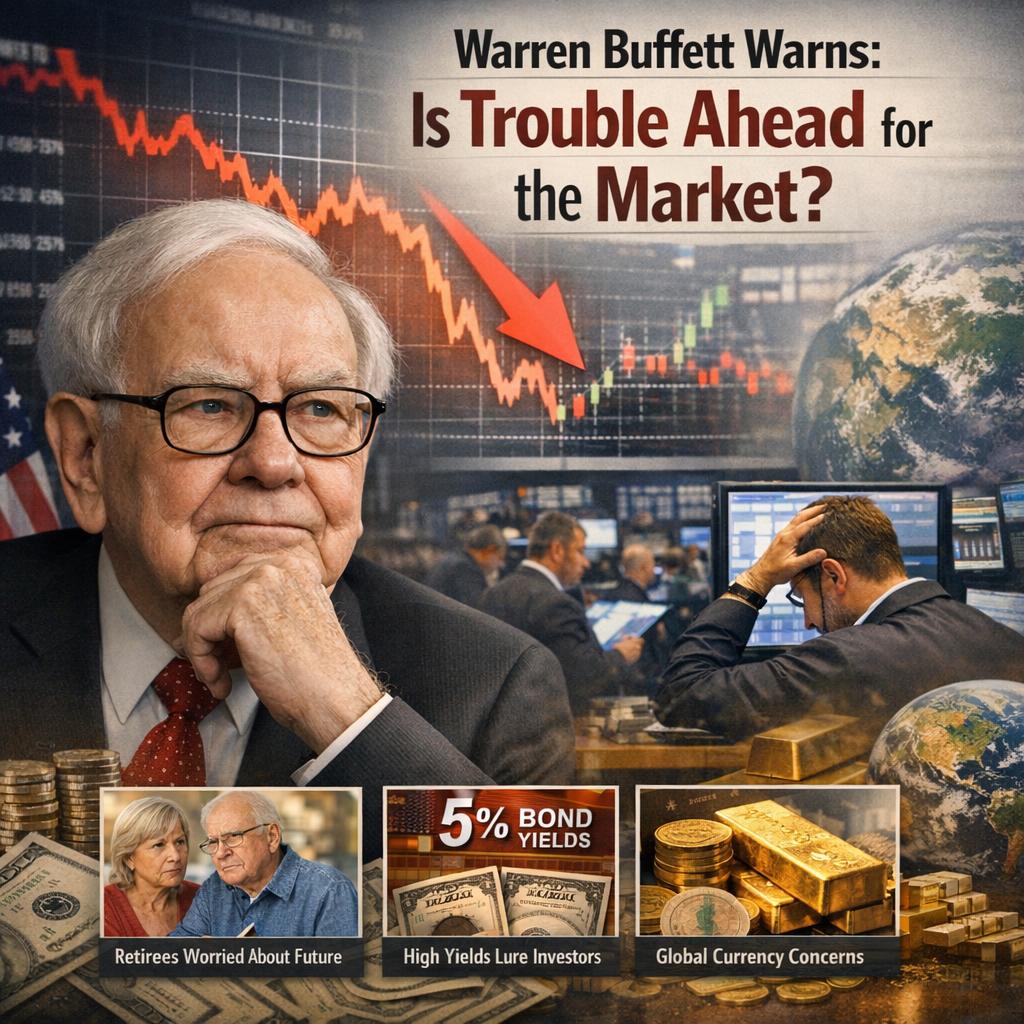
The story circulating now — that Buffett is warning the market may be headed for trouble — matters less as a predictive alarm and more as a framing device for what investors globally should be thinking about in this phase of the cycle.
Because “trouble” in markets rarely arrives as a single dramatic event. More often, it’s the slow accumulation of fragile assumptions: that earnings will always rescue valuations, that liquidity will always be there when you need it, that diversification means simply owning a lot of tickers, and that the crowd is usually right because the chart looks good.
What Buffett usually signals (directly or indirectly) is that the market’s pricing mechanism can drift far from business reality for longer than expected — and then snap back faster than most portfolios are built to handle.
1) The real risk isn’t volatility — it’s paying too much for certainty
One of the most persistent investor mistakes isn’t buying risky assets. It’s paying “safe” prices for them — the premium we hand over when we convince ourselves a company, a theme, or an index is unstoppable.
In late-cycle optimism, we see it everywhere:
– Valuation multiples expand while the narrative does the heavy lifting.
– “Quality” becomes a synonym for “anything that has worked.”
– Investors stop underwriting outcomes and start underwriting headlines.
Buffett’s core message across decades is simple: the price you pay determines the return you get. That’s not a motivational poster — it’s math. If the market’s future returns are being pulled forward by multiple expansion today, tomorrow’s returns have already been spent.
For global investors, this matters even more now because the largest public companies (particularly in the US) effectively act like global assets. When they get pricey, it’s not just an American portfolio problem. It shows up in international index funds, pension allocations, sovereign wealth exposure, and the risk budgets of institutions from Singapore to Stockholm.
2) Why this connects to the “silent” risk: concentration inside diversification
A lot of people think they’re diversified because they own an index, a basket of ETFs, or “a bit of everything.” But many portfolios are diversified by the number of holdings, not by the number of drivers.
In reality, modern equity markets often become concentrated under the surface:
– A handful of mega-caps can dominate index performance.
– Factor exposure (momentum, growth, quality) becomes the true bet.
– The same macro forces (rates, liquidity, risk appetite) drive everything at once.
When Buffett expresses caution, I interpret part of it as a warning about hidden concentration risk. Not just “this stock is expensive,” but “the market’s return is being carried by fewer shoulders.”
Globally, the implication is straightforward: if your local market is calm but your international allocation is effectively a bet on the same narrow leadership group, your portfolio can feel diversified right up until it suddenly isn’t.
3) The interest-rate backdrop changes what “reasonable” means
Investors who started in a near-zero-rate world internalized a different set of rules:
– Long-duration growth was rewarded.
– Cash had an obvious opportunity cost.
– Valuations could stay elevated because discount rates were low.
But when cash and high-quality bonds offer real yield, the competition for stocks becomes more serious. Equity returns don’t just need to look attractive versus the past — they need to look attractive versus what you can earn with far less risk today.
This is where Buffett’s voice is useful. Berkshire has always treated cash not as “dead money,” but as optionality — the ability to act when pricing becomes favorable. In a world where 5% yields exist in plain sight, optionality is no longer expensive. It’s rational.
That doesn’t mean “sell everything.” It means the bar for what you’re willing to pay should be higher, and the penalty for overpaying can be harsher because safer alternatives finally exist.
4) What “trouble” can look like (and why it hits global investors differently)
When people hear “market trouble,” they picture a crash. But the more common outcomes are:
– A grinding sideways market that quietly destroys real returns through inflation and time.
– A sharp rotation where yesterday’s leaders lag for years.
– A volatility regime shift that forces leveraged and illiquid strategies to unwind.
– A recession scare that widens credit spreads and punishes lower-quality balance sheets.
Different investors feel this differently:
– US investors face the direct impact of domestic equity repricing.
– International investors face the double effect: US equity drawdowns plus currency swings (which can either cushion or worsen outcomes depending on the direction).
– Emerging market investors often experience “risk-off” as both capital flight and higher dollar funding stress.
So Buffett’s warning shouldn’t be heard as “American stocks might wobble.” It’s more like: when the world’s largest risk asset complex reprices, the shockwaves travel through currency markets, credit spreads, commodities, and cross-border capital flows.
5) Practical takeaways without turning this into doomscrolling
The most useful thing an investor can do with a Buffett-style warning is not panic. It’s to stress-test assumptions.
A few portfolio behaviors that tend to age well in late-cycle pricing environments:
– Tighten your definition of “margin of safety.” If you can’t explain what has to go right for the investment to work, you’re probably renting a story.
– Rebalance intentionally. If winners have swollen beyond your risk tolerance, trimming isn’t betrayal; it’s risk management.
– Know your liquidity. If “trouble” arrives, the best opportunities go to people who can act. That means cash buffers, high-quality bonds, and not being over-allocated to anything you can’t exit cleanly.
– Separate “great company” from “great investment.” A wonderful business can still be a poor buy at the wrong price.
– Check concentration at the driver level. Ask what actually moves your portfolio: rates, tech leadership, credit conditions, the dollar, commodity cycles. If the answer is “one or two things,” diversify by drivers, not by labels.
Buffett’s edge has never been secret information. It’s temperament plus price discipline. And in periods where markets feel priced for perfection, that combination becomes unusually valuable.
If you’re positioning for the next few years, the point isn’t to predict a headline event. It’s to avoid building a portfolio that only works if the market stays kind.
If you’ve been adjusting your allocations lately — adding more cash, leaning into bonds, trimming crowded trades, or doing the opposite and staying fully risk-on — feel free to comment with how you’re thinking about it.