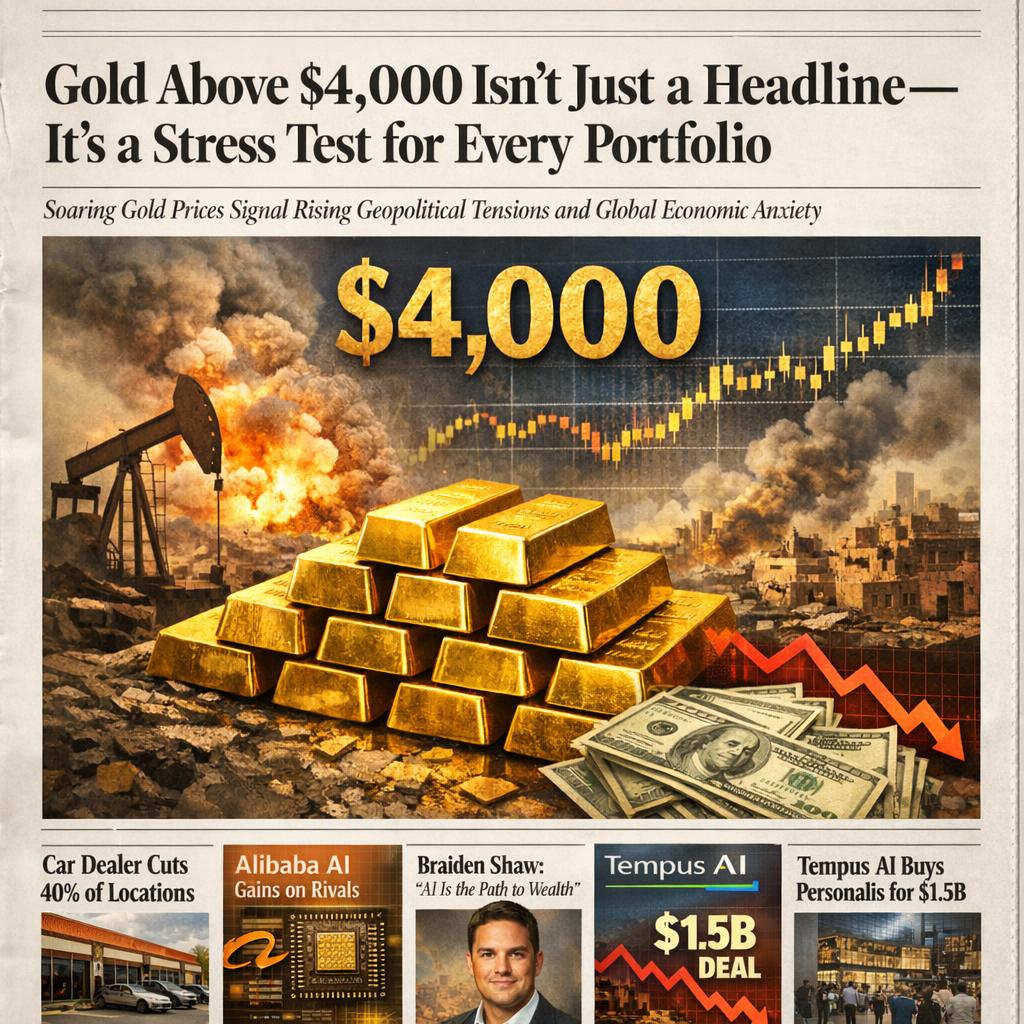
Gold Above $4,000 Isn’t Just a Headline — It’s a Stress Test for Every Portfolio
Gold holding above $4,000 while geopolitical risk stays elevated is one of those market stories that feels dramatic on the surface, but becomes even more important when you zoom out. It’s not simply “investors are scared, so they’re buying gold.” At this level, gold is sending a broader message about trust, liquidity, inflation psychology, and what global capital does when it can’t get comfortable with the forward path of growth and rates.
For investors globally, this matters whether you own gold or not, because it influences currency dynamics, real yields, equity leadership, and even the cost of capital in places far removed from the immediate source of the tension.
1) What gold above $4,000 is really pricing in
Gold is often described as an “inflation hedge” or a “safe haven,” but those labels can be too simplistic. When gold pushes to an extreme level and stays there, the market is usually pricing in a combination of forces:
A higher baseline of geopolitical risk
Not necessarily a prediction of a single catastrophic event, but a recognition that disruptions are no longer “tail risks.” Investors start assigning a permanent premium to uncertainty: energy supply routes, shipping security, regional instability, sanctions, cyber risks, all of it. The result is a world where the discount rate for riskier cash flows quietly rises, even if policy rates don’t move much.
A credibility question around real returns
Gold tends to do best when investors are less confident that “safe” assets will preserve purchasing power after inflation. That doesn’t always mean inflation is about to spike tomorrow. Sometimes it means the market thinks inflation will be stubborn enough (or policy constrained enough) that real returns won’t compensate for volatility elsewhere.
Demand for a politically neutral reserve asset
Central banks and large institutions do not think like retail investors. When gold becomes more attractive as a reserve asset, that’s a structural demand story, not a short-term trade. Even if you never buy a single ounce, that demand can change the way capital moves between currencies and regions.
2) The quiet knock-on effect: real yields and the “competition” for capital
The most practical way to think about gold is this: it’s an asset with no cash flow that competes with real yields.
When real yields are high and stable, gold has a harder time justifying a big run because investors can earn a strong inflation-adjusted return holding government bonds. When gold is strong despite decent nominal yields, it suggests one of two things:
Either real yields aren’t as attractive as they look (because inflation expectations are sticky, or because investors doubt the durability of disinflation), or
Investors are willing to pay for insurance, even if it has a carrying cost.
This is where the global impact comes in. If capital is allocating more aggressively to “insurance assets,” it can subtly reduce the marginal bid for risk assets. Not necessarily crash equities, but it can compress multiples, rotate leadership, and make markets more sensitive to earnings disappointments.
3) Currency implications: it’s not just a US story
Gold is priced globally, and a sustained rise interacts with currencies in ways investors often underestimate.
If the US dollar is strong at the same time gold is strong, it’s a signal that global demand for safety is extremely high. That combination can tighten financial conditions abroad. A strong dollar makes dollar-denominated debt more expensive to service, raises import costs for many countries, and can force tighter policy choices in places that would rather be stimulating growth.
If the dollar weakens while gold rises, that’s a different message: it suggests a broader diversification away from the dollar and/or a shift in global liquidity preferences. Either way, it matters for multinational earnings, commodity-importing economies, and anyone invested internationally.
So when you see gold holding a very high level, it’s worth thinking less about the metal itself and more about what it implies for the plumbing of the global system: collateral, reserves, and the direction of “risk-free” confidence.
4) What this does to equity leadership
A persistent bid in gold tends to nudge equity markets toward a different kind of leadership. Not always immediately, but the gravitational pull is there.
Companies with stable cash flows and pricing power tend to look more attractive when uncertainty is being repriced.
Highly levered balance sheets tend to look worse, because the market becomes less forgiving about refinancing risk and demand volatility.
Long-duration growth equities can still do well, but they need cleaner execution. When gold is screaming “insurance is expensive,” the market is less willing to pay for distant profits that might be revised down.
This doesn’t mean “sell growth, buy defensive” as a blanket rule. It means the bar rises for narrative-driven valuations. In an environment where a non-yielding asset is commanding a premium, investors are revealing a preference for certainty. That preference seeps into equity selection.
5) Portfolio implications (without turning this into a gold cheerleading post)
There are a few practical takeaways that don’t require anyone to become a gold bug:
First, treat this as a signal to revisit concentration risk
When macro uncertainty rises, correlations can change quickly. A portfolio that looks diversified by ticker can still be concentrated by factor exposure (duration, momentum, liquidity, cyclical sensitivity). Gold’s strength is a reminder to check what you actually own.
Second, watch the second-order beneficiaries and casualties
Gold miners and commodity producers are the obvious beneficiaries, but the second-order impacts can matter more: countries with strong commodity export baskets, currencies tied to resource flows, and sectors sensitive to inflation expectations. On the flip side, industries dependent on cheap energy, smooth logistics, or heavy leverage can face subtle pressure even if headline indices look fine.
Third, don’t ignore volatility as an “asset class”
When gold is elevated, it’s often because investors are paying up for protection. That can show up not just in the metal, but in option markets and credit spreads. If protection is expensive, it changes how you should think about position sizing and rebalancing. Sometimes the best move isn’t adding a hedge at any price; it’s reducing the exposure that needs hedging in the first place.
Fourth, be careful with simplistic narratives about inflation
Gold can rise with inflation fears, but it can also rise with growth fears, policy constraints, and reserve diversification. Investors who reduce it to one storyline tend to make one-way bets that don’t hold up when the regime shifts.
6) Why this matters even if geopolitics cools down
A lot of market participants assume that if tensions ease, gold will immediately revert lower and everything goes back to “normal.” Maybe. But the more interesting possibility is that markets have structurally repriced uncertainty.
If businesses and investors start treating disruptions as a persistent feature rather than an occasional shock, you can get lasting changes in:
Inventory strategies (more redundancy, higher costs, less efficiency)
Supply chain design (reshoring, friend-shoring, regionalization)
Defense and security spending (public budgets and corporate priorities)
Energy and commodity risk premiums
Those structural shifts can keep inflation more “lumpy,” keep rate cuts less aggressive than prior cycles, and keep investors more selective about where they take risk.
That’s why gold at this level is bigger than a trade. It’s a referendum on the stability of the environment that supports easy forecasting.
If you’re watching this story too, comment with how you’re interpreting gold above $4,000: is it mainly geopolitics, a currency signal, or a deeper confidence issue about real returns?