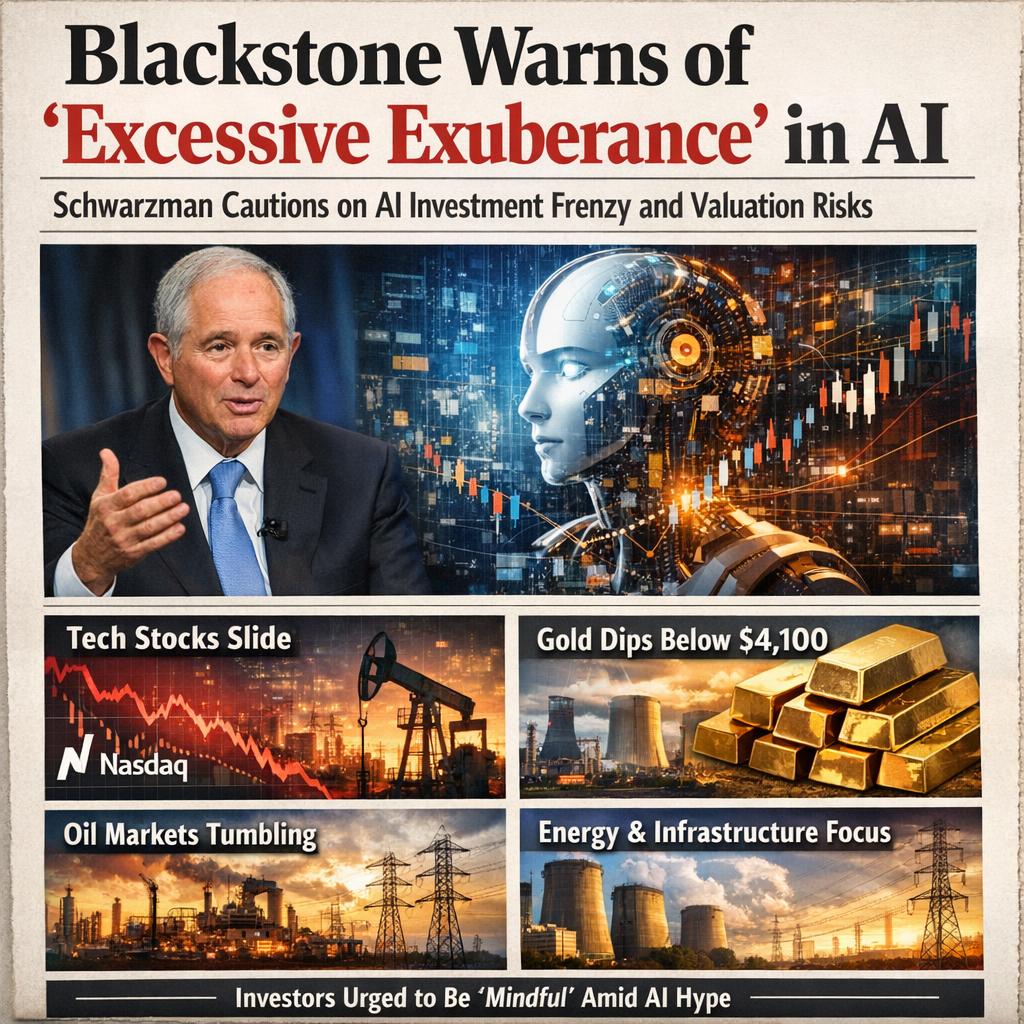
Blackstone’s “Excessive Exuberance” Warning on AI Isn’t a Tech Take — It’s a Capital Markets Signal
One of the more interesting market moments this week didn’t come from a central bank, a CPI print, or an earnings surprise. It came from a line that’s easy to gloss over if you’re only watching the Nasdaq tape: Blackstone CEO Stephen Schwarzman saying the firm is “mindful” of “excessive exuberance” in AI.
That phrasing matters, and not just because Blackstone is a household name in private markets. It matters because it captures, in a few words, the tension shaping global portfolios right now: AI is real, transformative, and investable — but the pricing of “AI exposure” is increasingly becoming its own trade, sometimes detached from cash flows, competitive moats, or even basic cycle awareness.
When the biggest pools of patient capital start choosing their words carefully, investors should pay attention. Not because it means “sell everything tech,” but because it hints that we’re moving from the early phase of an investment cycle (discovery and under-ownership) into the harder phase (crowding, valuation discipline, and differentiation).
The shift from “AI is coming” to “AI is crowded”
Most major market themes go through a familiar arc.
First, they’re dismissed. Then they’re accepted. Then they’re chased. Then they’re regulated, competed, and normalized.
AI has moved beyond the “dismissed” and “accepted” phases. In public markets, it’s already been chased — aggressively. In private markets, the chase has been even more intense because the narrative supports two things that investors love: a massive total addressable market and the possibility of winner-takes-most outcomes.
That combination pulls forward capital.
It pulls forward multiples.
And it pulls forward expectations.
When Schwarzman talks about exuberance, it’s less about a single sector and more about a market dynamic: the premium investors are paying for future certainty in a world that is anything but certain. AI is being treated, in some cases, like a macro hedge: a bet that growth will return, productivity will surge, and the next decade of winners will justify today’s prices.
That’s a powerful story. It’s also a story that can get ahead of itself.
Why this matters globally (even if you don’t own “AI stocks”)
AI is no longer a “US tech” story. It’s a capital allocation story that touches almost every region and asset class.
1) Equity indices become more top-heavy
When the market decides a theme is “the future,” it concentrates leadership in fewer names. That’s not theoretical; it changes the risk profile of passive investing. If a small cluster of companies drives index returns, the index becomes less diversified than it looks on paper.
For global investors, that concentration can show up in unexpected ways. A UK or European investor buying a broad global fund can end up with a much bigger implicit bet on US mega-cap tech than they realize. A pullback in that leadership group then ripples through “diversified” portfolios worldwide.
2) Venture and private markets can misprice duration risk
Private markets live and die on the cost of capital. When rates are higher for longer, long-duration growth assets feel heavier — unless they can grow into their valuations quickly.
AI has been one of the few areas where investors have been willing to suspend the usual discomfort around duration because the upside narrative is so compelling. But that doesn’t repeal math. If you’re paying for five to ten years of growth upfront, you are sensitive to two things: funding conditions and execution risk.
When a firm like Blackstone signals caution, it can mean the easiest money has already been made in the “label trade” (anything with AI in the pitch) and the next phase will reward operational proof rather than story equity.
3) Commodities, power, and infrastructure become the “second-order AI trade”
One of the most underappreciated parts of the AI boom is how physical it is. Compute requires chips, data centres, cooling, and above all, electricity. That creates second-order effects in energy markets, utilities, industrials, and infrastructure finance.
For investors outside the US, this is where the opportunity set can broaden. Not every market has mega-cap AI platforms, but many markets have exposure to power generation, grid buildout, industrial components, and the financing structures that support large-scale infrastructure. In other words: you don’t have to own the “obvious” names to be positioned for the theme.
But exuberance can spread here too. When everyone discovers the “picks and shovels,” the picks and shovels get expensive.
The difference between a bubble and a boom
It’s tempting to reduce any cautionary comment to “bubble talk.” Markets love a simple binary. But most real cycles aren’t binary — they’re layered.
A boom can be real and still be overpriced at the margin.
A technology can change the world and still deliver disappointing investor returns if the entry price is too high.
A sector can be full of genuine innovation and still suffer from crowded positioning, where too many investors reach for the same exposure at the same time.
That’s why “excessive exuberance” is an unusually helpful phrase. It doesn’t deny AI’s importance. It points to the risk that expectations have become too smooth, too linear, too confident.
And AI is not linear.
There will be breakthroughs, yes. There will also be bottlenecks: regulation, data governance, security concerns, enterprise adoption cycles, pricing pressure, and plain old competition. In most gold-rush moments, the first wave of winners aren’t always the final winners. Early leaders can get disrupted. Margins compress. Customers negotiate. The market’s “best case” becomes the baseline, and then returns disappoint even if revenues rise.
What I’m watching now (as an investor, not a spectator)
Here are a few things that matter more than the daily headlines:
1) Breadth versus leadership
If AI is healthy as a market theme, you want to see broader participation — not just a narrow group dragging everything higher. Narrow leadership is fragile. Broad leadership is resilient.
2) Earnings quality, not just earnings beats
In late-cycle enthusiasm, the market rewards “beats” even if they come from one-off items, accounting optics, or aggressive adjustments. I’m far more interested in repeatable free cash flow, sustainable margins, and signs that AI spend is translating into pricing power rather than just higher capex.
3) The capex-to-cash flow trade-off
The AI buildout is expensive. Some companies will be spending heavily now to defend moats later. That can be rational, but it changes valuation frameworks. Investors need to be clear on what they own: a cash compounder today, or a strategic reinvestment story that may pay off later.
4) Funding conditions in private markets
Private valuations don’t always adjust in real time. If public multiples compress and funding gets more selective, the private side can see a quieter re-pricing: down rounds, slower deal flow, tougher terms. That’s not necessarily “bad,” but it’s a regime change.
So what does “mindful” actually mean for positioning?
To me, it means the market is entering a phase where “AI” stops being a sufficient investment thesis by itself.
The next phase is about separation:
Who has distribution?
Who has proprietary data advantages?
Who can defend margins when AI features become table stakes?
Who can scale without permanently diluting returns through endless capex?
It also means investors should think in portfolios, not single bets. If you have heavy exposure to the obvious AI leaders, consider whether you’re also overexposed to the same underlying factors: long-duration growth, crowded momentum, and high expectations. There’s nothing wrong with owning winners — but there is risk in believing winners can’t re-rate.
One of the healthiest things a market can do is replace blind enthusiasm with informed optimism. That’s when capital starts to price risk properly again.
If you’re allocating today, I’d love to hear how you’re thinking about AI exposure: are you sticking with the megacaps, moving down the stack into infrastructure and enablers, or avoiding the trade entirely until valuations cool? Share your view in the comments.