Tariffs Are Back in the Price Action — And Investors Should Treat This as a Regime Signal, Not a One-Day Headline
The market move that matters most right now isn’t a single earnings beat or miss, a flashy AI announcement, or a surprise upgrade. It’s the re-emergence of tariffs as a live variable inside daily equity pricing.
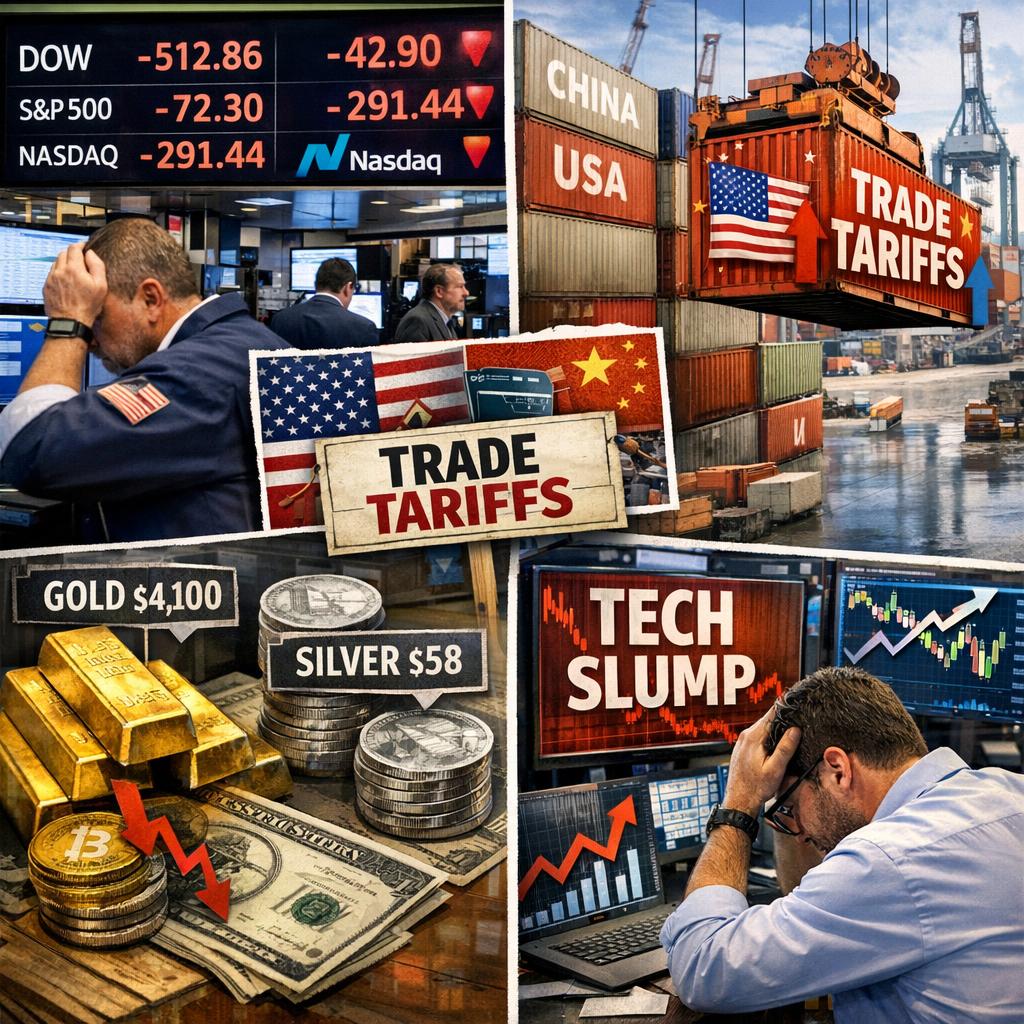
When broad indices wobble right after new tariffs take effect, especially with tech under pressure, it’s tempting to file it away as “headline volatility.” But this kind of wobble is usually the market doing something more important: re-rating assumptions. Not just about margins, but about how predictable the rules of global trade will be over the next few quarters.
And for global investors—whether you’re sitting in US equities, European exporters, Asian supply chains, or EM credit—tariffs are one of those policy levers that travel fast across asset classes.
Why this matters: tariffs don’t just hit companies, they hit models
The reason tariffs are so disruptive is that they don’t only change costs; they change planning.
A typical corporate forecast assumes some baseline stability in:
1) Input costs (components, energy, logistics)
2) Demand (consumer and enterprise spending)
3) FX conditions
4) Competitive landscape (who can source cheaper, who can ship faster)
Tariffs jam themselves into all four.
If you’re a hardware company, tariffs can raise bill-of-materials costs or force supply-chain reconfiguration. If you’re a software company, you might think you’re insulated—until your customers (manufacturers, retailers, shippers, industrials) start cutting discretionary spend to protect their margins. Even the “pure digital” names can feel it through second-order effects: weaker capex, slower expansion plans, and a more cautious CFO mindset.
That’s why a tech rout tied to tariffs isn’t just about “tech sentiment.” It’s about the market re-assessing how wide the margin-of-error just became for earnings expectations.
The hidden mechanism: tariffs can act like a tax at exactly the wrong time
Tariffs function like a targeted tax on trade flows. Whether the cost is absorbed by the foreign producer, the importer, the end consumer, or split among them depends on pricing power and competition. But the key is this: somebody pays.
If inflation is already sticky, tariffs can keep goods prices elevated. If growth is already slowing, tariffs can weaken demand. If central banks are trying to thread the needle, tariffs make that needle thinner.
This is why tariff headlines often show up alongside moves in rates, FX, and defensives—not because investors are being dramatic, but because they’re doing scenario math in real time.
You can see the broader “rates and safety” complex react when policy uncertainty rises. Gold hovering below a psychological level ahead of a rate decision, silver responding to higher rate risks, crypto retreating as Treasury yields rise—these aren’t random crosscurrents. They’re different corners of the same room: the market repricing the cost of capital and the value of liquidity.
Put simply: tariffs are not isolated. They interact with the interest-rate story.
The global investor takeaway: this is about correlation risk
When tariffs become a market driver, correlations tend to climb. In plain English, more things start moving together, and diversification works less efficiently—at least for a while.
Here’s how that usually shows up:
– Equities sell off together, led by the most duration-sensitive and sentiment-sensitive areas (often tech and other growth sectors).
– The dollar can strengthen or weaken depending on the inflation/growth mix and perceived policy trajectory—but FX volatility rises either way.
– Bond yields can do a push-pull: inflation risk nudges yields up, growth fear nudges yields down. The path depends on which narrative dominates that week.
– Commodities split: industrial metals can wobble on growth fears, while “store of value” assets can firm up on uncertainty and real-rate expectations.
For investors running global portfolios, the practical implication is that the next drawdown may not look like the last one. If your risk framework still assumes neat diversification between regions and sectors, tariffs can break that assumption.
Who is most exposed? It’s not just “importers”
The obvious losers are companies directly paying higher costs on goods crossing borders. But the more interesting exposure is indirect:
1) Firms with fragile demand
Companies selling discretionary products into price-sensitive consumers are vulnerable if tariffs raise end prices or if consumers feel poorer due to higher cost of living.
2) Firms with tight inventory cycles
Retailers, auto manufacturers, and industrials that rely on just-in-time supply can get hit by both cost increases and timing disruptions.
3) Firms dependent on stable capex cycles
When uncertainty rises, CFOs delay. That hits enterprise spending, which can flow through to IT budgets, cloud optimization initiatives, and broader corporate services.
4) Firms with geopolitical “headline beta”
Some stocks trade like proxies for macro confidence. When the tape turns risk-off, they can drop faster than fundamentals justify.
The point: you don’t have to be a company paying the tariff to be affected by the tariff.
What I’m watching next: three signals that matter more than the day-to-day noise
1) Earnings commentary, not just results
In a tariff environment, management guidance becomes more valuable than the quarter that just ended. Listen for language around pricing power, supplier shifts, inventory strategy, and “demand visibility.” Those phrases are the early warning system.
2) Treasury yields and the shape of the curve
If yields are rising because inflation risk is being re-priced, that’s one kind of problem for equities. If yields are falling because growth fear is rising, that’s a different kind of problem. Either way, the curve is often a cleaner read than the equity headlines.
3) The market’s tolerance for crowded winners
When uncertainty rises, investors usually become less forgiving of high-multiple names where perfection is priced in. That doesn’t mean the long-term story breaks. It means positioning and expectations matter more in the near term.
How to think about positioning (without pretending we can forecast policy)
No one can reliably forecast every tariff adjustment or negotiation twist. But investors can build portfolios that respect the risk:
– Make sure you know where your “hidden cyclicals” are. Some growth holdings are economically sensitive even if they don’t look like it on the surface.
– Don’t assume mega-cap equals defensive. Size helps, but valuation and expectations still drive drawdowns.
– Keep an eye on liquidity. When correlations rise, the ability to rebalance matters as much as the assets you hold.
– Treat policy risk like volatility fuel. Even if tariffs don’t crush earnings, they can widen the distribution of outcomes—and markets price distributions, not just averages.
The bigger message: markets are adjusting to a world where policy is a variable again
There are periods where markets mostly trade economics—growth, inflation, earnings. And there are periods where markets trade politics and policy—regulation, trade, national security, industrial strategy.
When tariffs start moving indices and leading sectors, it’s often a sign we’re leaning into the second world.
And in that world, investors get paid not just for being right about fundamentals, but for being disciplined about exposure, assumptions, and time horizon.
If you’re tracking this theme too, feel free to comment with what you’re watching most closely—rates, earnings guidance, FX moves, or sector rotation.