Sometimes, the most significant shifts happen not with a headline-grabbing bang, but through a quiet, technical integration that unlocks a new layer of functionality. This week provided a compelling example, tucked away from the main drama of economic data and central bank speculation. It’s a story about infrastructure, and how a single connection can subtly alter the landscape for entire asset classes.
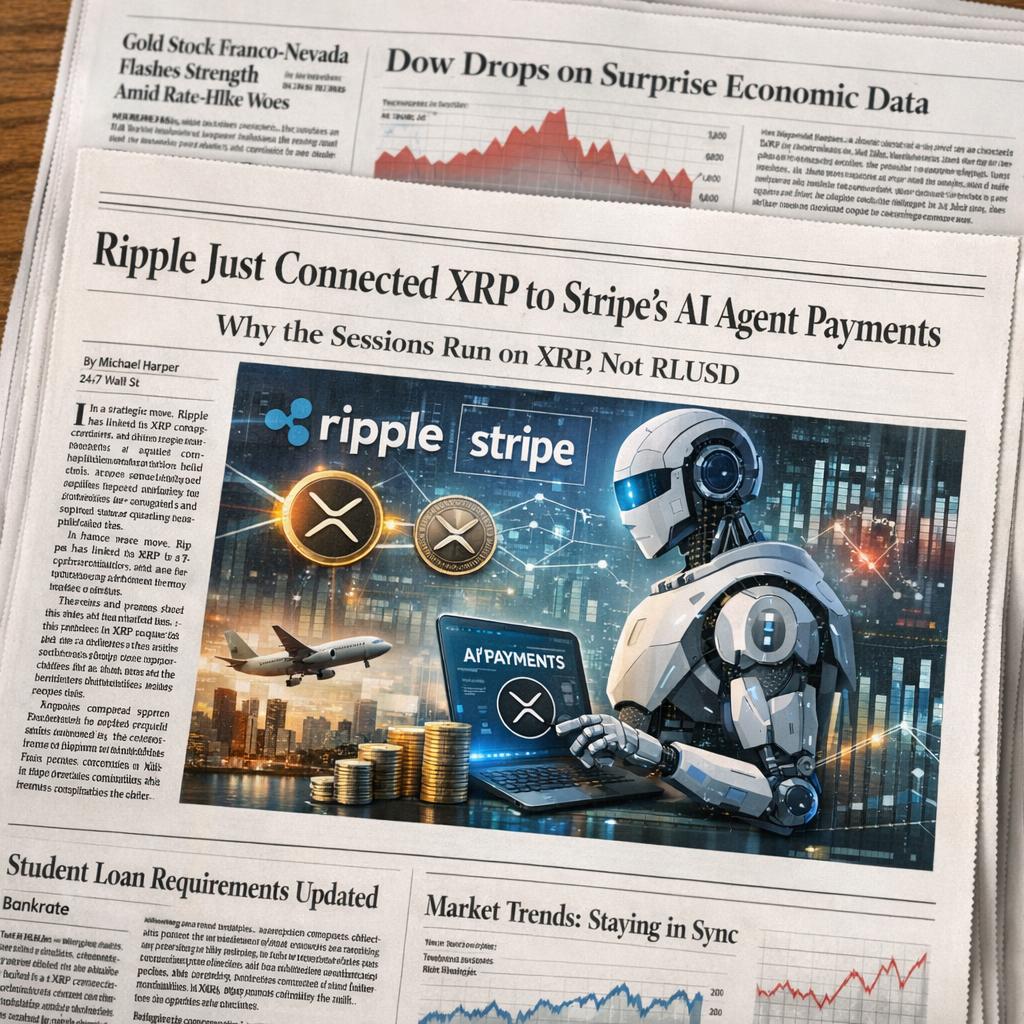
The news is that Ripple has connected its XRP digital asset to Stripe’s new AI agent payments system. On the surface, this is a niche tech story: a blockchain company partnering with a fintech giant to facilitate payments for AI agents. But peel back one layer, and the implications for investors—both in crypto and in traditional finance—become far more interesting.
The critical detail, often lost in the shorthand of headlines, is why these AI agent sessions are settling on XRP and not another asset, like Ripple’s own USD-pegged stablecoin, RLUSD. This isn’t a random choice or a mere branding exercise. It speaks directly to the perennial challenge in both crypto and global finance: liquidity and settlement finality.
AI agents operating in an economic capacity are, by design, speed and efficiency engines. They need to transact across borders, at any hour, with minimal friction and absolute certainty. A stablecoin like RLUSD solves the volatility problem for the denomination of value, but it doesn’t inherently solve the settlement layer’s speed and cost. The underlying blockchain on which it operates still needs to be fast, cheap, and reliable for the final settlement leg.
This is where XRP’s design comes in. The XRP Ledger was built from the ground up as a settlement layer, with transaction times measured in seconds and costs measured in fractions of a penny. By choosing XRP as the native settlement asset for these AI agent sessions, Stripe and Ripple are effectively saying that for high-frequency, automated, micro-value transactions, the optimal path is a dedicated, liquid, and purpose-built digital asset. They are prioritizing the efficiency of the railroad over the stability of the cargo for the final, instantaneous leg of the journey.
For investors, this is a nuanced but important development. It moves the narrative for assets like XRP incrementally away from pure speculative trading and toward a measurable utility metric: transaction volume driven by real-world use cases. Every AI agent interaction that settles via XRP represents a tiny, automated vote for its underlying infrastructure. In a market saturated with tokens promising future utility, the activation of a major, scalable pipeline like Stripe’s AI network is a tangible validation.
Furthermore, it highlights a growing segmentation within the digital asset ecosystem. Some tokens will function primarily as stores of value or collateral, others as governance tools, and others, like XRP in this instance, as optimized settlement fuels. This differentiation is crucial for portfolio construction. It means investors can no longer treat “crypto” as a monolithic bet; they must assess which assets are positioned as the plumbing for the next generation of economic activity—AI commerce, in this case—and which are not.
The ripple effects, pardon the pun, extend beyond crypto. It’s a live demonstration of how traditional financial giants like Stripe are navigating the new landscape. They are not betting the entire house on any one blockchain or asset. Instead, they are architecting systems that can plug into the most efficient settlement layer for a specific task. This modular, best-of-breed approach by major platforms should signal to traditional market participants that the integration of digital assets is becoming increasingly granular and pragmatic, not ideological.
While the market today might be focused on surprising economic data or the gyrations of major indices, it’s these under-the-hood integrations that often lay the groundwork for tomorrow’s structural shifts. The connection between an AI agent’s decision and its instantaneous payment isn’t just a tech feature; it’s a small-scale blueprint for a more automated, interoperable, and efficiency-driven financial system. And it’s worth watching closely to see which assets become the preferred fuel for that new engine.
I’m keen to hear your take on this shift toward utility-driven valuation in digital assets. Feel free to share your perspective in the comments.