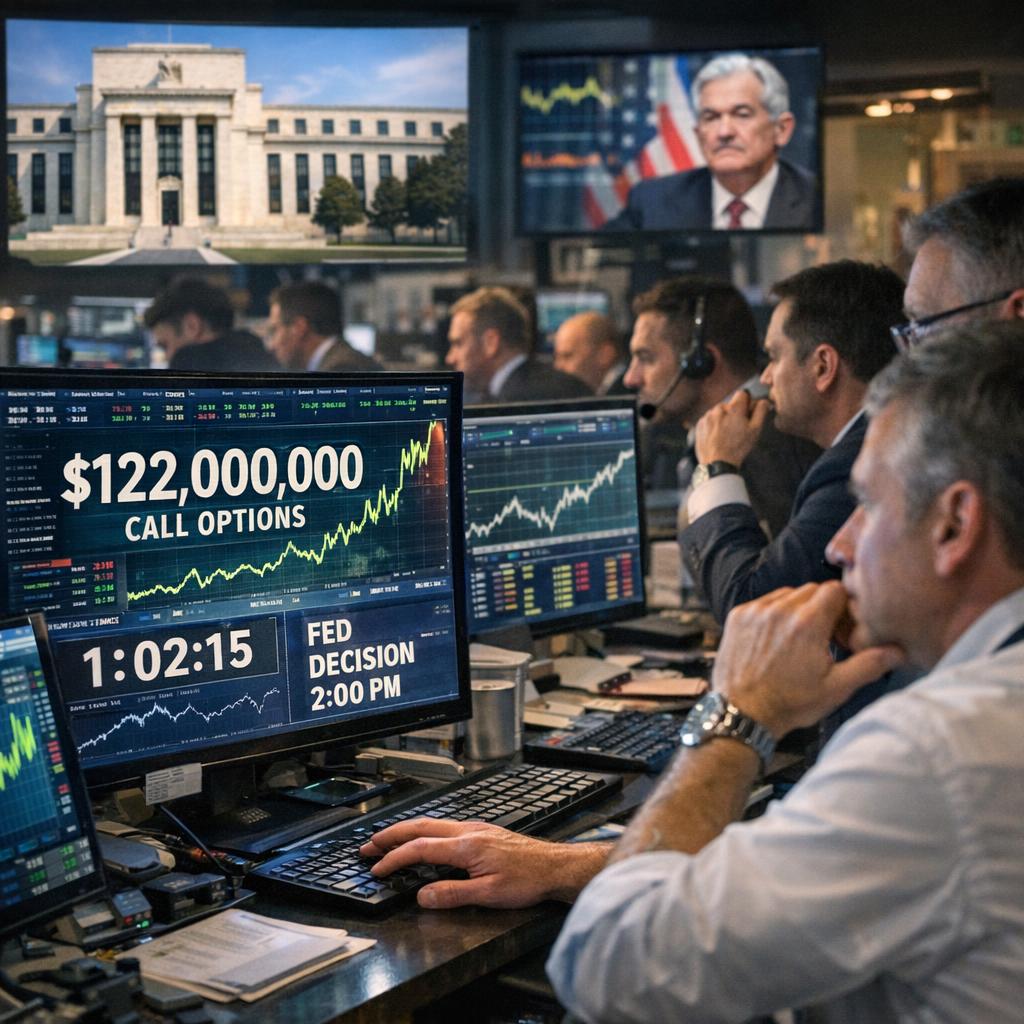
In the minutes before a major Federal Reserve announcement, the market holds its breath. Algorithms stand ready, traders hover over terminals, and the air grows thick with anticipation for the language of the statement, the nuance of the dot plot, the tone of the Chairman. It is a moment of pure, distilled reaction, where microseconds matter and positioning is everything.
This week, a single transaction cut through that anticipatory silence like a lightning bolt. Roughly an hour before the Fed’s 2 p.m. decision, a mysterious trader moved $122 million into call options on the S&P 500. This wasn’t a broad, hedged bet. This was a concentrated, high-conviction wager with a very specific message: a sharp, immediate rally was coming.
Institutional moves of this size are never truly anonymous; they leave a seismic footprint on the tape. But the identity of the actor is less important than the audacity of the act itself. Placing such a colossal, directional bet directly ahead of a known volatility event flies in the face of conventional wisdom. For most, the prudent path is to reduce exposure, to wait for clarity, to see the cards before raising the stakes. This trader did the opposite. They aggressively increased risk, betting not just on the outcome, but on the market’s precise reaction to that outcome.
This tells us several things about the current market psyche. First, it underscores the sheer dominance of central bank policy as a market driver. Company earnings, economic data, even geopolitical flares—all are now often secondary to the parsing of Fedspeak. The trade was a pure bet on monetary policy interpretation, nothing else. Second, it reveals a market where someone, with significant capital, believed they had a high degree of certainty. This could stem from sophisticated modeling of likely Fed language, an analysis of recent economic data flows that made a dovish tilt seem inevitable, or perhaps a reading of market positioning that suggested a violent short-covering rally was primed regardless of the actual news.
The aftermath, with the Nasdaq leading a charge and major tech names rising, suggests the bet paid off, at least initially. But the more fascinating angle is what this signifies for the broader landscape. When a single pre-Fed options trade can capture headlines, it highlights a market that is increasingly binary in its short-term movements, pivoting on central bank cues. It also points to the immense power and influence wielded by large, opaque pools of capital that can move markets based on private conviction.
Contrast this bold, macro gamble with the other stories floating through the financial ecosystem this week. While this trader was betting on the entire index, individual sectors were telling their own, more granular stories. In healthcare, Novartis and Ionis saw a years-long, multi-billion dollar cholesterol bet stumble in a late-stage trial, a stark reminder of the binary, high-risk nature of pharmaceutical R&D where data readouts can erase or create billions in value in an afternoon. Meanwhile, in tech, Meta’s stock climbed on excitement around its Muse AI platform, a sign that the AI catalyst cycle is far from over, but is becoming increasingly dependent on demonstrable product advancements and monetization pathways, not just hype.
Elsewhere, the news of a VinFast-backed taxi firm plotting a global push ahead of a Hong Kong IPO speaks to the continued, volatile expansion of the EV and mobility ecosystem, while a strategist dramatically cutting his S&P 500 target—not due to earnings, but to other factors—hints at the rising influence of geopolitical and liquidity concerns on valuation models.
Yet, the $122 million bet sits apart. It is a pure expression of timing, leverage, and conviction on the macro scale. For global investors, the lesson isn’t to try and mimic such trades—that’s a fast path to ruin. The lesson is in recognizing the environment this trade exemplifies: a market where liquidity events from central banks create massive, short-term opportunities and risks; where the gap between institutional insight and public information can be starkly displayed in a single order; and where sentiment can pivot on a dime based on a few carefully chosen words from a marble building in Washington.
It serves as a powerful reminder that alongside the slow grind of fundamental analysis and the steady drip of economic data, there exists a parallel market of high-stakes, tactical plays that operate in the shadows of major events. These moves don’t change the long-term trajectory of a company or an economy, but they can violently reprice assets in the short term, creating waves that all investors, whether watching from the sidelines or actively participating, must navigate.
The mysterious trader has likely already closed their position, banking a profit or absorbing a loss. But the imprint of that trade remains, a footnote in the market’s memory that illustrates just how much the game continues to revolve around the actions, and the anticipated reactions, of the world’s most powerful central bank. The real mystery isn’t who placed the bet, but whether the confidence it displayed is a sign of a market that has become dangerously predictable to the well-connected, or simply a one-off gamble that happened to land on green.