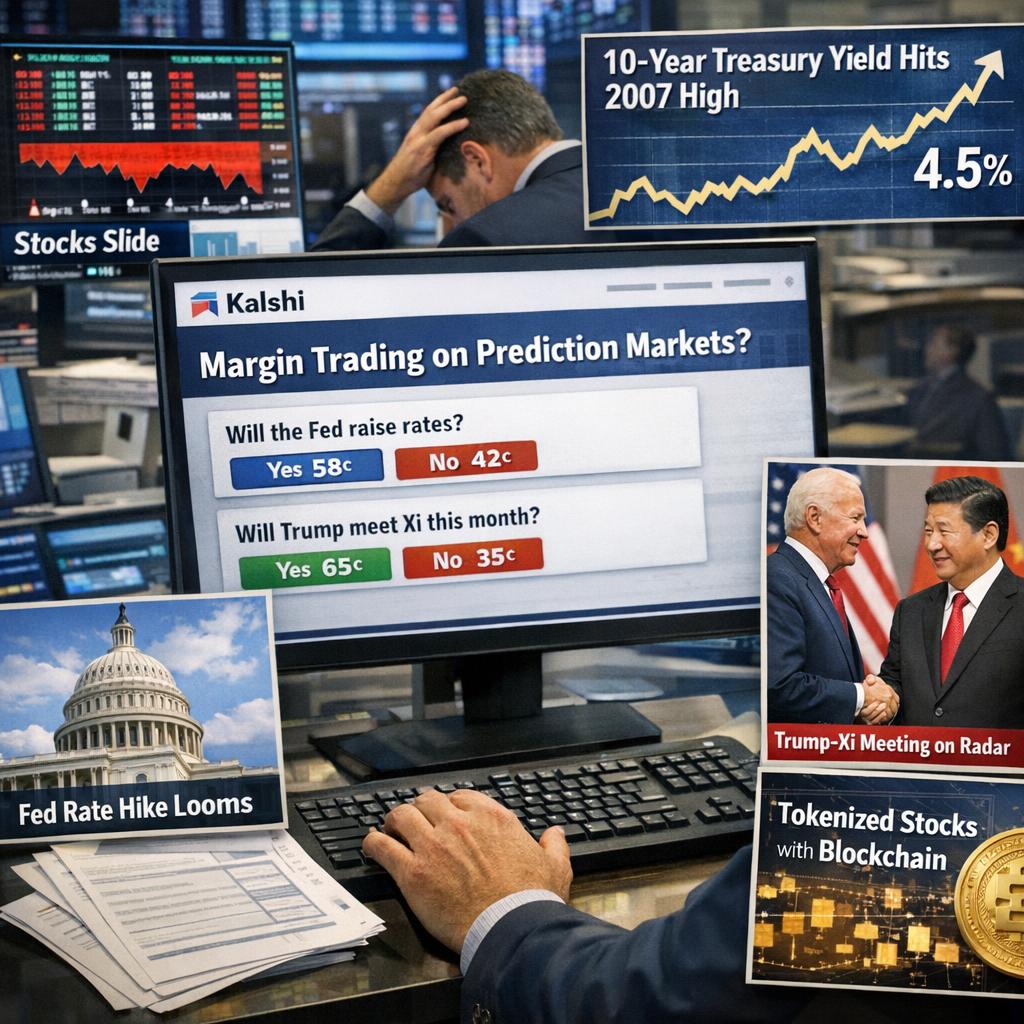
While the major indices dipped this week, pulled lower by a surge in the 10-year Treasury yield to heights not seen since 2007 and a general recalibration ahead of looming high-stakes meetings, a quieter but potentially more transformative development was unfolding in the regulatory arena. It’s a story that speaks less to immediate price action and more to the fundamental architecture of how risk is priced and traded in the modern era.
The news that prediction market platform Kalshi has petitioned the CFTC to allow margin trading on its contracts is a subtle tectonic shift. On the surface, it’s a technical regulatory request. But if granted, it would represent a significant blurring of lines—and a profound expansion of what constitutes a legitimate financial instrument for the average investor.
For the uninitiated, Kalshi allows users to trade on the outcome of future events, from the mundane to the macroeconomic. Will the Fed hike rates at a specific meeting? Will a particular stock close above a certain price by month-end? Will a geopolitical event occur? These are binary, yes-or-no contracts. Currently, trading them requires putting up the full notional value. Margin trading would change that, allowing participants to gain much larger exposures with only a fraction of the capital upfront, mirroring the leverage available in options or futures markets.
This proposal arrives at a fascinating juncture. We are in a market environment deeply sensitive to policy uncertainty and macroeconomic forecasts. The yield curve is shouting its expectations for sustained higher rates, and every data point is scrutinized for its Fed implications. In this climate, a tool that allows for leveraged, pure-play bets on policy outcomes isn’t just a novelty; it becomes a highly targeted risk management or speculative instrument.
Imagine being able to directly hedge a portfolio against the outcome of a Trump-Xi meeting, or a specific inflation print, with the efficiency and leverage of a futures contract. That’s the promise. It democratizes access to a form of volatility trading that was previously the domain of institutional desks with complex derivatives strategies.
But the implications cut both ways, and this is where the story connects to the broader market tremors we’re seeing. The same leverage that allows for precise hedging also enables magnified, casino-like speculation on world events. It creates a new, highly reactive feedback loop between political intelligence, market sentiment, and capital flows. A surge in margin-fueled bets on a particular outcome could, in theory, start to influence the perceived likelihood of that event itself, creating a self-referential loop that potentially distorts price discovery rather than enhancing it.
Furthermore, it raises a fundamental question about the compartmentalization of risk. Is a bet on a Fed decision meaningfully different from a bet on a Treasury yield? Should it be as easily accessible and levered? The NYSE’s parallel move to explore tokenized stocks with Blockchain.com points to a broader industry trend of digitizing and fractionalizing every conceivable asset and risk. We are marching toward a world where every forecast, every corporate milestone, every election result can be sliced, diced, and traded with leverage.
The market’s reaction this week—the flight from small caps amid hot data, the defensive rotations, the jitters around overextended tech narratives like AI—shows a collective nervous system attuning to traditional risks: rates, earnings, and economic cycles. The Kalshi proposal hints at the next layer of complexity being built beneath that system. It’s the financial engineering of uncertainty itself.
As investors, our focus is necessarily on the now: on Micron’s guidance, on Home Depot’s positioning for a housing recovery, on whether Eli Lilly or Pfizer is the better pharmaceutical haven for 2027. Yet, the structures being approved today will define the risk landscape of tomorrow. The approval of margin on prediction markets wouldn’t just create a new trading product; it would be a quiet endorsement of a world where event risk is not just something to analyze, but something to be directly, and powerfully, traded. That’s a conceptual shift worth watching, even if its immediate market impact is overshadowed by the day’s yield spike.
It’s a reminder that while we watch the ticks of the 10-year yield, the real revolution might be in how we are permitted to bet on what makes it tick. I’m keen to hear your thoughts on whether this represents a healthy evolution in market sophistication or an unnecessary complication of an already complex ecosystem. Feel free to share your perspective below.