Houthi Missiles, Maritime Risk, and the Hidden Price Tag for Global Portfolios
One of the most market-relevant developments in the past few days hasn’t been a central bank speech or an earnings surprise. It’s the clearer involvement of Yemen’s Houthi rebels in the wider Iran war narrative, and what that signals for the security of vital maritime routes.
Investors often treat geopolitical headlines like background noise—until a specific channel of transmission becomes unavoidable. Shipping lanes are one of those channels. They sit quietly beneath the surface of global trade, and then suddenly they become the story.
Why this matters: markets don’t price “conflict,” they price constraints
The market doesn’t react to geopolitics in an abstract way. It reacts when geopolitics threatens:
1) The flow of energy
2) The flow of goods
3) The cost of insurance and financing
4) The confidence needed to deploy capital
A missile attack linked to a non-state actor matters less for the headline itself than for what it implies: a wider set of participants, more unpredictable decision-making, and a greater chance that commercial routes face disruption, detours, or intermittent shutdown risk.
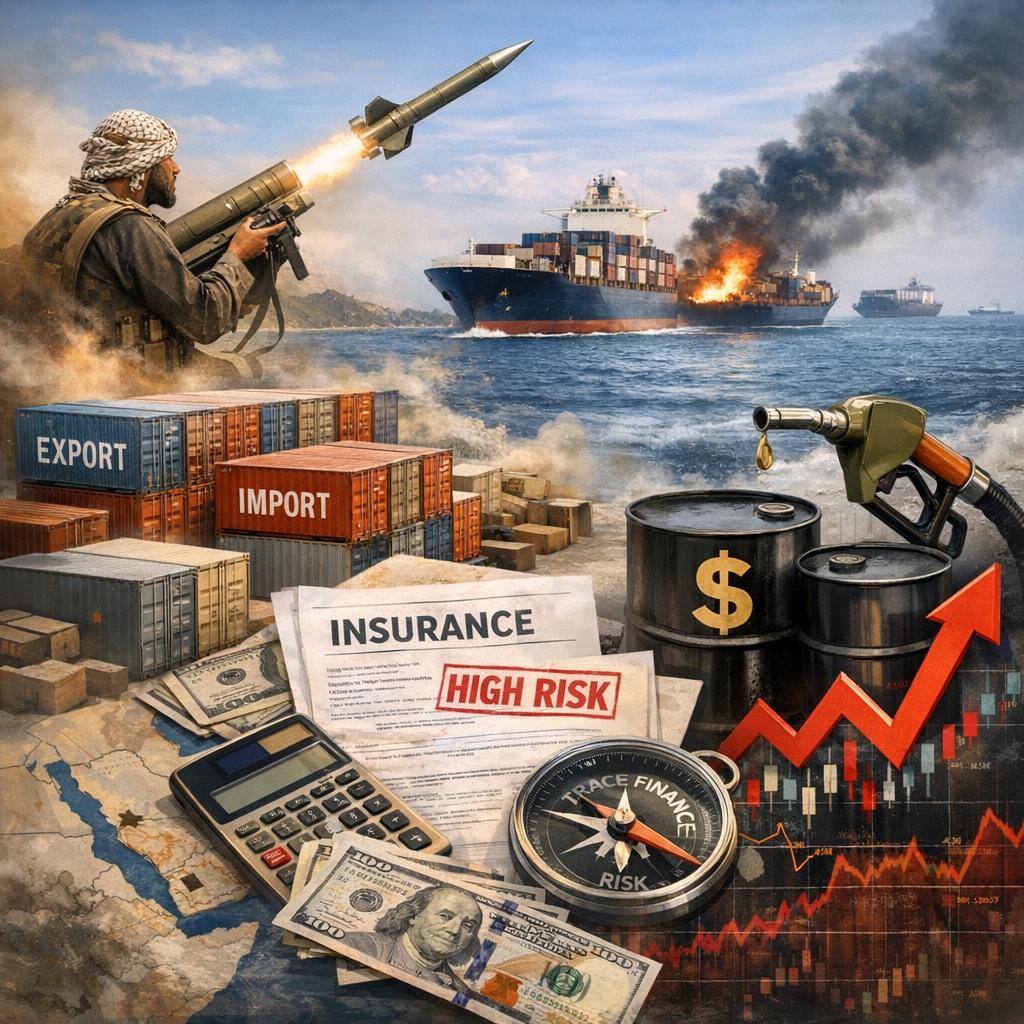
The moment investors start believing the “operating environment” for global logistics has structurally worsened, you see it show up in multiple places at once—freight rates, insurance premia, oil risk premia, and FX moves in trade-exposed economies.
The first-order impact: a shipping and insurance tax on the world
When maritime risk rises, the immediate market effects are rarely clean and linear, but they rhyme:
Higher war-risk insurance premiums
Insurers and underwriters don’t wait for worst-case scenarios to materialise. They adjust pricing as probabilities change. That feeds into shipping costs quickly, and those costs ultimately land somewhere: corporate margins, consumer prices, or both.
Longer routes, slower delivery times
If routes are diverted to reduce risk, the world effectively becomes “further apart.” That means higher fuel usage, higher costs, and more working capital tied up in inventory while goods are in transit.
Tighter conditions for trade finance
Banks and trade financiers become more cautious when routes and counterparties look riskier. That can tighten liquidity at the edges of the system—particularly in emerging markets and for smaller importers.
This is why a maritime-security story can morph into an inflation and growth story even without a major supply shock.
The second-order impact: oil is only half the story
Energy gets the spotlight because it’s the most visible macro lever, but investors shouldn’t ignore the non-oil pathways.
Yes, oil can gap higher on risk premium alone, especially if markets begin to worry about sustained missile exchanges, retaliation cycles, or miscalculation. But even if crude prices don’t explode, the “cost of doing business” rises across globally distributed supply chains.
That matters for:
Industrials and consumer goods with heavy shipping exposure
If you’re selling physical products across borders, logistics is a real input cost. It’s also a reliability problem: missed deliveries can be as damaging as higher costs.
Companies with fragile margin structures
Some businesses can pass costs through. Others can’t—especially in competitive categories or in weaker demand environments.
Countries dependent on imports of energy/food
Higher shipping and insurance costs can worsen trade balances and put pressure on currencies, which then feeds back into imported inflation.
The portfolio angle: what tends to get repriced first
In episodes like this, markets typically reprice risk in a familiar sequence:
1) Energy and defence-linked equities often catch bids first (sometimes too enthusiastically)
2) Shipping/logistics names move next, depending on whether higher rates are viewed as margin-positive or disruption-negative
3) Travel and discretionary sectors can soften on risk sentiment and higher fuel expectations
4) Credit spreads can widen if investors sense a growth hit or renewed inflation persistence
5) Safe-haven flows show up in USD strength and demand for high-quality duration—unless inflation fears dominate, in which case duration doesn’t get the same protection
The “unless” is important. When geopolitical risk pushes inflation expectations higher, the usual defensive playbook can fail in parts. Investors can end up simultaneously worrying about growth and inflation—never a comfortable mix for either equities or bonds.
What I’m watching next (because it affects pricing)
Markets will focus less on the rhetoric and more on three practical signals:
1) Frequency and geographic spread of incidents
Is this an isolated action, or the start of a pattern that forces lasting rerouting?
2) Shipping behaviour, not headlines
Are major carriers changing routes materially? Are delays and costs sticking? The tape will tell you what the industry truly believes.
3) Official responses that change the cost curve
Escorts, patrols, restrictions, sanctions, or expanded military engagement can all change the probability-weighted outcomes quickly—either calming risk or escalating it.
Positioning without panic
This kind of story punishes complacency more than it rewards drama.
For long-term investors, the key isn’t to “trade the news.” It’s to stress-test portfolios for the world where trade is a bit more expensive, inflation is a bit stickier, and risk assets demand a slightly higher return to compensate for uncertainty.
That can mean reassessing concentration in industries highly exposed to shipping costs, reviewing EM currency and rate exposure where import bills matter, and being honest about how much “geopolitical beta” you already hold through energy, defence, and commodity-linked assets.
If you’re following this closely, share what you think markets are underpricing right now: the energy risk premium, the supply-chain knock-on effects, or the impact on inflation expectations.