The $33bn buyback boom at America’s biggest banks is a market signal worth taking seriously
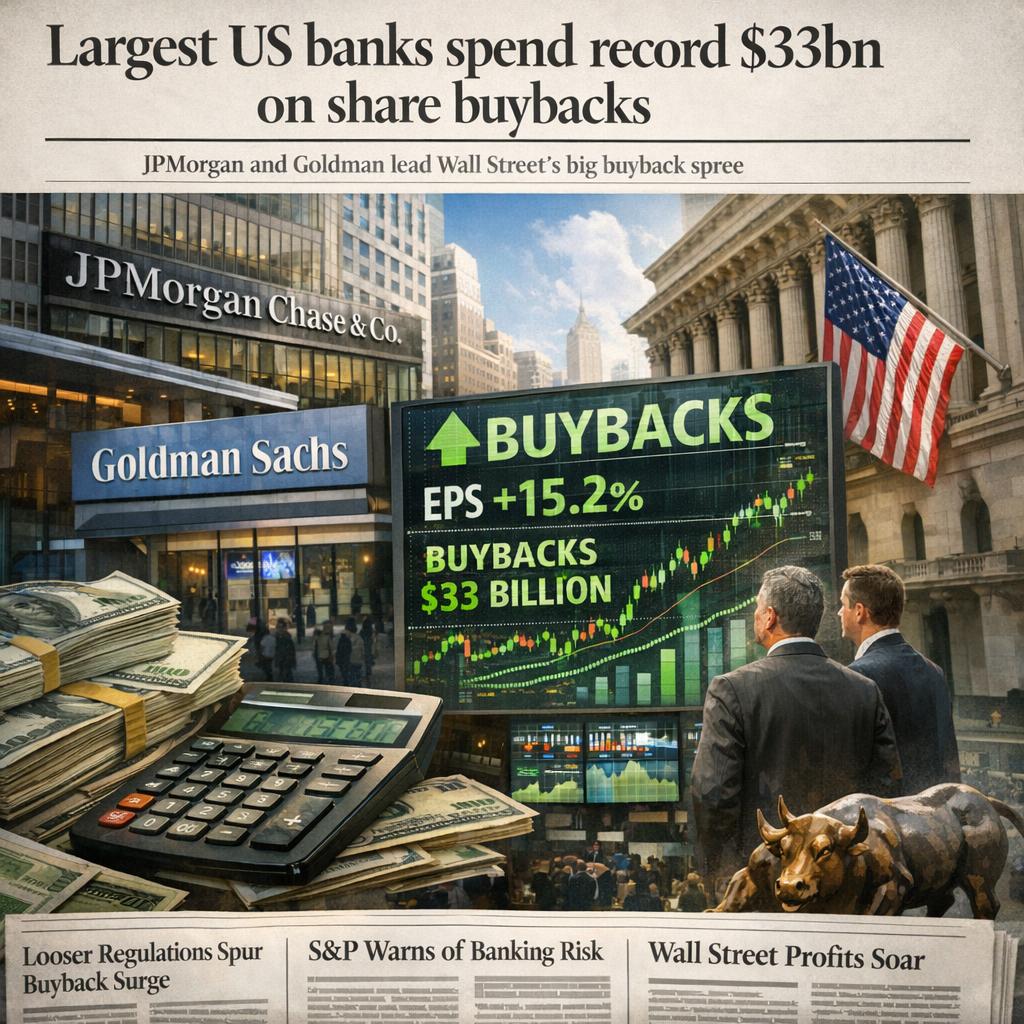
One of the more revealing stories in markets right now isn’t about a single earnings beat or a flashy deal. It’s that the largest US banks have collectively spent a record $33bn on share buybacks—led by names like JPMorgan and Goldman—helped along by a looser regulatory stance.
On the surface, buybacks are simple: banks return capital to shareholders by reducing the share count, often boosting earnings per share and supporting the stock price. But when buybacks hit record levels, it’s rarely just “shareholder friendliness.” It’s a statement about how bank executives see the world, how regulators are shaping incentives, and what kind of risk appetite is being reintroduced into the system.
1) Why banks love buybacks (and why markets often cheer)
Buybacks are the cleanest form of capital return because they’re flexible. Unlike dividends, they can be turned up or down without the same reputational penalty. For investors, that flexibility matters: buybacks can act as a buffer in volatile markets and a tailwind when valuations are reasonable.
If you’re holding bank stocks, buybacks can:
– Lift EPS even if revenue growth is modest
– Improve return on equity metrics optically (and sometimes genuinely)
– Signal management confidence in balance-sheet strength
In a sector where confidence is currency, a large buyback authorization is a public message: “We believe our capital position is solid, and we don’t see better risk-adjusted uses for this cash.”
2) The bigger issue: buybacks reflect the opportunity set—or lack of it
The most interesting question isn’t “Will this boost the stock?” It’s: what does it say about the underlying business environment?
When banks prioritize buybacks, it often implies one (or more) of the following:
– Loan growth isn’t compelling enough on a risk-adjusted basis
– Deal-making and investment banking pipelines are uncertain
– Management prefers returning capital over expanding balance sheets into late-cycle risks
– Regulatory constraints have eased enough to make aggressive capital return rational again
That last point matters globally. US banks sit at the core of the world’s funding and market-making machinery. If the regulatory mood is shifting, it affects liquidity conditions and risk pricing well beyond US borders—especially in dollar-funded markets.
3) Looser rules: supportive for equities, but watch the second-order effects
A lighter regulatory touch can be a near-term positive for bank shareholders. It can allow more capital distributions and reduce compliance friction. Markets tend to price that quickly.
But the second-order effects are where global investors should pay attention:
– If capital is being returned rather than retained, resilience to future shocks can weaken at the margin
– Higher payouts can encourage more leverage and more balance-sheet optimisation across the sector
– Competition may push banks toward higher-yielding, higher-risk activities to maintain returns
None of this guarantees a crisis—capital levels today are not what they were pre-2008—but it does change the texture of risk in the system. When the largest intermediaries in the world get more “room” to distribute capital, the entire credit and liquidity ecosystem adjusts.
4) What this means for investors outside the US
Even if you don’t own US bank stocks, this matters because US banks influence:
– The pricing of corporate credit globally
– Liquidity in rates, FX, and credit markets
– Risk sentiment in financials, which often acts as a barometer for broader equity markets
In practical terms, sustained buybacks at this scale can support US financial indices and, by extension, global risk appetite—until something forces capital preservation back into fashion (a funding squeeze, a credit event, or a sharp recessionary shift).
For investors watching from Europe, Asia, or emerging markets, it’s also a reminder that US policy and regulation can export financial conditions. When Wall Street is allowed to run “hotter,” the rest of the world often feels the heat—sometimes in the form of easier liquidity, sometimes through more abrupt repricing when the cycle turns.
5) The key thing to watch next
Record buybacks are not automatically bullish or bearish. They’re conditional.
If buybacks are being funded by genuinely surplus capital and strong underlying profitability, they can be a healthy sign of system strength.
If they’re happening alongside rising dependence on market-based income, tighter credit conditions for consumers, or growing leverage in pockets of the system, then they become more of a late-cycle tell—one that can look smart right up until it doesn’t.
As always with banks, the story isn’t only the headline number. It’s the quality of earnings, the durability of funding, and the discipline around risk.
If you’re tracking financials, I’d be interested to hear your take: are these buybacks a sign of strength and efficient capital management—or an early warning that policy is tilting the system back toward fragility?