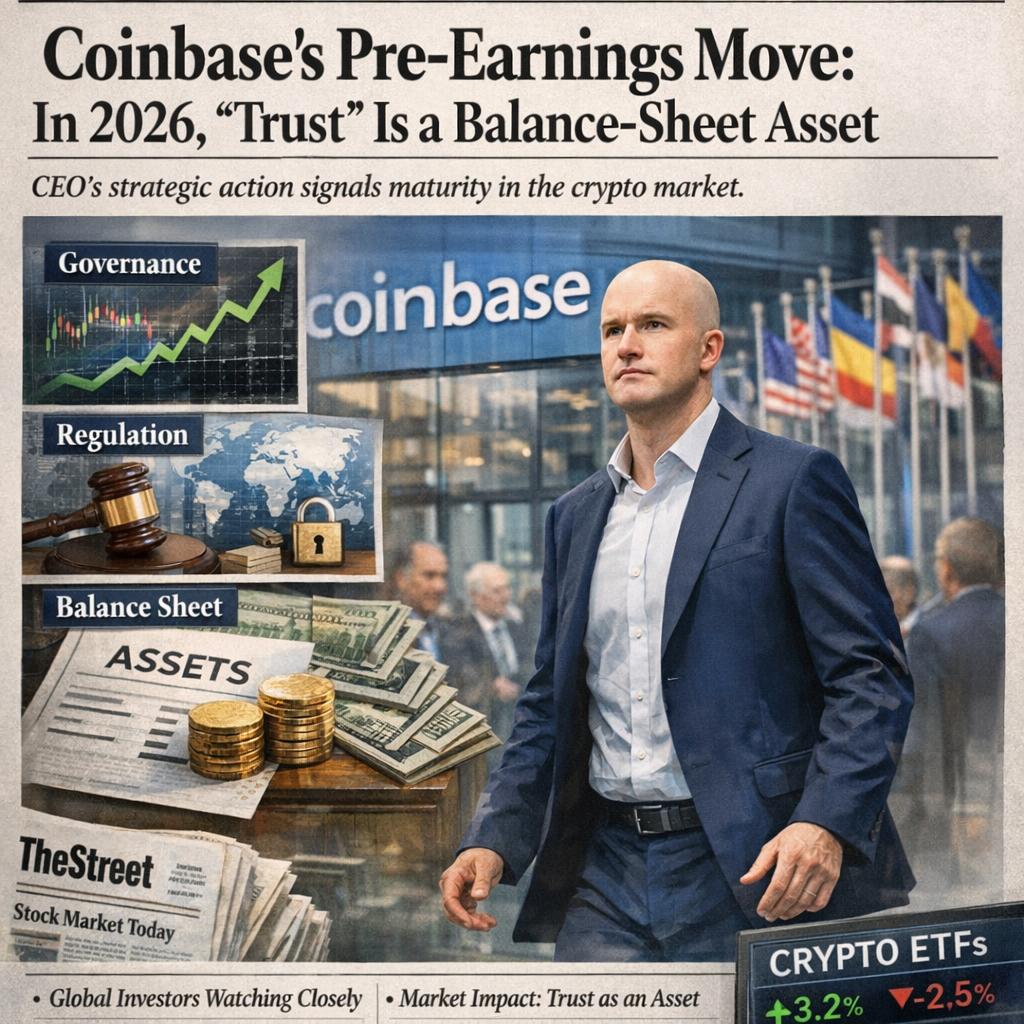
Coinbase’s Pre-Earnings Move Is a Reminder: In 2026, “Trust” Is a Balance-Sheet Asset
One of the more telling stories on my screen this week wasn’t a flashy macro print or a dramatic index swing. It was a very deliberate, very strategic move made by Coinbase’s CEO right before earnings.
Why does that matter to investors globally?
Because crypto has matured into something far bigger than a “risk-on toy,” but it’s still priced, regulated, and traded like an industry that’s constantly on probation. In that environment, what leadership does ahead of results can be as market-moving as the numbers themselves.
The real signal: crypto is being valued like financial infrastructure
Coinbase sits at an intersection that traditional investors understand well: brokerage-style revenues, custody-like trust requirements, and regulatory exposure that can change the story overnight.
That’s why a “critical move” ahead of earnings lands differently for Coinbase than it would for, say, a standard software firm. In crypto, leadership actions are interpreted through three lenses at once:
1) Governance
Investors want to know whether this is an institutionally serious company, or a cycle-driven trading venue. Anything that improves clarity, accountability, or alignment tends to compress the “credibility discount” that crypto equities still wear.
2) Regulatory posture
The regulatory overhang is not just a US issue; it affects global liquidity. If the market senses Coinbase is positioning itself to play offence rather than defence—whether through compliance, jurisdictional planning, or product reshaping—it can change how international investors think about headline risk.
3) Balance-sheet and risk optics
In 2026, investors have become more sensitive to hidden leverage, counterparty exposure, and revenue quality. A pre-earnings move often reads as: “We know what the market is worried about, and we’re addressing it before you ask.”
Why this matters beyond Coinbase: it’s about the cost of capital
When markets decide an industry is “trust-sensitive,” its companies pay for uncertainty in very tangible ways: higher volatility, wider valuation ranges, and a harsher reaction function on earnings days.
That ripples outward:
– Crypto-linked equities and ETFs can re-rate together, not because fundamentals are identical, but because perception moves as a basket.
– Liquidity can shift across borders fast. When US-listed crypto names look more investable, international capital tends to follow the deepest, most regulated venues.
– Even non-crypto fintech gets affected. If Coinbase can reduce perceived risk, it can draw capital that otherwise might have flowed into payments, trading platforms, or high-growth software.
What I’d watch going into earnings (and why global investors should care)
This isn’t just about whether Coinbase “beats” or “misses.” The market is likely to price the narrative around three things:
– Revenue mix: Is growth coming from more durable streams (subscriptions, services, custody), or mostly from transaction sensitivity?
– Expense discipline: Are they scaling like a mature platform, or spending like a company still fighting for survival in the next cycle?
– Regulatory clarity and international positioning: Any indication of expanding compliant rails, partnerships, or jurisdictional advantage matters because crypto is increasingly a global market with local rulebooks.
The bigger takeaway: markets are paying for credibility again
We’ve had years where liquidity drowned out nuance. That’s not this tape.
Right now, investors are rewarding companies that anticipate scrutiny—especially in sectors where the product is money-adjacent, custody-adjacent, or regulation-adjacent. Coinbase is one of the clearest case studies in that theme, because it has to sell trust to both users and institutions, at the same time, in public.
If you’re investing globally, this story isn’t “just crypto.” It’s a live example of how quickly the cost of capital can tighten or loosen based on governance signals—and how leadership actions can front-run the market’s toughest questions.
If you’re watching Coinbase this quarter, what matters more to you: the earnings print, the forward guidance, or the regulatory/strategy signals around the business? Share your take in the comments.