The “Magnificent 7” just got a very political portfolio update — and investors worldwide should pay attention (even if they never plan to mirror a politician’s trades).
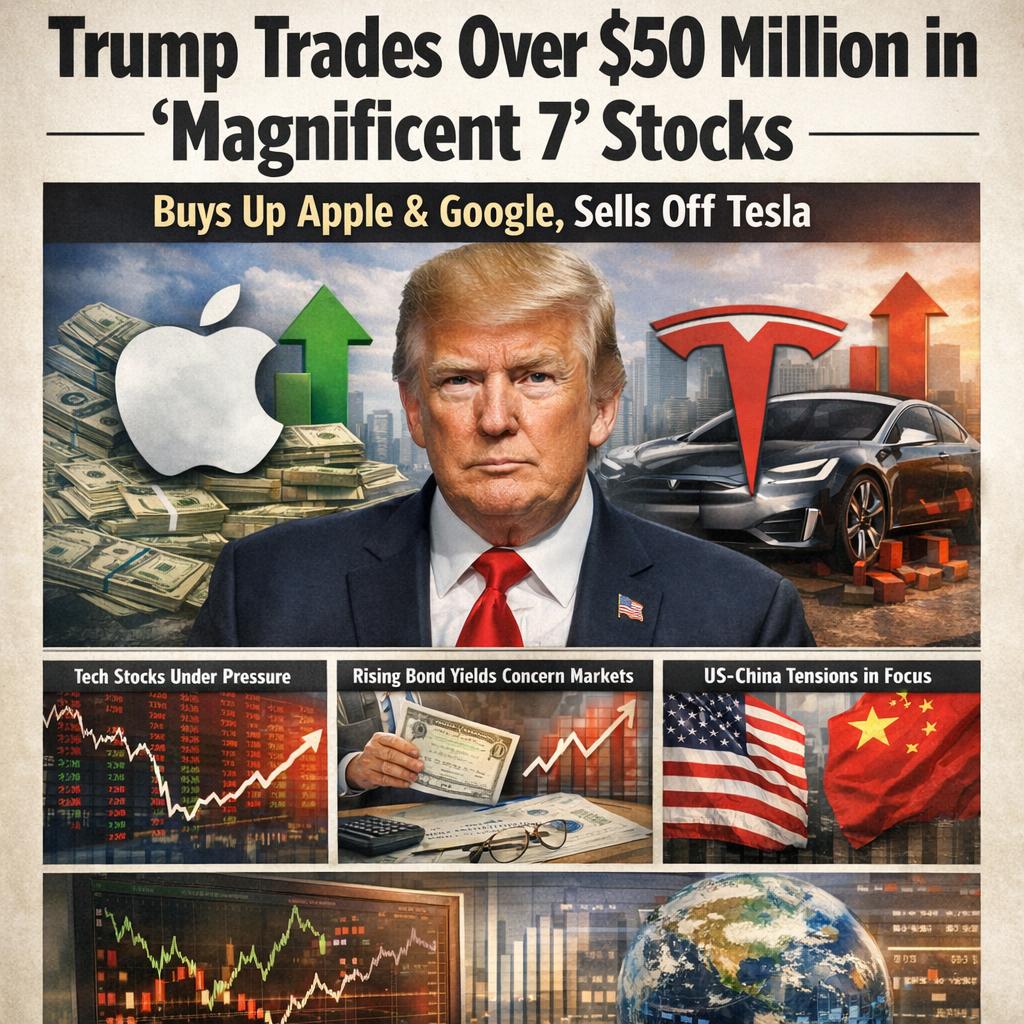
One of the more eye-catching market stories making the rounds is that President Trump reported over $50 million of trading activity in the Magnificent 7 last quarter, notably adding to Apple and Google while trimming Tesla. On the surface, it reads like a celebrity portfolio headline. Underneath, it’s a neat snapshot of where large-cap tech sentiment is heading at a time when global markets are already wrestling with higher bond yields, choppy risk appetite, and renewed scrutiny on US mega-cap concentration.
Here’s what I think actually matters for investors globally.
1) This isn’t “stock picking gossip” — it’s a signal about narrative leadership
Whether you like Trump or not is irrelevant to the market impact. The real takeaway is that Apple and Google remain the perceived “default safe” choices inside big tech: cash generative, entrenched distribution, resilient ecosystems, and still viewed as capable of defending margins even as the cost of capital stays elevated.
Tesla, by contrast, has become the market’s most visible stress test for long-duration growth: more competition, more pricing pressure, more sensitivity to rates, and more dependence on investor optimism. Selling Tesla while adding Apple/Google fits the broader global pivot we keep seeing: investors aren’t necessarily abandoning tech, they’re rotating toward tech with sturdier cash flows and clearer downside protections.
If you’re investing from outside the US, this matters because US mega-cap tech is effectively a global asset class. It’s in everyone’s benchmarks, pension funds, ETFs, and “global growth” allocations. When leadership within that group shifts, it changes the behavior of portfolios from London to Singapore to Toronto.
2) It highlights how crowded the “quality trade” has become
Apple and Google are not obscure opportunities. They’re some of the most heavily owned equities on earth. When high-profile flows (or headlines about flows) stack into the same names, it reinforces a dynamic global investors should be mindful of:
– Crowding can reduce diversification when you think you’re diversified.
– “Quality” can become expensive not because fundamentals deteriorate, but because everyone wants the same perceived safety at the same time.
– When rates rise quickly, even great businesses can get repriced, and crowded positioning can make drawdowns sharper than expected.
So if you’re holding broad US equity exposure through an index, you’re already holding a large dose of Apple/Google. The practical investor question isn’t “should I copy this trade?” but “how much of my portfolio risk is ultimately a bet on a handful of US mega-caps continuing to dominate?”
3) It’s a reminder that policy risk and portfolio risk are now intertwined
Markets increasingly trade on the intersection of regulation, geopolitics, and industrial policy. With Apple and Google, that means:
– antitrust and platform regulation
– AI governance and data rules
– US-China technology tensions
– supply chain exposure and export controls
None of these risks are “new,” but their probability distribution shifts depending on election cycles, policy agendas, and the geopolitical temperature. When a major political figure is associated with certain holdings, fair or not, investors start mapping narratives: which companies might be “favored,” which might face pressure, which sectors might see shifts in enforcement tone.
International investors should care because these policy spillovers don’t stay inside US borders. They ripple through ADRs, suppliers, semiconductor capex plans, digital advertising ecosystems, and FX flows tied to risk-on/risk-off moves.
4) Zooming out: it fits the current market regime
At the same time this story is circulating, markets are also dealing with higher bond yields keeping pressure on equities and a continued wobble in tech. That’s a classic environment where investors de-risk at the margin: fewer “story stocks,” more cash flow, more balance-sheet strength.
In that context, adding Apple/Google and trimming Tesla is less a heroic call and more a regime-consistent rotation: from high volatility growth to mega-cap “quality growth.” It’s exactly the type of trade you’d expect when duration risk is being repriced.
What investors can take from this (without turning it into a personality trade)
– Treat US mega-cap tech as a macro allocation, not just individual stocks. Your exposure is often larger than you think.
– Separate company fundamentals from positioning. Great businesses can be risky at the wrong price with the wrong crowding.
– In a higher-yield world, the market tends to reward cash flow reliability and punish uncertainty more aggressively.
– Don’t confuse headline-driven moves with a durable edge. The advantage is in portfolio construction, risk management, and time horizon discipline.
If you’ve been rotating within tech (or reducing concentration risk), I’d be interested to hear how you’re thinking about it right now. Comment with the main thing you’re watching: yields, earnings quality, regulation, or valuation.