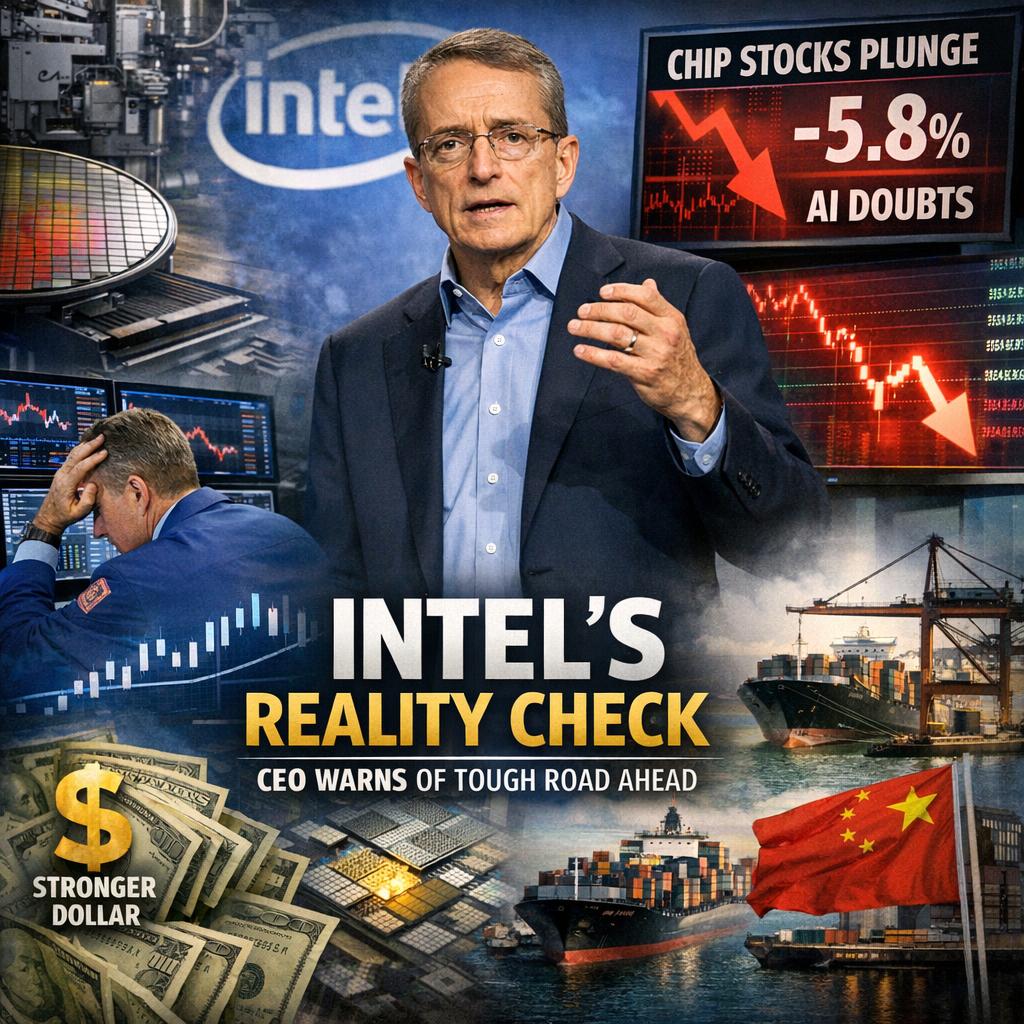
Intel’s CEO Just Gave Investors the Message Many Didn’t Want to Hear
There’s a particular kind of market pain that shows up when a story stops being inspirational and starts being operational. That’s what this latest Intel commentary feels like: less about grand ambition, more about the gritty timeline, cost, execution, and trade-offs required to compete in a chip cycle that’s moving at full speed.
The “reality check” isn’t that semiconductors are suddenly unimportant. It’s the opposite. Chips are arguably the most strategically sensitive industrial product on the planet right now. The reality check is that in a world where AI demand is pulling the entire compute stack upward, investors have become conditioned to expect clean narratives: rapid ramps, quick product wins, and margin expansion that arrives on schedule.
But manufacturing-led turnarounds don’t work like SaaS turnarounds.
1) The market is re-learning the difference between “AI exposure” and “AI leadership”
For the past couple of years, being adjacent to AI was often enough to earn a premium. If you had data centers, networking, cloud demand, or anything resembling an accelerant to compute, markets were willing to assume the growth would find you.
That phase is maturing.
Investors are increasingly separating companies into buckets:
– Direct winners (clear leadership in AI compute and the ecosystem around it)
– Secondary beneficiaries (tools, infrastructure, memory, power, cooling, connectivity, services)
– Aspirational challengers (credible, but with execution risk and longer timelines)
– Narrative passengers (AI mentioned a lot, but economics don’t change much)
Intel’s moment here is important because it highlights how quickly the market can move a company from “strategic hope” to “prove it in the numbers.”
2) Chips are a global asset class now, not just a tech subsector
Semis aren’t trading purely on company-specific fundamentals anymore. They’re trading like a macro-sensitive complex:
– Capex cycles
– Currency moves
– Rate expectations
– geopolitics and industrial policy
– supply chain confidence
That’s why a single executive tone shift can matter. When leadership signals “this will take time” or “this will be harder than expected,” the market doesn’t just reprice one name. It can ripple across the entire chip basket, because investors immediately start asking: if it’s tough here, where else are expectations too high?
3) The investor impact isn’t confined to US equities
If you’re a global investor, this matters in a few underappreciated ways:
A) Passive exposure and index concentration
Semiconductors sit inside major US indices, global tech funds, and thematic AI ETFs. When chip sentiment cools, it’s rarely a tidy, isolated move. It travels through passive allocations and rebalancing flows.
B) Second-order effects across regions
European industrials with automation exposure, Asian supply-chain manufacturers, and even emerging market exporters can see sentiment shift when the chip cycle looks less “straight line” and more “lumpy.”
C) Currency and rates sensitivity
A more cautious tone around high-growth tech often coincides with investors rotating toward cashflow certainty and defensive positioning. In practice, that can strengthen safe-haven flows, tighten financial conditions at the margin, and amplify volatility for markets that rely on dollar liquidity.
4) What I think investors should take away
This isn’t an argument that Intel can’t execute. It’s an argument that the market is becoming less forgiving about timelines and less generous with valuation for “eventually.”
A few practical implications:
– Longer-duration stories will likely trade with wider swings. If the path is multi-year, the stock can become more sensitive to quarterly proof points and macro shocks.
– “AI” as a label won’t protect a company if margins, product competitiveness, or delivery dates slip.
– Diversification inside tech matters again. Owning only the most crowded AI expressions can feel great until the market collectively decides it wants a reality check across the whole complex.
The broader theme: we’re moving from the “discovery phase” of AI investing (where excitement did most of the work) into the “distribution phase” (where the economic winners and losers separate more sharply).
If you’re watching this space closely, I’d be interested to hear how you’re positioning: staying concentrated in perceived leaders, broadening across picks-and-shovels, or trimming exposure until expectations cool. Comment with your current approach.