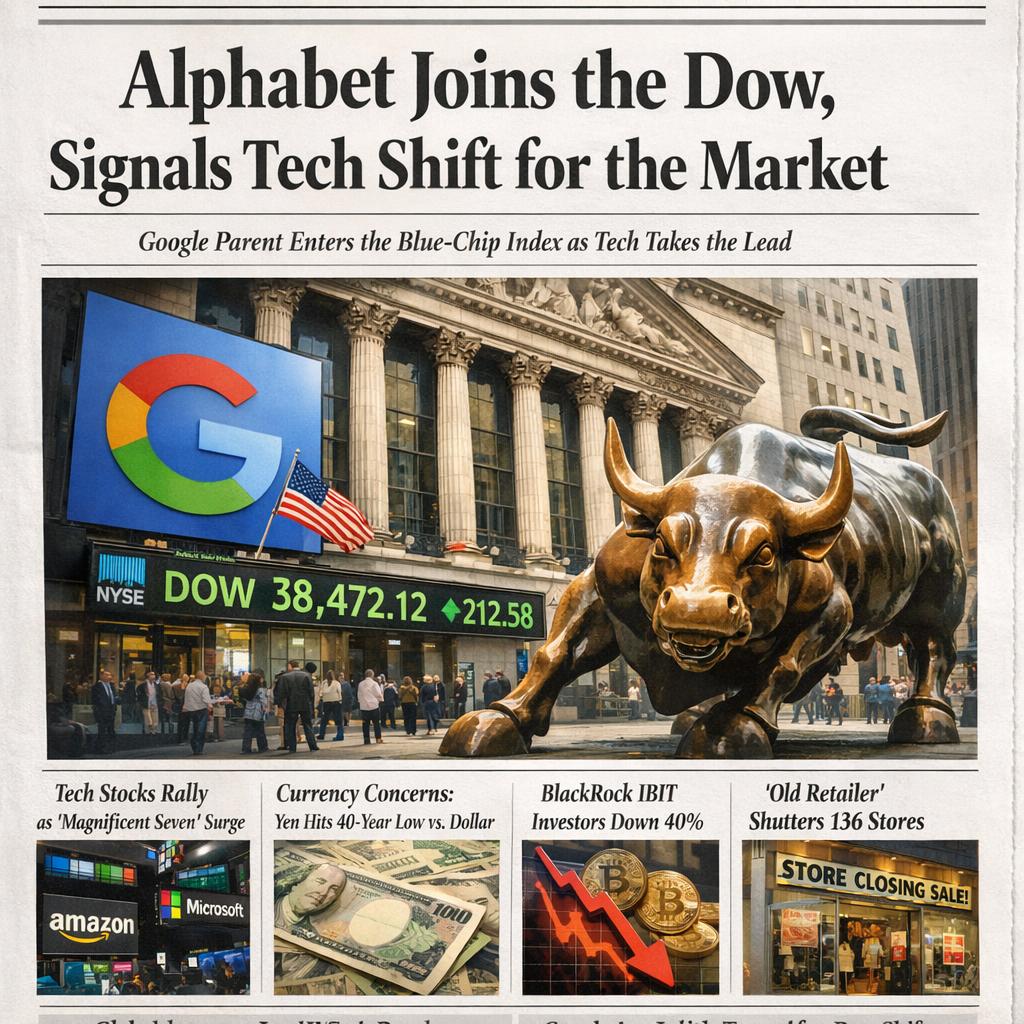
Alphabet’s Arrival in the Dow Isn’t Just Symbolic — It’s a Quiet Signal About Where “Core” Market Risk Now Lives
One of the most underappreciated market stories this week is Alphabet officially debuting in the Dow Jones Industrial Average.
On paper, index changes can feel like housekeeping. A reshuffle, a headline, a day or two of forced buying and selling by index funds, then everyone moves on.
But this one matters, because it tells us something bigger: the Dow — still treated by many as the “main street” snapshot of US corporate health — is leaning further into the same tech gravity that’s already shaped the S&P 500 and the Nasdaq for years.
And that has real implications for investors globally, even if you’ve never bought a Dow ETF in your life.
1) The Dow is becoming less of a “value barometer” and more of a “mega-cap quality” basket
The Dow has always been a little unusual: price-weighted, legacy-heavy, and culturally important. Historically, many investors saw it as a steadier, more industrial-tilted counterpoint to the tech-heavy indices.
Alphabet joining pushes the signal in the opposite direction. It’s another reminder that “old Dow vs new Nasdaq” is not the clean diversification story people think it is.
If you hold global equity funds, pension allocations, robo-advisor portfolios, or anything benchmark-aware, your “core” exposure is increasingly a bet on a relatively small group of US mega-cap business models:
– digital advertising and attention
– cloud infrastructure
– AI tooling and distribution
– platform economics
– intangible-asset-driven margin structures
That can be great when the narrative is strong and earnings keep compounding. But it also means index-level stability is more dependent on a handful of firms staying dominant, politically tolerated, and technologically ahead.
2) Passive flows don’t just follow the market — they shape it
When a company enters a major index, the mechanical effect matters: passive vehicles and benchmarked managers adjust holdings.
For Alphabet, the dollars involved aren’t trivial. But the bigger issue is what this does over time: it reinforces the feedback loop where the largest, most liquid names become even more central to “market performance,” which attracts more capital, which further increases their weight across portfolios.
For investors outside the US, this shows up in a very practical way. Many “global” or “international” strategies still have heavy US exposure because the US market is such a large share of global market cap. When US indices tilt more toward mega-cap tech, global portfolios inherit that tilt.
You can end up more concentrated than you think, without ever making an active choice.
3) Index composition is now a macro factor: rates, regulation, and AI adoption
When the headline index becomes more tech-sensitive, macro drivers transmit differently.
A few examples:
– Interest rates: higher-for-longer discounting can hit long-duration cash flows harder, and mega-cap tech often trades like “duration with earnings.”
– Regulation: antitrust, digital competition rules, data/privacy, and content moderation frameworks can become index-level risks rather than single-stock risks.
– AI capex cycles: if the market is rewarding AI leadership, then shifts in AI spend, enterprise adoption pace, and margin impact stop being niche tech stories and become broad-market stories.
In other words, “market risk” increasingly includes “tech policy risk” and “platform risk.”
That is a meaningful change from the world where industrial cyclicals, banks, and energy set the tone.
4) The currency layer: why this matters for non-US investors
For anyone investing from the UK, Europe, Asia, Africa, or the Caribbean, the US equity story is rarely just an equity story. It’s also a currency story.
If US tech-heavy indices are the engine of your returns, then USD moves can amplify or dilute performance when translated back home. A tech-led risk-on rally often coincides with a certain kind of USD behavior; risk-off periods can flip the relationship fast.
So the “Alphabet in the Dow” story becomes part of a larger portfolio reality: your base exposure may now be more sensitive to a combination of US tech sentiment and FX swings than you intended.
5) The investor takeaway: know what your “boring” index fund actually holds
None of this is an argument against Alphabet as a business, or against passive investing. It’s an argument for being honest about concentration and factor exposure.
If your portfolio is built around broad index funds, it’s worth recognising that:
– “broad market” increasingly means “mega-cap led”
– “diversified” may still share the same underlying drivers across indices
– the most important risks may come from policy, platform disruption, and valuation regime shifts, not just GDP growth
If you’re an active investor, the implication is different but just as important: the benchmark is evolving, and relative performance is increasingly a function of how you manage exposure to the handful of stocks that dominate flows and sentiment.
If you’ve looked at your portfolio recently, did you realise how much of your “core” exposure ultimately maps back to a small cluster of US tech giants? Feel free to comment what you found — or what surprised you.