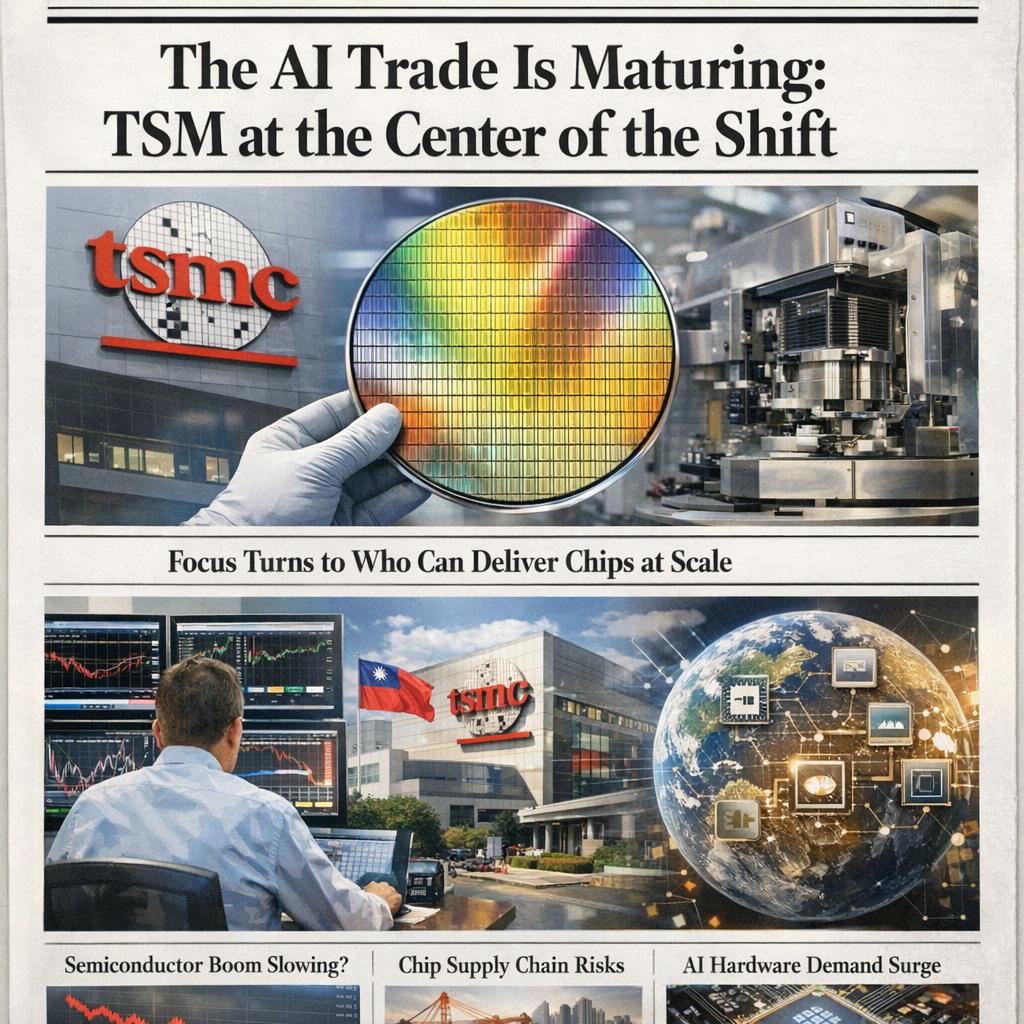
The AI Trade Is Maturing — and That Changes How Investors Should Read the Semiconductor Headlines
A lot of investors still talk about “AI stocks” as if they’re one single trade. But the market is quietly telling us something more nuanced: we’re moving from the excitement phase into the selection phase. And few names sit at the centre of that shift more than Taiwan Semiconductor Manufacturing (TSM).
TSM has been rallying on what many are calling “exceptional momentum,” and on the surface that’s easy to understand. If AI is the new industrial revolution, then advanced chips are the new machinery. Companies can design the blueprints, but someone still has to build the product at scale, with high yields, on cutting-edge nodes, and with the kind of reliability that hyperscalers and major hardware platforms demand. That manufacturing reality is where TSM’s strategic power lives.
But here’s the part investors globally should pay attention to: the story is no longer simply “AI demand is strong.” It’s increasingly “who can actually fulfil AI demand consistently, profitably, and without bottlenecks?”
Why TSM matters beyond the ticker
TSM isn’t just another semiconductor stock. It’s closer to a global utility for advanced computing.
When you buy a basket of US mega-cap tech, you’re often indirectly buying exposure to TSM’s execution. When European industrials talk about automation and edge computing, you’re often talking about chips that depend on the same ecosystem. When emerging market funds allocate to “future tech,” the supply chain usually traces back to a few critical manufacturing chokepoints.
That’s why moves in TSM can ripple across portfolios even if investors don’t own it directly. It’s one of those rare stocks that functions like a barometer for the wider AI capex cycle.
Momentum is a signal — but it’s not the whole story
A strong rally can mean the market is correctly pricing in better earnings power. It can also mean positioning is getting crowded. With AI enthusiasm still high, it’s tempting to assume any dip is a gift and any breakout is confirmation.
But the AI supply chain is starting to behave like a more classic cycle:
1) Capacity and lead times matter again.
As demand ramps, the key question becomes whether capacity expansions arrive on time and at the right cost. Investors should track capex plans, utilisation rates, and commentary around packaging and advanced manufacturing constraints. AI isn’t just about compute; the “how” of delivering that compute is increasingly a profit driver.
2) Pricing power shifts over time.
Early in a boom, suppliers often have the upper hand. Later, large customers negotiate harder, alternative supply comes online, and pricing power becomes more contested. The best operators still win — but the easy narrative (“demand up, stock up”) starts to break.
3) The market starts separating “AI beneficiaries” from “AI essentials.”
Designers, cloud platforms, equipment makers, foundries, memory providers — they don’t all experience the same margin profile at the same time. That’s why the debate around different parts of the chip ecosystem is heating up. Investors are beginning to care less about who has an AI slide deck and more about who controls scarce, monetisable capacity.
The global investor takeaway: concentration risk is the hidden theme
One of the biggest under-discussed issues for global markets is how concentrated advanced chip manufacturing is. Whether your portfolio is US-heavy, global, or “diversified,” you may still be concentrated through supply chain dependency.
That creates a different kind of risk management problem:
– If AI demand stays strong, the winners can compound for years — but valuation discipline matters because momentum can overshoot fundamentals in the short run.
– If the cycle cools temporarily, the most expensive parts of the trade can correct sharply even if the long-term thesis is intact.
– If supply chain shocks occur (geopolitical, logistical, regulatory), the impact won’t be isolated to semis. It can spill into software guidance, cloud capex plans, consumer electronics pricing, and broader index performance.
In other words, TSM’s rally isn’t just “a stock going up.” It’s a signal about the market’s confidence in the physical layer of the AI economy.
How I’m thinking about positioning right now
I’m increasingly viewing the AI theme through three lenses:
– Core infrastructure: companies that are difficult to replace and structurally tied to AI build-out.
– Cyclical beneficiaries: companies that can do extremely well, but are more exposed to inventory, pricing, and timing.
– Narrative premium: companies where the multiple is doing more work than the cash flows (at least for now).
TSM tends to sit closer to the core infrastructure bucket — but even “core” doesn’t mean risk-free. It simply means the long-term demand driver is more tangible. Investors still need to respect entry points, expectations baked into the price, and the reality that even the highest-quality compounders can go sideways when the market gets ahead of itself.
If you’ve been watching the AI trade closely, I’d be interested to hear how you’re approaching it now: are you focusing more on the “picks and shovels” names, or rotating into areas you think the market is still underpricing? Share your take in the comments.