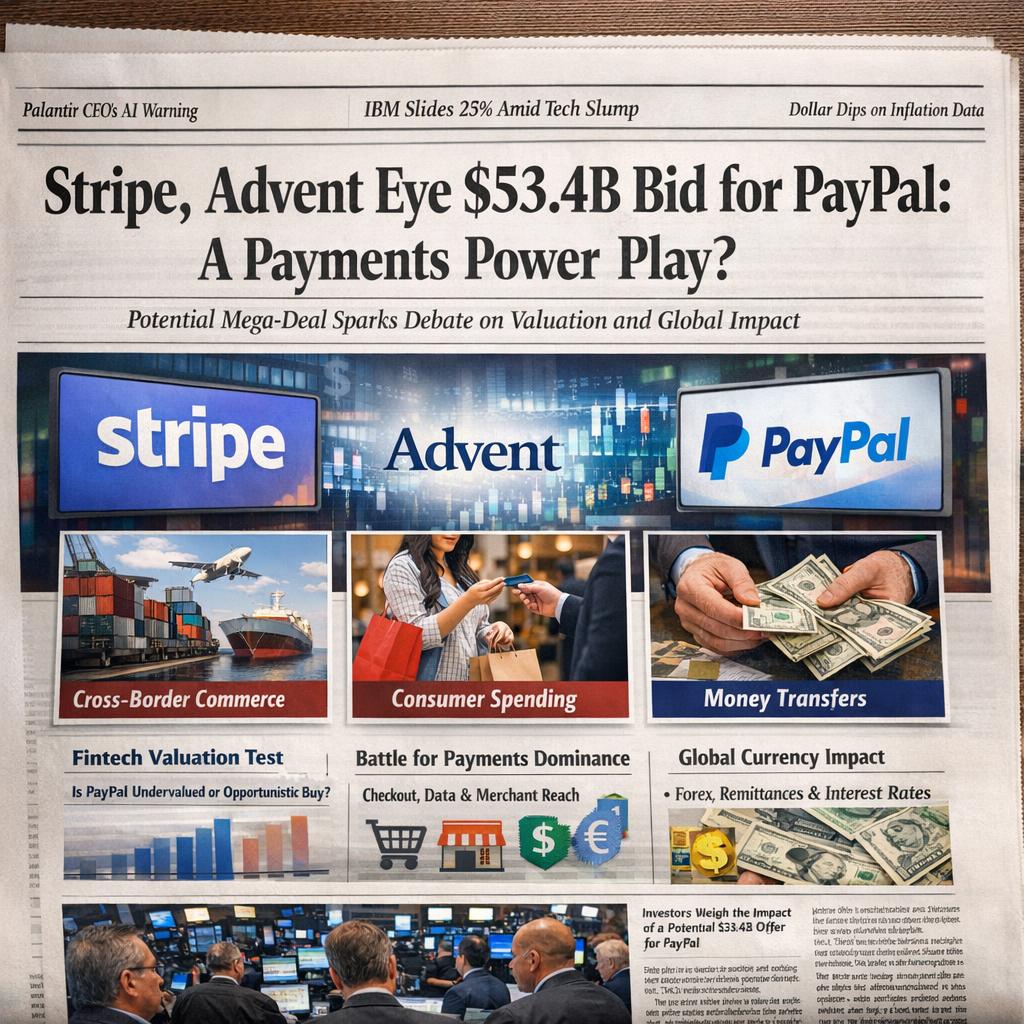
Stripe + Advent reportedly floating a $53.4B bid for PayPal isn’t just a spicy M&A headline — it’s a real-time stress test of how the market is valuing “payments scale” in 2026.
For investors globally, this matters because PayPal sits at the crossroads of three big themes that don’t stay neatly inside US equities: consumer spending, cross-border commerce, and the cost of moving money in a higher-rate, tighter-margin world.
1) A price tag is a signal — even before a deal happens
When a credible bid number hits the tape, it becomes an instant reference point for the entire sector. Whether or not it closes, it forces the market to answer a blunt question: is PayPal a mature cashflow machine that’s been mispriced, or a legacy platform facing structural margin pressure?
If the market begins to treat $53.4B as “reasonable,” it reframes how investors look at other publicly traded fintechs and payments names across the US and Europe. If it’s seen as opportunistic (i.e., buying quality while sentiment is weak), that also tells you something about where sophisticated capital thinks the cycle is.
2) Payments is turning into a distribution war, not just a tech race
Stripe has always been associated with developer-led adoption and online-first businesses. PayPal’s footprint is broader and more consumer-facing, with deep merchant acceptance and brand recognition. Combine those two and you’re no longer only talking about product features — you’re talking about distribution at global scale.
That matters because payments has become a game of:
– owning checkout
– owning merchant relationships
– owning data
– and bundling financial services (credit, lending, fraud, treasury)
In a world where customer acquisition is expensive and switching costs can be quietly powerful, buying distribution can be cheaper than building it.
3) Private capital is telling you where it thinks public markets are wrong
This is the part global investors should really sit with. If a major private player and a large capital partner are circling, the implicit message is: “we think the public market is discounting this asset too heavily.”
That doesn’t automatically mean the stock should trade at the bid price tomorrow. But it does mean sentiment gaps can become opportunity gaps — and that can ripple across global portfolios, from US mega-cap tech allocations to European fintech baskets and emerging-market payments exposure.
4) The FX and cross-border angle isn’t optional
PayPal is not a purely domestic story. Cross-border e-commerce flows, travel spending, remittances, and currency volatility all feed into the payments ecosystem. When the dollar moves, when global demand softens, when fraud patterns shift — payments companies feel it quickly.
So even if you’re sitting outside the US, this kind of headline is another reminder that payments is a macro-sensitive industry wearing a “tech” label.
5) What investors should watch next (even if you don’t own the name)
If this story develops, the market will likely focus on a few practical things:
– whether the bid is formalized and financed cleanly
– what regulators might do with a deal that changes competitive dynamics
– whether management signals openness or resistance
– and how peers trade in sympathy (a read-through for sector positioning)
Most importantly: watch what happens to valuation multiples across the space after the initial excitement fades. That’s where the real repricing shows up.
If you’re following fintech closely, comment with what you think is driving this most: a genuine strategic fit, a valuation mismatch, or a sign that the payments industry is entering a new consolidation cycle.