Bull Markets Don’t End Because Tech Gets Bruised — They End When Leadership Narrows and Credit Quietly Cracks
One of the most useful market stories today wasn’t a dramatic “everything is collapsing” headline. It was the calmer, slightly uncomfortable reminder that this bull market is still historically strong even after a bout of pain in big tech.
That matters because a lot of investors—especially global investors watching US markets as the de facto risk barometer—tend to treat the Nasdaq as the whole game. When the largest tech names wobble, the instinct is to assume the entire structure is about to tip. But broad bull markets rarely die simply because a single leadership group hits turbulence. More often, they fade when two things happen at the same time: the market’s engine loses breadth (fewer stocks doing the lifting), and the funding environment begins to tighten in ways people don’t notice until it’s too late.
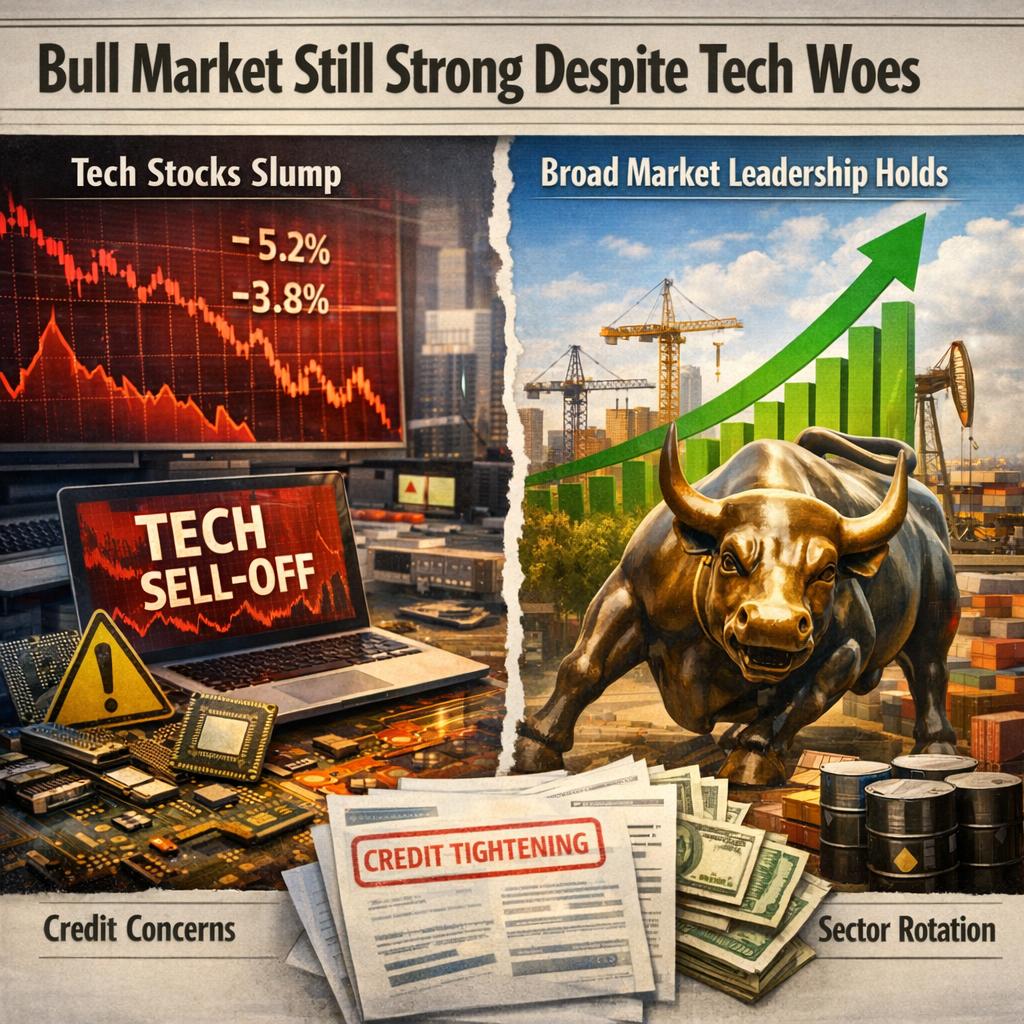
The current setup is interesting because we’re seeing a classic split-screen.
On one side: tech stock pain, semiconductor weakness, and a general “risk-off” mood that can feel like the start of a larger unwind.
On the other: a bigger-picture bull market that, by historical standards, is still intact—and in some measures, still unusually resilient.
So what should investors globally take from that?
1) Tech weakness is a warning light, not an automatic off-switch
When tech sells off, it doesn’t only hit portfolios. It hits confidence. Tech has become the market’s storytelling engine: AI, cloud, productivity, next-gen hardware, digital advertising, platform economics. When those stocks drop, it can feel like the future is being repriced lower.
But here’s the key distinction: repricing growth expectations is not the same thing as repricing the entire economy into a downturn.
A meaningful tech pullback can happen for plenty of non-apocalyptic reasons:
– Valuations got ahead of earnings reality
– Positioning became crowded
– Rates ticked higher, lifting discount rates and compressing multiples
– Investors rotated from high-duration assets into cash-flow-now businesses
– A couple of disappointing reports triggered a broader de-risking reflex
None of those forces, on their own, necessarily end a bull market. What they do is test whether the rally had real breadth underneath it—or whether it was essentially a one-sector phenomenon wearing a “market” costume.
2) The real tell is market breadth and leadership rotation
A bull market that survives leadership changes is a bull market with depth.
If tech and semis are falling but other areas are quietly holding up—industrials, energy, defense, healthcare, financials, or even selected consumer names—that’s not just trivia. It’s the market saying: “Risk is being repriced, not abandoned.”
For global investors, this is crucial because US equities are often the anchor allocation in internationally diversified portfolios. If the US market is rotating internally rather than breaking structurally, the implications for a UK investor, a Canadian pension, or an Asian family office are very different than if the US market is outright losing its footing.
Rotation can be frustrating, especially if your portfolio is concentrated in the previous winners. But it’s also how bull markets extend their lifespan: the baton gets passed, narrative leadership shifts, and the index can keep grinding higher even while a crowded trade unwinds.
3) Watch credit conditions like a hawk (because equities usually do… late)
If you want a global early-warning system, it isn’t always the equity index. It’s the cost of money and the willingness of lenders to refinance risk.
One of the most underappreciated developments in markets is how often corporate borrowers try to “manage time” rather than “solve leverage.” When the refinancing window narrows, you see more amend-and-extend behavior, more covenant negotiations, more maturity pushes. That’s not automatically bearish—sometimes it’s prudent treasury management. But it’s also a signal that the easy-credit regime is not as easy as it was.
The global impact here is straightforward:
– Tighter US credit conditions ripple into global dollar funding markets
– Emerging market corporates and sovereigns feel it through spreads and currency pressure
– Risk assets that depend on abundant liquidity (small caps, high growth, crypto-adjacent equities) become more fragile
– “Quality” gets re-rated upward relative to “promise”
If equities are celebrating while credit is quietly deteriorating, that’s when you should worry. If equities wobble while credit remains orderly, that’s often a reset rather than a regime change.
4) Semiconductors matter — but not for the reason most people think
Semis are not just “tech.” They’re a global industrial supply chain expressed as a stock chart. They sit at the intersection of:
– consumer electronics demand
– enterprise capex cycles
– data center buildouts
– geopolitical policy (export controls, industrial subsidies)
– pricing power and inventory cycles
So when semis slide, it can mean multiple things. Sometimes it’s a growth scare. Sometimes it’s a digestion phase after a huge run. Sometimes it’s simply the market accepting that the AI buildout won’t be a straight line.
For global investors, semis are also a geographic story. The winners and losers of a chip cycle are spread across the US, Taiwan, South Korea, Japan, parts of Europe, and increasingly new entrants trying to climb the value chain. If the chip trade goes “risk-off,” it’s not just a Nasdaq issue. It hits Asia-heavy indices, hardware supply chains, and FX dynamics tied to export sensitivity.
In other words: semiconductor weakness isn’t only a sector call. It’s a global macro signal that needs context.
5) How to think about positioning when the bull market is “fine” but feels shaky
This is the psychological trap: the index can be resilient while the average investor feels punished. That happens when the headline index strength is driven by a subset of names, or when recent leaders revert sharply.
So the practical approach for globally minded investors isn’t to swing between “all-in” and “all-out.” It’s to tighten process:
– Separate your long-term thesis from short-term crowding
– Know which holdings are valuation-sensitive (high duration) versus cash-flow resilient
– Diversify factor exposure: quality, value, low volatility, momentum (but don’t worship any single factor)
– Keep an eye on currency exposure if your base currency isn’t USD; a market drawdown plus FX moves can compound outcomes
– Don’t confuse “strong bull market statistics” with a promise that your specific pocket of the market won’t suffer
Most importantly: if the bull market remains historically strong, that doesn’t mean it’s low risk. It means the market has had a lot of good news priced in. When that’s the backdrop, corrections are not a surprise—they’re a feature.
The takeaway
The headline here isn’t “ignore tech pain.” It’s “interpret tech pain correctly.”
If this is a healthy rotation with stable credit and improving breadth, the bull market can continue—just with different leaders and a more selective reward system.
If this is narrowing leadership, deteriorating credit, and a market that can’t find new shoulders to carry the load, then the “historically strong bull market” statistic can flip from reassurance to warning faster than people expect.
If you’ve been tracking this week’s price action closely, share what you’re watching most right now: breadth, credit spreads, rates, earnings revisions, or something else entirely.