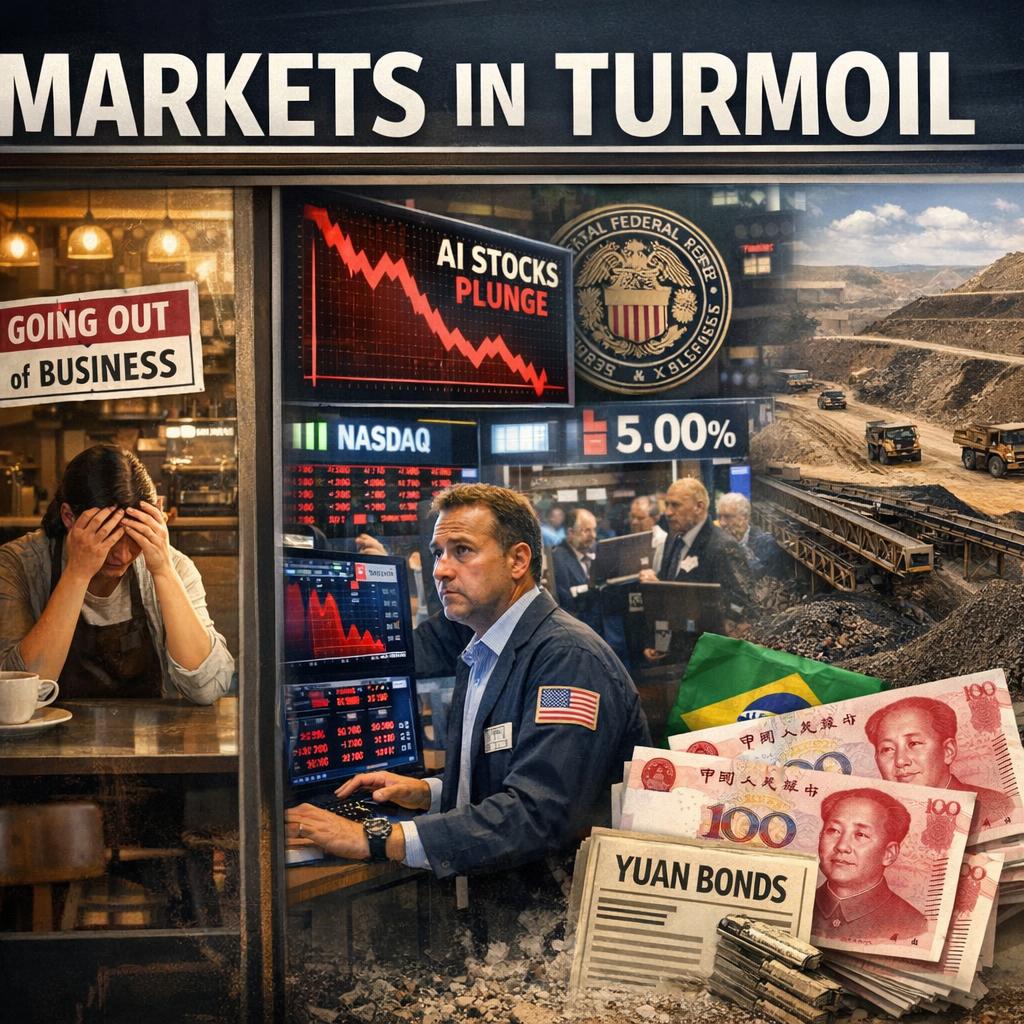
A quiet coffeehouse chain filing for Chapter 11. A century-old mining giant preparing to issue bonds in Chinese yuan. A major AI company issuing a sobering warning about its own technology’s economic impact. On the surface, these are disparate stories from a single day’s financial news flow.
But taken together, they paint a remarkably clear picture of the undercurrents now shaping the global market. This isn’t about a single bad day for the S&P 500; it’s about the convergence of three powerful forces that are redefining risk and opportunity for investors everywhere.
The first force is the great inflation aftershock. We’ve moved past the initial surge, but the structural adjustments are ongoing and brutal. The story of another coffeehouse succumbing to rising costs isn’t a niche retail tale—it’s a microcosm of the pressure felt across the consumer discretionary space. When input costs for labor, ingredients, and energy remain elevated, and consumers finally push back on price hikes, the margin erosion is swift. This is the reality playing out in small business headlines every day, a reminder that the higher-cost environment is a persistent filter, separating resilient business models from vulnerable ones. It directly feeds into the central bank narrative that continues to loom, with every data point scrutinized against the Federal Reserve’s meeting schedule.
The second, and perhaps most significant, force is the AI recalibration. The sharp pullback in AI-related stocks following a warning from a key player is a watershed moment. For years, the narrative has been one of unbridled growth and transformative potential. What we’re witnessing now is the market beginning to price in the real-world costs, uncertainties, and potential regulatory headwinds of that transformation. The fact that Europe’s AI trade is also hitting reverse signals this is a global sentiment shift, not an isolated correction. The market is moving from valuing AI purely on promise to valuing it on plausible paths to profitability and tangible impact. This doesn’t mean the AI story is over; far from it. It means the investment phase is maturing. The easy money has been made, and we are entering a period of scrutiny and differentiation. This volatility in what was the market’s leading growth engine is a primary contributor to the broad index weakness.
The third force is the quiet rewrite of global capital alliances. While tech stocks sag and coffee shops close, a Brazilian mining titan is making moves to deepen its financial ties with China, potentially issuing debt in yuan. Simultaneously, a US energy giant considers a secondary listing in Texas, a move laden with both strategic and political implications. These are not random corporate decisions. They are deliberate maneuvers in a fragmenting global financial landscape. Companies are actively seeking capital and partnerships outside traditional pathways, hedging against geopolitical friction and currency risk. For global investors, this means the map of where and how value is created and funded is being redrawn in real-time. It introduces new layers of currency risk, governance nuance, and geopolitical exposure into investment theses.
So, what does this mean for the global investor?
The days of a simple “risk-on, risk-off” approach are increasingly inadequate. The market is now discerning risk at a much more granular level. It is punishing companies exposed to lingering inflationary pressures while also reevaluating the premium it’s willing to pay for long-duration growth stories like AI. At the same time, it is rewarding—or at least closely watching—firms that are proactively navigating the new geopolitical and capital market realities.
This creates a bifurcated environment. On one side, you have the “here and now” pressures squeezing consumer-facing businesses and keeping central banks cautious. On the other, you have the “future and elsewhere” strategies playing out in tech recalibration and corporate financial engineering. Navigating this requires a portfolio mindset that acknowledges both realities: defensive positioning for the ongoing inflationary hangover, selective conviction in tech sectors undergoing necessary corrections, and a strategic eye for companies adept at playing the new global capital game.
The takeaway from this September day is that the market is no longer trading on a single story. It is processing several profound transitions at once. The convergence of these forces—inflation’s legacy, AI’s adolescence, and capital’s new frontiers—is what is driving the volatility and defining the opportunities. Understanding their interaction is the key to navigating the quarters ahead.
I’d be keen to hear your take on which of these forces you see as the most dominant driver for the rest of the year. Feel free to share your perspective in the comments.