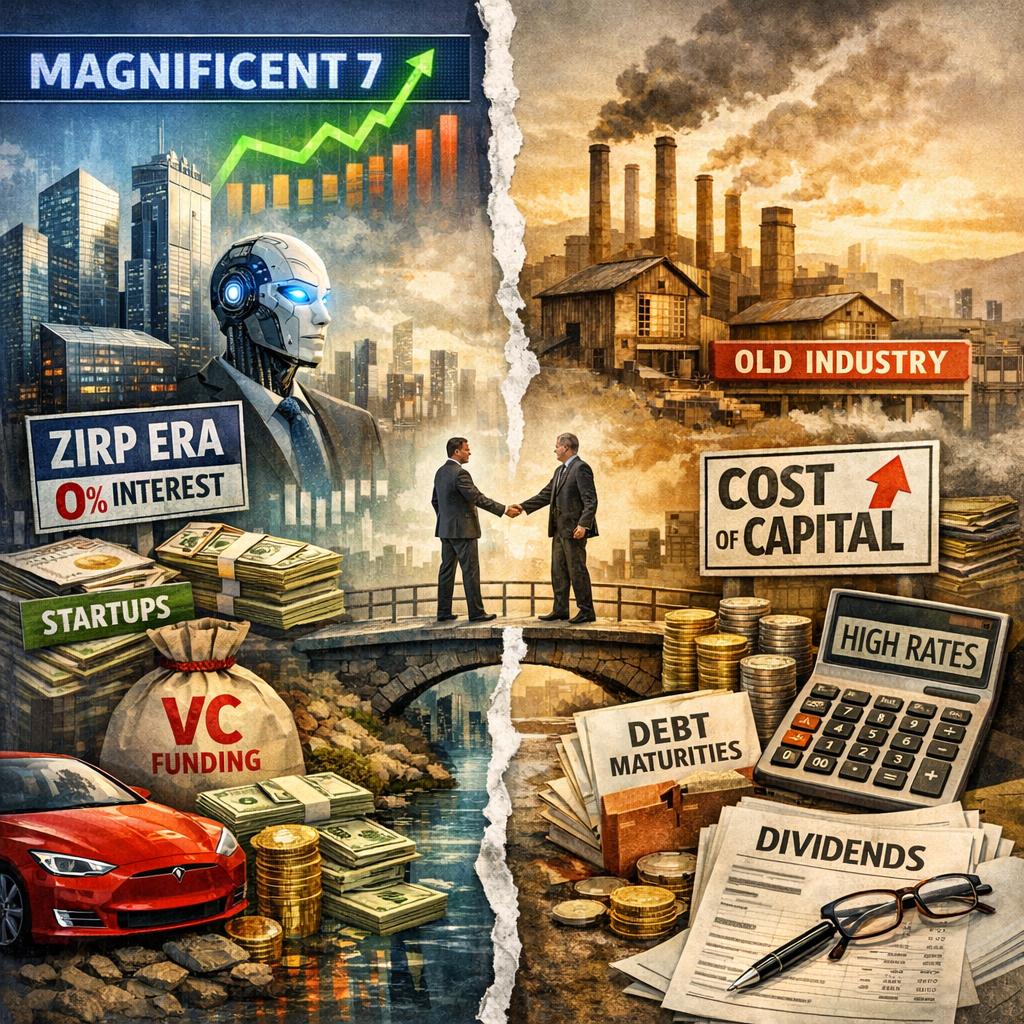
The narrative of the last few years has been one of stark, almost theatrical, polarity. Markets have been dominated by the story of haves and have-nots: the Magnificent Seven versus the rest of the S&P 500, AI beneficiaries versus legacy industries, zero-interest-rate-policy (ZIRP) darlings versus today’s reality. It’s been compelling, easy to understand, and has driven tremendous momentum.
But recently, a different kind of story is beginning to thread its way through the financial press, one that is less about grand narratives and more about subtle, systemic shifts. It’s a story not of winners and losers, but of reconnection. Specifically, the slow, deliberate, and often painful process of financial markets reconnecting with a concept many had relegated to the history books: the actual cost of capital.
For over a decade, the price of money was effectively zero, or even negative in some corners of the world. This wasn’t just a monetary policy setting; it was the foundational premise for an entire generation of investment. It justified sky-high valuations for companies with no profits, fueled the venture capital boom, made debt-funded share buybacks a corporate sport, and allowed governments to borrow with historically minimal burden. The “cost” in “cost of capital” became almost an abstract idea.
The current environment feels different. Central banks, while perhaps pausing, have made it clear that the era of free money is decisively over. The “higher for longer” mantra on interest rates is no longer a threat but a baseline assumption being priced into everything from corporate bonds to commercial real estate. This isn’t a short-term volatility event; it’s a fundamental reset of the financial landscape’s operating system.
And this reset is manifesting in ways that are quietly reshaping investor priorities globally.
We’re seeing it in the renewed, almost obsessive, focus on profitability and cash flow. Companies that can self-fund, that generate real cash returns, are being rewarded not just with stability, but with increasing investor interest. The premium placed on a robust balance sheet has skyrocketed. It’s no longer enough to have a great story; you must have a path to tangible returns that can justify your cost of that now-expensive capital. This is pulling investor attention back towards sectors and companies that were previously considered “boring”—industries with stable demand, pricing power, and the ability to return cash to shareholders through dividends and buybacks, funded by operations, not debt.
Conversely, the great disentanglement is beginning. Business models built exclusively on the assumption of perpetually cheap refinancing are facing an existential audit. This stretches from highly leveraged corporations facing a wall of debt maturities to segments of private equity and venture capital, where the exit environment has fundamentally changed. The cost of capital is acting as a great revealer, separating resilient operations from financial engineering.
For the global investor, this shift demands a subtle but critical change in perspective. The playbook of simply riding the wave of easy money and narrative-driven momentum is insufficient. It requires digging deeper into balance sheets, understanding debt maturity profiles, and critically assessing a company’s true economic moat beyond its growth story. It means that geographic exposure matters differently now, as the pace and impact of this reset varies across regions and central bank policies.
This isn’t to say growth or innovation are unimportant. Rather, they are now being weighed on a different scale. A promising tech startup must now demonstrate a path to profitability that can cover a substantially higher cost of equity and debt than its predecessors. An AI narrative must be grounded in near-term monetization potential, not distant promise. The cost of capital is the gravity that has returned to the financial universe, and everything is being pulled towards its new center.
The market action of the coming quarters will likely be less about dramatic swings based on Federal Reserve meeting minutes and more about this slow, company-by-company, sector-by-sector reckoning. It is a move from the speculative to the substantive. For investors, the task is to listen less to the loud narratives and more to the quiet, persistent signal of balance sheet strength, sustainable cash generation, and a viable plan for thriving in a world where money, once again, has a real and meaningful price.
It’s a more demanding environment, but perhaps also a more rational one. I’m keen to hear your perspective on where you’re seeing this shift play out most clearly in your own analysis.