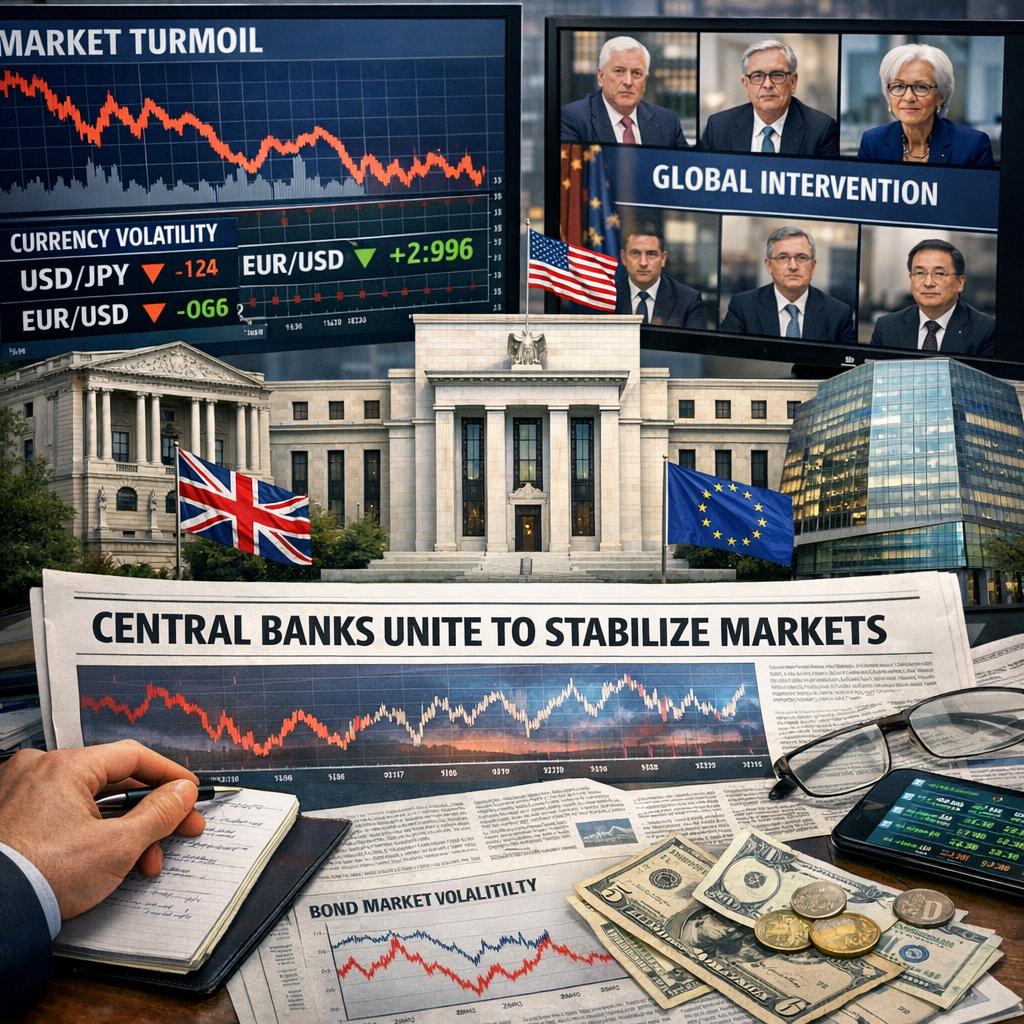
The recent surge in volatility across major equity markets is a stark reminder that the forces which govern global finance are never truly dormant. This week, one story cut through the noise with particular clarity: the dramatic, coordinated intervention by several of the world’s largest central banks to bolster liquidity and stabilize currency markets. For investors watching from every time zone, this wasn’t just a technical maneuver—it was a powerful signal of the underlying stresses in the system and a preview of the new playbook authorities are drafting.
For years, the dominant narrative has been one of divergence. While the Federal Reserve, the Bank of England, and others embarked on aggressive tightening cycles to combat inflation, other major economies maintained more accommodative stances. This policy divergence created predictable, albeit powerful, currents in foreign exchange and bond markets. The strong dollar was more than a headline; it was a fundamental driver of global capital flows, corporate earnings, and emerging market debt sustainability.
The coordinated action we’ve just witnessed suggests that era of comfortable divergence may be giving way to one of forced, fragile coordination. The trigger was a rapid, disorderly move in key currency pairs that threatened to unhinge derivative markets and spill over into a broader seizure of credit channels. Central banks, famously independent and often at odds in their domestic mandates, found a common enemy in market dysfunction. Their message was unified and clear: while policy paths may differ, financial stability remains a non-negotiable, shared priority.
For the global investor, this pivot carries profound implications. First, it places a hard floor under market sentiment in the short term. Knowing that the most powerful institutions are standing ready to act as a collective backstop reduces the probability of a pure liquidity-driven crash. This is not a guarantee against losses driven by fundamentals, but it is a powerful circuit breaker for panic.
Second, and more critically, it changes the calculus for currency exposure. The “strong dollar” trade, which has been a cornerstone of many international portfolios, now faces a new and potent countervailing force. If markets believe that central banks will act to prevent extreme currency misalignments, the one-way bets that characterized recent years become far riskier. Investors need to scrutinize their FX hedges and consider whether their strategies are prepared for a world where volatility is contained, but direction is less certain.
Third, this action illuminates the central tension of the current moment: the fight against inflation versus the preservation of financial stability. By acting in unison, the banks have signaled that when these two goals come into direct conflict—when tightening financial conditions threaten to break something in the plumbing of global finance—stability will, at least temporarily, take precedence. This does not mean an abrupt end to rate hikes or quantitative tightening, but it does introduce a new element of conditional flexibility. Future policy decisions will now be weighed against this demonstrated willingness to intervene.
This creates a more complex, nuanced environment. The “Fed put” or “ECB put”—the long-standing belief that central banks will ease policy to support asset prices—has evolved into a “systemic stability put.” It is narrower in scope but potentially more powerful in its execution. Investors can no longer simply bet on policy pivots driven by recessionary data; they must also factor in the risk of pre-emptive action driven by cross-border financial stress.
In practical terms, this likely means continued high volatility within a managed range. Assets most sensitive to liquidity conditions and dollar strength—such as certain emerging market bonds, commodities priced in USD, and multinational corporate earnings—may see violent swings, but perhaps without the sustained trending moves of the past year. It argues for robust diversification, a focus on quality balance sheets, and a disciplined approach to risk management over speculative positioning on central bank policy alone.
The coordinated move is a reminder that in our interconnected system, domestic policy is ultimately international. The actions of one central bank ripple out, creating waves that others must then navigate. What we are seeing now is the formal acknowledgement of that reality through action. For investors, the task is to adjust sails for waters that are no longer simply choppy, but where the currents themselves are being actively, and collectively, redirected.
The coming weeks will reveal whether this intervention was a one-time reset or the first chapter in a new handbook for global monetary policy. Share your thoughts on how this changes your outlook in the comments.